
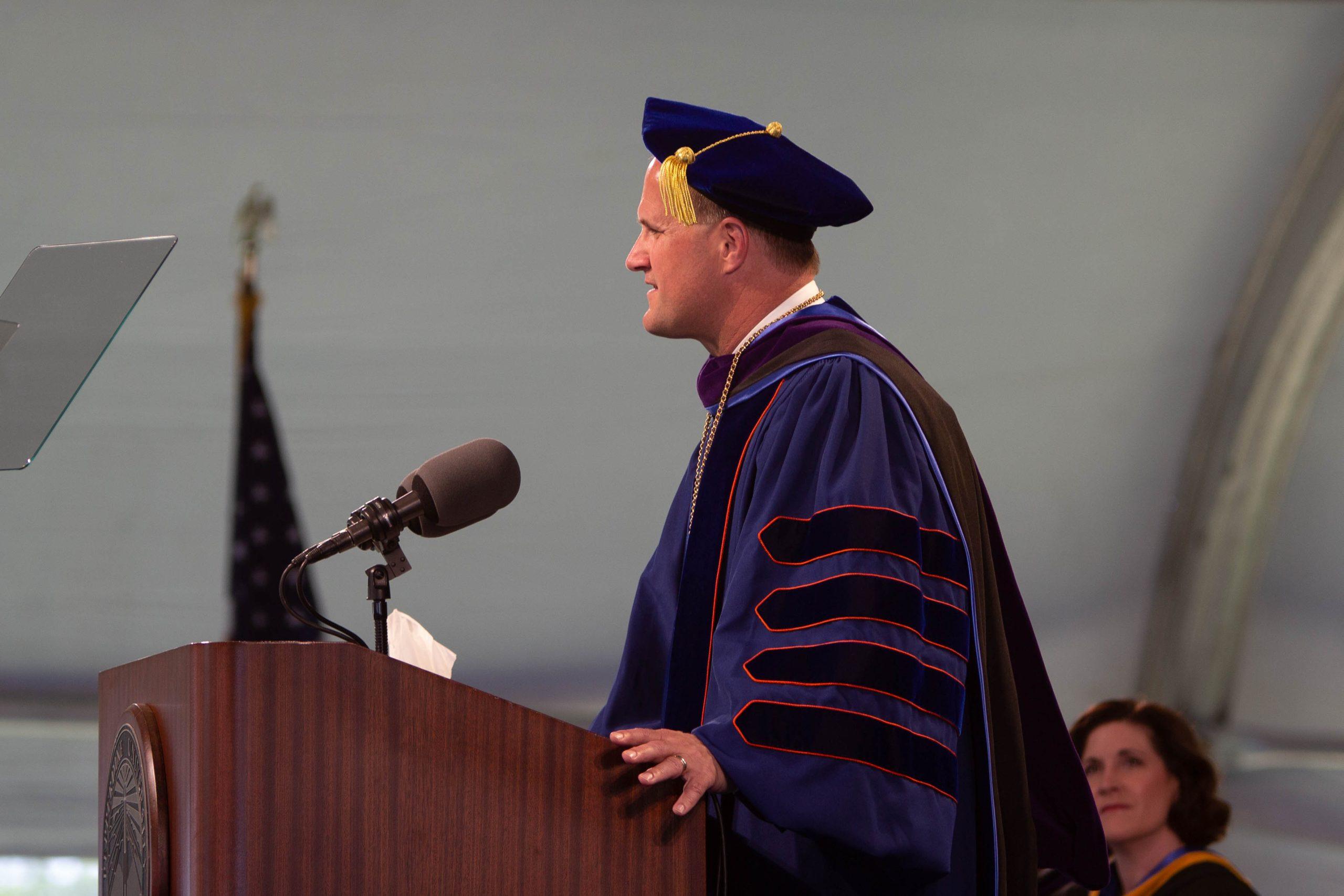
President Jim Gash delivers his inauguration address on Alumni Park in September 2019. Gash’s presidential selection followed Andrew K. Benton’s 19-year presidency. File photo.
Editor’s Note: Henry Adams was News editor of the Graphic in the spring semester. Adams completed the reporting and writing of this story before his graduation in May 2026.
Feb. 13, 2019. It was a rainy morning in Los Angeles.
After months of searching, interviewing and deliberating, the 39-member Board of Regents convened at the Marriott’s Westin Hotel near Los Angeles International Airport to make an era-defining decision for the University: the selection of Jim Gash as the eighth president of Pepperdine.
The regents’ selection process — largely behind closed doors — involved a lot of hard work and debate, several former regents said.
So what was it about an associate dean at Pepperdine Caruso School of Law that made him stand out among the rest? Why did regents choose Gash out of a candidate pool whose finalists included two provosts, the dean of an Ivy League seminary and the president of a fellow Churches of Christ institution?
“It was a very, very intense process because there was a lot on the line,” said Marnie Mitze, a vice president under former president Andrew K. Benton, who served as his chief of staff. “And people really, really care about Pepperdine. And therefore, because they care so deeply, there was a lot of emotion on the table and passion, and it was some very, very, very long days and hours and a lot of hard work by a lot of people in order to do what we felt was the best decision for the University.”
The Graphic attempted to contact every member of the Presidential Search Committee, conducting phone interviews with five people — regents and non-regents — who served on the committee and four others who sat on the Board of Regents at the time of the final vote. Some sources spoke exclusively off the record, informing the Graphic’s investigation without being named in this reporting.
Their individual perspectives offer a glimpse into the board’s vision for the next chapter of Pepperdine, though no one could speak to the rationale of all 39 members — some of whom, including former chair Ed Biggers, have since died.
The Graphic also made repeated attempts to schedule an interview with Gash through Michael Friel, senior director of Communications and Public Relations, over the course of a month during the spring 2026 semester. Gash never agreed to an interview for this story, but agreed to an interview with another Graphic reporter for a general profile piece in mid-March, where he shared some details of his experience.
Infographic by Henry Adams
The Legacy of Andrew K. Benton
In March 2018, Benton announced he would step down from his position after 19 years, the longest of any Pepperdine president, at the conclusion of the 2018-2019 academic year, according to previous Graphic reporting. He cemented a reputation as the “students’ president,” in part because he regularly ate lunch with students in the cafeteria. During his presidency, Benton oversaw the construction of the Drescher graduate campus, Seaside Residence Hall, three new abroad programs, the doubling of undergraduate applications and over $1 billion in total asset growth, according to a 2018 news release from Pepperdine.
Like any Pepperdine president, Benton faced challenges, both in his personal life and with the political change taking place at the turn of the century.
In August 2012, the LA County Sheriff’s Department arrested Benton’s son, Christopher, on campus during New Student Orientation after he made threats against his family, according to the Chronicle of Higher Education. A judge sentenced Christopher to two years in California prison after he was convicted of two felony charges: making criminal threats and possession of a firearm by a narcotic addict. Benton told Biggers he would resign if the Board of Regents wished, but the regents overwhelmingly supported the continuation of Benton’s presidency.
Benton developed a reputation for his approach to politically charged conflict on campus. Mitze said she admired Benton’s ability to “manage gray.”
“It’s the role of a good president to manage that conflict in that gray area where you can,” Mitze said. “Both sides need to be heard but one side cannot dominate.”
Benton said in a 2012 University-wide briefing that Pepperdine could be described as a “pretty conservative Christian heritage-type organization.” But his politics, unlike some of his presidential predecessors, were not strictly conservative. Public records show contributions to both Democrat and Republican political candidates throughout his presidency, according to OpenSecrets.
“Because I am conservative — and not in a political sense, but just kind of conservative in my approach to life — I think I was slow to respond to social issues,” Benton said in an October 2018 interview with the Graphic. “I think I found a good place on LGBTQ+, for example. That was not something that anybody trained me for or equipped me — it was something that I had to figure out for myself: ‘How do I honor Pepperdine’s heritage while preparing the University for the future and while loving all students?’”
When a Pepperdine professor associated the school with an endorsement of Proposition 8 — a 2008 ballot measure that would have banned same-sex marriage in California, according to Ballotpedia — Benton wrote to the Pepperdine community about his disapproval of the affiliation. He wrote he believed universities cannot endorse political candidates or propositions.
“I and perhaps many of you continue to receive words of praise and condemnation from people who are either thanking us or sharply criticizing us,” Benton wrote. “Whether the writers are for or against Prop 8 I take no comfort from either position as it puts us where we don’t belong — in partisan politics.”
As the United States made progress on LGBTQ+ issues at large, Pepperdine slowly shifted its approach under Benton. Over time, Benton’s administration went from denying official recognition of an LGBTQ+ club in 2011 to recognizing one in 2016, with each decision made on the basis of alignment with Pepperdine’s mission, according to previous Graphic reporting.
Benton also directly addressed student protests during his term, including in 2016 when a group of undergraduates protested a Christopher Columbus statue located above the Amphitheatre, according to previous Graphic reporting. The protest was part of a wider movement pushing for inclusivity on campus.
“My colleagues and I will listen carefully to those who disagree with the artistic rendition present today and we will measure those thoughts against others who have spoken,” Benton wrote in another 2016 email to the Graphic. “In my view, it is important to listen to all voices.”
The statue was removed and placed in storage in 2017 before being relocated to Thomas Aquinas College in 2018, according to a news release by the college.
Biggers, former Board of Regents chair and chair of the 1999 Presidential Search Committee that recommended Benton, reflected on Benton’s presidency during the 2019 Seaver College commencement ceremony.
“I cannot begin to tell you how gratifying it is, and what a blessing it is, to look back 20 years later and to know that with God’s guidance we made the right choice,” Biggers said.
Now it was time for Biggers to set another presidential search in motion.
At the Regents’ Discretion
As the chief policy board of Pepperdine, the Board of Regents is responsible for appointing the University’s president, who also serves as chief executive officer, according to the Fourth Amended and Restated Bylaws of Pepperdine University, which were in effect from 2015 to 2020. The exact process is not codified, but at the “discretion” of the board.
Biggers was responsible for overseeing the process of selecting Benton’s successor, former regent Harold Smethills said. Biggers formed the Presidential Search Committee, which oversaw the process and presented a recommendation to the wider board, which made the final call.
The board appointed Regent Dale Brown to chair the committee, with Smethills as the vice chair, according to an archived screenshot of Pepperdine’s website. Seven other regents, plus Biggers and Mitze each serving as ex-officio, joined them to form the initial committee roster. Mitze served as the senior staff and committee liaison.
“Biggers picked people who would speak up, speak their mind and debate,” Smethills said. “That’s what you want — that’s how you come to good organizational decisions.”
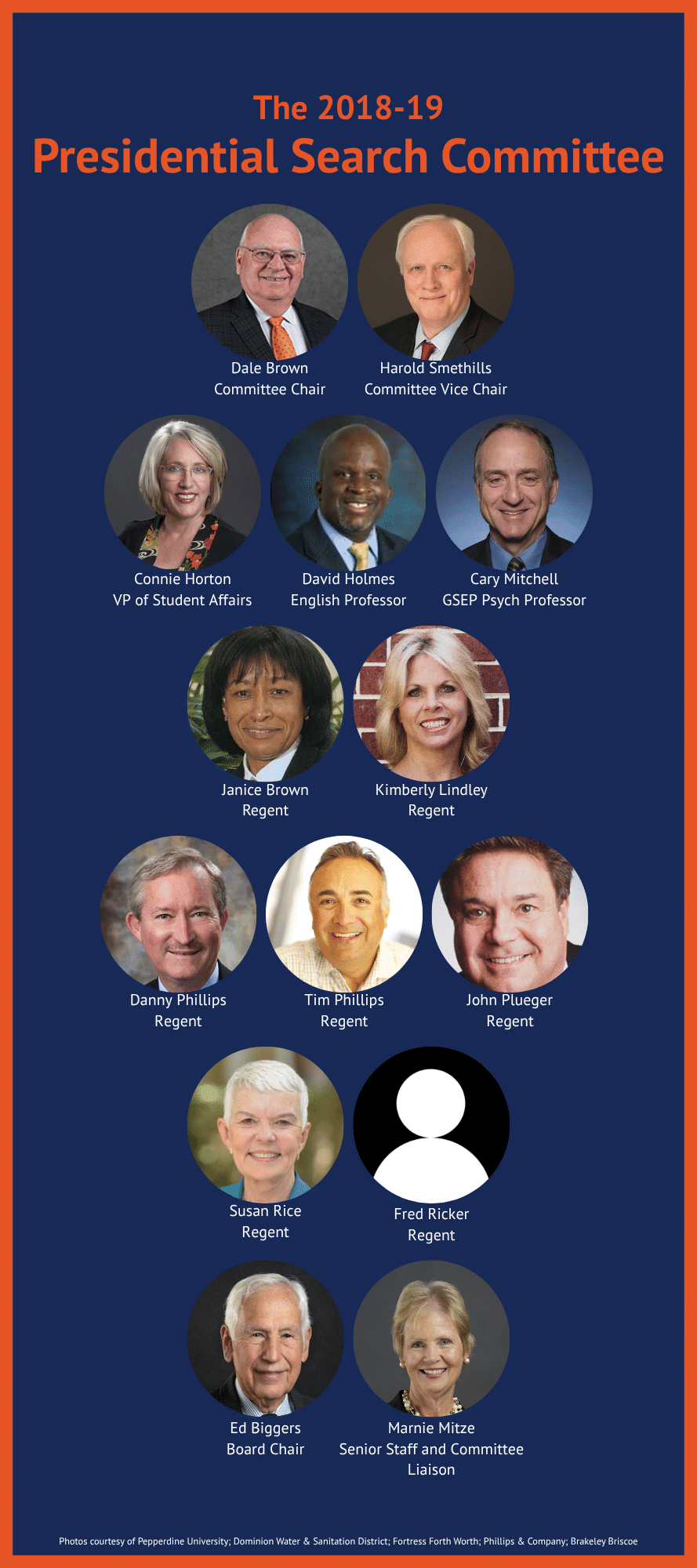
Infographic by Henry Adams
Benton stayed out of the search process, opting to let regents decide his successor, Mitze said. As a regent himself, Benton was still part of the final vote.
“It’s impossible for anybody to select somebody to follow them,” Mitze said. “He was very neutral.”
One of the first things the committee did was spend a day in a May 2018 conducting a series of focus groups, said Mitze, who was responsible for organizing the sessions. These meetings were mostly held in the Thornton Administrative Center (TAC) and informed the position description for Pepperdine’s eighth president.
An April 2018 email written by Marnie Mitze, then-vice president and chief of staff, to members of the Seaver Faculty Association Executive Committee about their focus group session in May. The committee was replaced by the Seaver Faculty Senate in 2020, according to previous Graphic reporting.
An April 2018 email sent to one group of faculty members regarding their assigned focus session and obtained by the Graphic lists some example questions:
- When you think of Pepperdine, what first comes to mind?
- What do you think should be the top priorities for the next president?
- Both higher education and Pepperdine will continue to face challenges in the next 10 years; what are the greatest challenges the next president will need to address?
- What are the most important personal characteristics and leadership skills the next president should have in order to be successful?
In addition, over 4,000 alumni, faculty, staff, students and donors responded to a survey about Pepperdine’s next president, according to a June 2018 email sent to faculty and staff.
A June 2018 email sent by Pepperdine Public Relations to faculty and staff.
A few months later, applications and nominations opened for the president position, according to an August 2018 job listing on the Chronicle for Higher Education. A successful presidential candidate would have the “leadership skills, vision and enthusiasm” to advance Pepperdine and serve the Churches of Christ tradition as “both an anchor and a guide.” Other ideal skills included fundraising, administrative background, budgeting and the ability to advocate for Pepperdine.
“The position of a University president is one of the most difficult jobs out there,” Mitze said. “A corporate CEO pales in comparison, just because of the model of shared governance, tenured faculty and the challenge of having to deal with so many different constituencies.”
The president of Pepperdine must be a member in good standing of a Churches of Christ congregation, according to University bylaws. This strict requirement was a limiting factor in the search for Pepperdine’s president, Mitze said.
Pages 39 and 40 of the Fourth Amended and Restated Bylaws of Pepperdine University, which were operative from 2015 to 2020, codify the duties of Pepperdine’s president.
The Search Begins
Some faculty and staff became more directly included in the committee’s deliberations as the candidate review process was beginning.
English Professor Maire Mullins, president of the Seaver Faculty Association at the time, had been advocating for faculty involvement in the committee, Mullins wrote in a Feb. 21 email to the Graphic. The President’s Office took action: The Board of Regents announced the addition of two faculty and one staff member to the committee in early October, according to the University Faculty Council’s (UFC) October 2018 meeting minutes.
Those appointees were David Holmes, a then-Seaver English professor, Cary Mitchell, a then-Psychology professor at the Graduate School of Education and Psychology and Connie Horton, then-vice president of Student Affairs, according to the UFC meeting minutes. All three appointees were active members of the Churches of Christ. They were not voted on by their fellow faculty and staff to be representatives.
The inclusion of faculty and staff on the committee was a historical first for Pepperdine’s presidential searches, according to 2019 Graphic reporting. The new appointments came about a week before the job listing’s mid-October deadline, meaning Holmes, Mitchell and Horton could play a direct role in the vetting process.
“In some ways, this search was very different than prior searches for a president in that faculty and administration were included,” Mitchell said about the inclusion of faculty and staff in the process. “But in other ways, it wasn’t different in that the decision was made by the University Board [of Regents].”
Infographic by Henry Adams
The past four Pepperdine presidents — Benton, David Davenport, Howard A. White and William S. Banowsky — had each served as their predecessor’s executive vice president. Had that pattern continued, Gary Hanson, Benton’s second-in-command, would have been the logical successor. That prediction was common in the Pepperdine community following Benton’s retirement announcement, but Hanson ultimately did not throw his hat in the ring because he planned to retire in the near future, Gash said.
“Gary would have been a phenomenal president,” Gash said in a March interview with a Graphic reporter. “No one else would have been considered. He was that good. He was that respected.”
Hanson retired in July 2024.
Administrators in higher education institutions across the country applied and were nominated by their peers to be Pepperdine’s next president. Mitze said this was the “silent phase” of the search, in which Korn Ferry, an executive search firm, put together an initial pool of dozens of candidates. Pepperdine has worked with Korn Ferry for previous executive searches, including for the current deans of the law school and School of Public Policy.
Over the course of two days in November, around 10 candidates — some flying in from the East Coast, some driving about an hour from Malibu — traveled to Korn Ferry’s offices in Century City for interviews, Mitze said. Candidates met off-campus to maintain confidentiality; if they did not make the shortlist of finalists, they would not need to inform their respective employers.
Candidate Rick Marrs, provost of Pepperdine at the time, said he remembered going up the elevator to Korn Ferry’s 26th-floor suite for his interview with the Presidential Search Committee. The timing of candidates’ entry into the building was such that they would not see one another, another precaution to maintain confidentiality.
Marrs said he recalled working hard to talk more “like a president,” counteracting his quieter, academic persona as a provost. He spent time formulating answers for anticipated questions in advance of the interview. Unlike some other candidates, he already knew everyone in the room, including the Korn Ferry consultants, as he worked with them on other searches for administrative positions at Pepperdine.
At least two other candidates, including Gash, were also familiar with some of the interviewers. Mitze said Gash was “charismatic” and “totally engaging” during the Century City round of interviews.
“The guy just blew it out of the park,” Mitze said. “I mean, he’s brilliant.”
The Pool Narrows
After months of working behind closed doors, the committee publicly announced five finalist candidates through a January 2019 email to the Pepperdine community:
- Rick Marrs, provost and chief academic officer of Pepperdine
- Greg Sterling, dean of Yale Divinity School
- Nancy Shankle, provost and vice chancellor for Academic Affairs at Louisiana State University Shreveport
- Jim Gash, associate dean for strategic planning and external relations at Pepperdine’s School of Law
- Tim Perrin, president and CEO of Lubbock Christian University (LCU)
Two finalists were already working in administrative roles at Pepperdine, and prior to his presidency at LCU in 2012, Perrin worked at Pepperdine’s law school for 20 years, according to his curriculum vitae. All five finalists were members of a Church of Christ congregation.
For five consecutive days in mid-January 2019, each finalist visited Pepperdine’s Malibu campus to meet with various constituencies of the University, according to the email. They each conducted a town hall and undergraduate faculty forum in Elkins Auditorium in the morning, a graduate school faculty forum in Wilburn Auditorium at Drescher Campus in the afternoon and a forum for students from all five schools in the Payson Library Surfboard Room in the evening.
The town halls were an opportunity for community members to hear brief presentations from the finalists before open Q&A sessions, Marrs said. Each lasted 45 minutes, except for the student town halls, which were 30 minutes, according to the email. Attendees could submit feedback for each candidate through an online survey.
“I hope the new president will be on campus with us and show his face in the library every now and then, like President Benton did,” then-sophomore Sara Smith said to the Graphic in 2019. “I feel like students appreciate getting to know the leaders of our school.”
Finalists also individually met with parts of administration, such as Advancement, all five deans and Benton’s senior cabinet, Mitze said. Alongside their spouses, they also attended dinners at Brock House, the president’s residence.
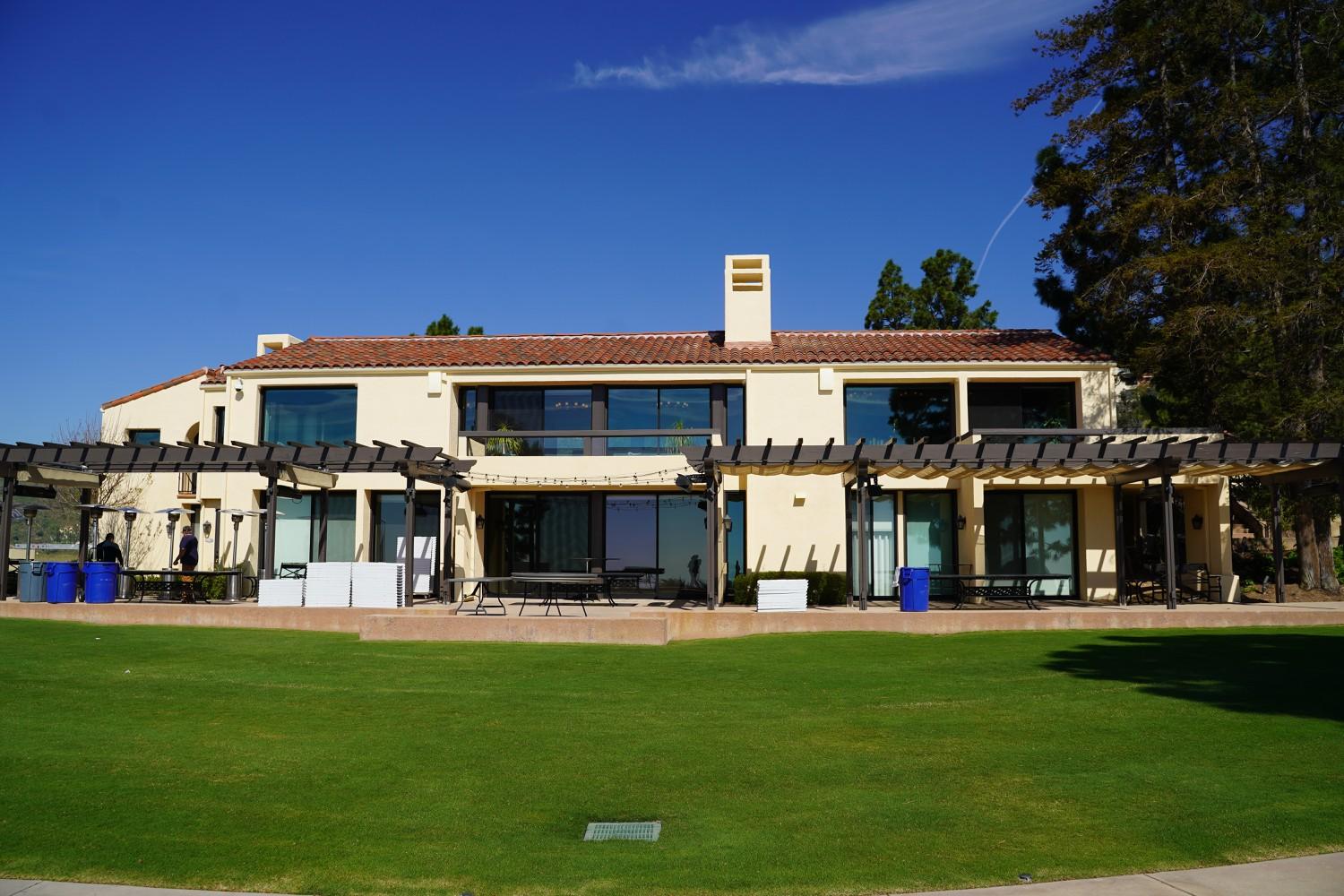 The sun shines on the backyard of Brock House in March. The residence, named after an influential Republican donor and dedicated in 1975 by former U.S. President Gerald Ford, is home to the president of Pepperdine. Photo by Melissa Houston (‘26)
Although the town halls and most of the forums were livestreamed, those recordings have since been deleted, Allen Haren, senior manager of digital asset management and archives, wrote in a March 24 email to the Graphic. As a result, it is difficult to ascertain the precise vision each finalist pitched, but through interviews with some finalists and others who recall the presidential search, a picture of the varying candidacies emerged.
Nancy Shankle
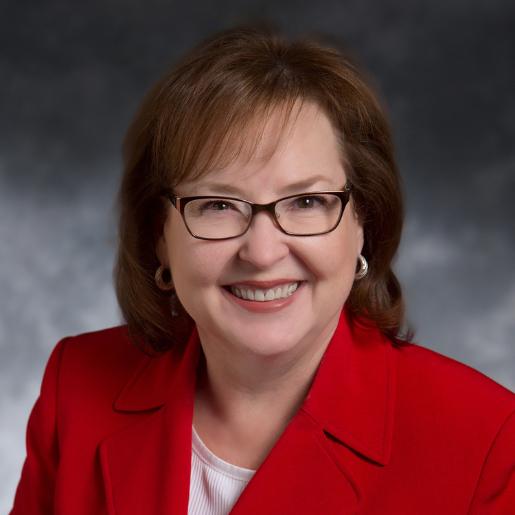 Nancy Shankle’s official headshot. Photo courtesy of Texas A&M University
Early in her career, Nancy Shankle, who previously used the surname Jordan, was an English professor at fellow Churches of Christ institution Abilene Christian University in Texas, according to her curriculum vitae. During her 24 years there, she became the associate dean of the undergraduate school and later an assistant provost between 2010 and 2014 before taking on several administrative roles, including associate provost, at Texas A&M University-Texarkana between 2016 and 2018.
Seven months before her visit to Pepperdine, Shankle was appointed provost and vice chancellor for Academic Affairs at Louisiana State University in Shreveport, the highest position she had held in her career up to that point, according to her curriculum vitae.
Nancy Shankle’s curriculum vitae from January 2019.
Chris Doran, a Religion and Sustainability professor who attended one of Shankle’s presentations, recalled thinking she did not have a serious chance at being considered for the presidency, between the fact she was an outside candidate and had not spent much time at Louisiana.
“I thought, ‘Oh, this is an interesting jump from, you know, no experience at this other spot to something completely new,’” Doran said.
Out of the finalists, Shankle had the weakest formal ties to Pepperdine. She was not an alumna, nor had she taught or worked at the school before. Her sole connection was moderating a panel at the annual Christian Scholars’ Conference in 2011, hosted by Pepperdine, according to her curriculum vitae.
Shankle did not respond to repeated requests for comment made via email and over the phone for this story.
Greg Sterling
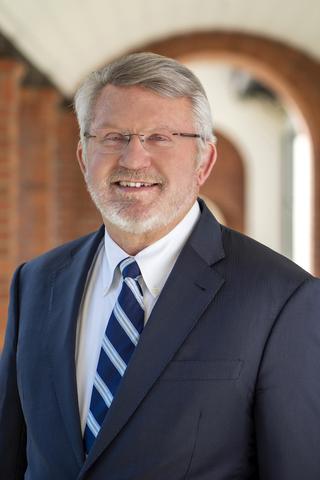
Dean Greg Sterling of the Yale Divinity School.
Greg Sterling’s official headshot. Photo courtesy of Yale University
Sterling’s decades-long career includes over 100 published scholarly papers, according to his curriculum vitae. From 1989 to 2012, he taught theology courses at the University of Notre Dame, where he eventually served as the acting dean of the undergraduate school and inaugural dean of the Graduate School. Since 2012, Sterling has been the dean of Yale Divinity School.
Although Sterling never worked at Pepperdine, he received his Master of Arts in Religion from the University in 1980. He has presented several guest lectures at Pepperdine over the years, and spoke at the 2008 Seaver College commencement ceremony. Nonetheless, Sterling’s ties to Pepperdine were weaker than his competitors’.
“My feeling was he wasn’t going to be taken seriously because we just don’t hire outside people for upper level positions like that, even as spectacular as he might have been,” Doran said.
Greg Sterling’s curriculum vitae from January 2019.
The Graphic interviewed Sterling by phone, where he shed light on what his vision for Pepperdine was in 2019. As a prospective president, he said his core priority was advancing Pepperdine’s national academic reputation.
“Pepperdine hadn’t really done well to excel academically in the way that I thought it could,” Sterling said. “That’s my strength. That’s my forte and that’s what I was interested in.”
Sterling said he cared deeply about Pepperdine and supported Pepperdine’s Christian mission. One of the challenges he saw was balancing the University’s Churches of Christ roots while also avoiding narrowly defining what its Christian identity means. He was specifically concerned with the way some evangelical Christians aligned their religion with politics.
“They’re [evangelicals] hurting Christianity in major ways,” Sterling said. “They’re so politically aligned that they’ve identified their religion with their politics, and I think that’s a mistake.”
Sterling declined to comment on whether he thought conservative evangelicalism is currently influencing the highest levels of Pepperdine, but said he got the sense that his own left-of-center politics may not have aligned with what the Board of Regents were looking for.
“I would have urged it [Pepperdine] to be true to its heritage,” Sterling said. “But I don’t think that means moving in the evangelical direction.”
While Sterling has been a lifelong member of the Churches of Christ, his wife Adrian is Catholic, according to Yale Daily News.
Rick Marrs
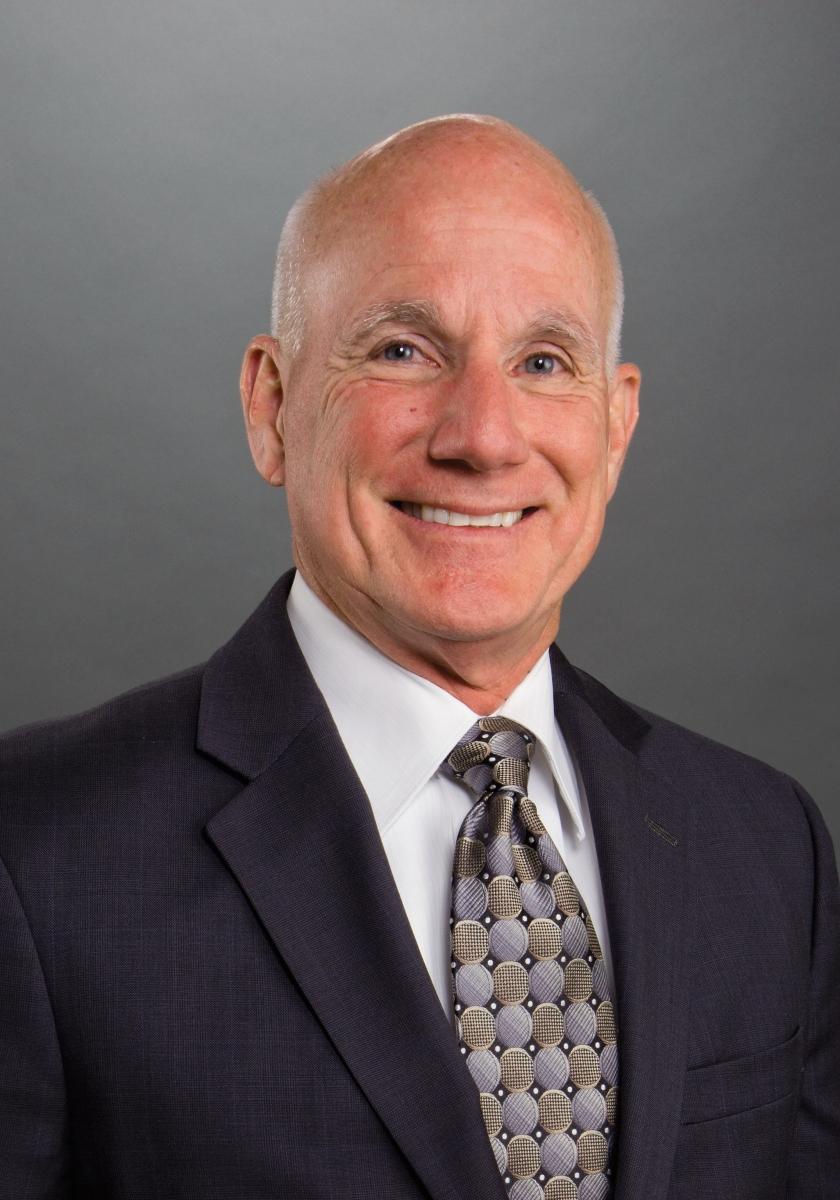
Rick Marrs’ official headshot. Photo courtesy of Pepperdine University
Marrs spent the majority of his career at Pepperdine, where he began as a Religion professor in 1987 before ascending the ranks to become dean of Seaver College in 2008 and provost in 2014, according to his curriculum vitae.
As provost, Marrs oversaw all academic areas of Pepperdine, granting him wide knowledge of the University’s inner workings, according to his curriculum vitae. As Seaver dean, he oversaw a $204 million budget and helped secure over $100 million in gifts and pledges for Seaver College.
Rick Marrs’s curriculum vitae from January 2019.
Marrs also spoke with the Graphic about what his vision was for Pepperdine in 2019. Similar to Sterling, Marrs said advancing Pepperdine’s national academic reputation was a top priority; with Marrs as provost, Pepperdine reached its peak position: No. 46 in the U.S. News and World Report’s Best National Universities Rankings.
“The genius of Pepperdine, which was very aspirational: Could you be a top tier academic institution with a vibrant Christian faith and be known publicly as a Christian university that took its Christian faith seriously?” Marrs said.
Marrs had an idea for how Pepperdine’s Christian mission should look, which he once outlined in a 2014 white paper for the board’s Religious Standards Committee — now called the Faith and Heritage Committee — through a metaphor called “open table.”
“True diversity creates genuine dialogue and increased understanding; the multiplicity of stories among the varied community members is not merely tolerated but celebrated,” Marrs wrote in 2014.
That vision resonated with Benton and the Religious Standards Committee at the time, according to a 2015 Pepperdine Magazine article Benton wrote. “The Open Table” also became Pepperdine’s annual theme in 2016.
Given his role as provost, Marrs said he felt the need to apply for the president position. Although Pepperdine has never historically promoted its provosts to presidents, Marrs knew his peers would have questions had he not applied.
“I never aspired to be president, but I knew that would have been the expectation and I knew faculty especially were really wanting an academic for president,” Marrs said.
In fact, Pepperdine has not had an academic in office since its fifth president, Howard A. White, who retired in 1985 after seven years. Davenport and Benton, the sixth and seventh presidents, were both lawyers.
“So that’s the thinking, if we could get an academic in as president, we could really move the school forward academically,” Marrs said.

The sun shines through the windows of Brock House’s second floor in March. The residence underwent extensive renovations starting in June 2019; Gash’s family moved into the house in late September 2021, according to previous Graphic reporting. Photo by Melissa Houston
Marrs said he remembered attending his respective Brock House dinner, an event several former regents said was key in discerning the next president of Pepperdine. These dinners involved regents outside of the search committee, allowing them to spend an evening with each of the five finalists. They were a test of the finalists’ abilities to “schmooze” and, alongside their spouses, to fundraise in a president’s typical social setting, Mitze said.
“Friendraising is fundraising,” Mitze said.
There were a few tables with a half-dozen regents sitting at each one. Marrs did not make the rounds by moving from table-to-table. He said he ate his dinner — alongside familiar faces, given his direct professional involvement with the board — before standing up in the Brock House’s second-floor to field questions.
One regent’s question to him stuck out as the most memorable.
“‘Who’s gonna replace you?’” Marrs said.
Marrs said he recalled the question was stated in a way that underscored the regent’s perception of him as someone fit for the provost role — not necessarily for the president’s.
After his full day of events, Marrs said he took a vacation to his home state of Arizona. He was exhausted.
“By the next day, I was actually hoarse,” Marrs said.
Tim Perrin
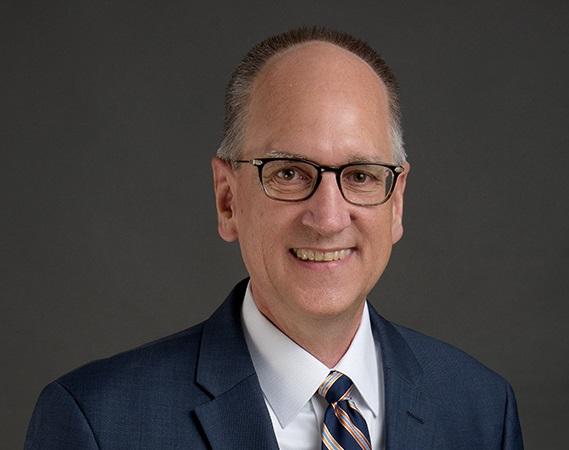 Tim Perrin’s official headshot. Photo courtesy of Pepperdine University
Like past Pepperdine presidents Benton and Davenport, Perrin came from a background in law, including both civil litigation and scholarship, according to his curriculum vitae. From 1992 to 2012, he worked as a law professor at Pepperdine, where he served as the vice dean for five years. He was also the associate provost of Pepperdine for five years.
Alongside Kenneth Starr, former law school dean, Perrin developed a short- and long-term strategic plan for the law school, according to a 2007 news release. Starr, once a prominent force in conservative politics, was known for leading the investigations that led to President Bill Clinton’s impeachment and defending President Donald Trump in his first impeachment trial.
Tim Perrin’s curriculum vitae from January 2019.
From 2012 up through the time of Pepperdine’s eighth presidential search, Perrin served as the sixth president of Lubbock Christian University, whose student body — including graduate students — was about a quarter of Pepperdine’s in 2018, according to U.S. News and World Report.
During his time as Lubbock Christian University president, Perrin oversaw major construction projects and the addition of a Spain study-abroad program, according to his page on Pepperdine’s website.
A University spokesperson said Perrin was unavailable for an interview after the Graphic spent four weeks attempting to schedule one. Through the spokesperson, Perrin said he was honored the regents considered him for the presidency.
Jim Gash
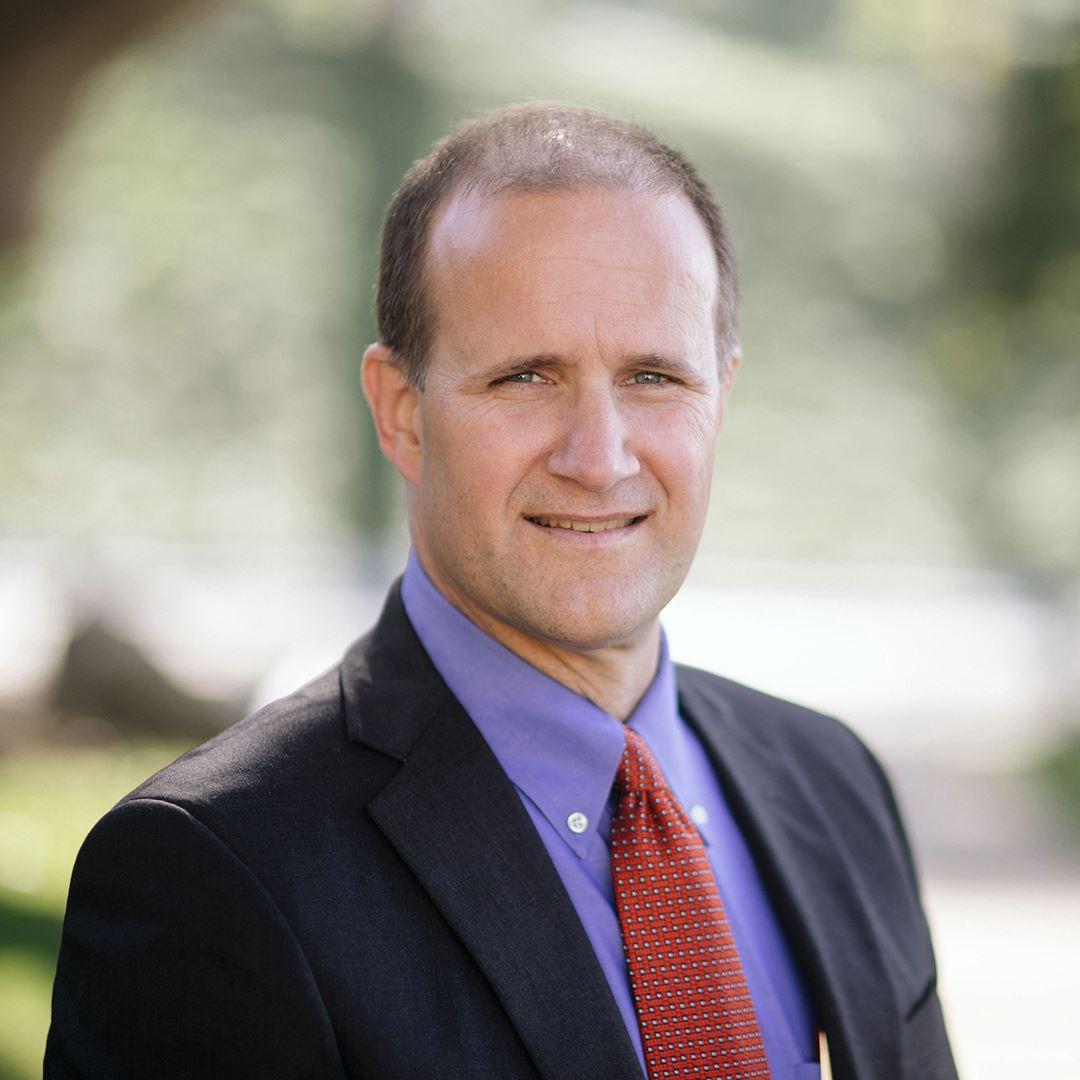 Jim Gash’s official headshot. Photo courtesy of Pepperdine University
Like Perrin, Gash came from a legal background, having worked as a civil litigator in the 1990s before joining the Pepperdine Law faculty in 1999, according to his curriculum vitae. Alongside Perrin and Starr, Gash worked in the law school’s administration, where he was dean of students from 2005 to 2012.
Since 2010, Gash had visited Uganda dozens of times to support the country’s justice system, which included successfully defending a teenager falsely accused of murder in court, according to Pepperdine’s website. Two years later, Gash remained involved in African criminal justice reform through serving as the director of the Sudreau Global Justice Program and becoming a special advisor to the High Court of Uganda.
In 2016, Gash published a book about these experiences, titled “Divine Collision An African Boy, an American Lawyer, and their Remarkable Battle for Freedom.” He also starred in a short film about his legal work in Uganda, titled “Remand,” which premiered in 2017.
Jim Gash’s curriculum vitae from January 2019.
Gash is also an alumnus of Pepperdine School of Law, where he served as editor-in-chief of Pepperdine Law Review and graduated with his J.D. as the valedictorian in 1993. He obtained a bachelor’s degree in Finance from Abilene Christian University, a fellow Churches of Christ institution, in 1989.
Gash said he did not initially apply to be Pepperdine’s next president, despite peers encouraging him to.
“And the reason I wasn’t going to apply was because if I was the only one who thought I should be president, then I shouldn’t be president,” Gash said to a Graphic reporter in March. “And I would have a serious self-awareness problem if I thought I should be president and nobody else did.”
But a few weeks into the search opening, Gash said he received a phone call from Korn Ferry: Several peers had nominated him for the position.
Gash and his wife Joline prayed about it. They spoke with each of their three kids about it. They told their kids if any of them did not want him to potentially be the next president, he would not consider the position.
“As you would expect, being the son and the daughter of the president, you get a lot more spotlight than you necessarily are looking for and it changes your life,” Gash said.
All three of Gash’s kids — Jessica (’18), Josh (’20) and Jenn (’22), the latter two being Pepperdine undergraduates at the time — were supportive.
The Final Decision
After each finalist had the chance to make their case to the Pepperdine community, including regents both on and off the Search Committee, the process once again moved behind closed doors. The public would not hear about the finalists until they announced their decision a few weeks later.
During this time, the Search Committee parsed through the community’s feedback, Mitze said.
“Not surprisingly, everything was all over the map,” Mitze said.
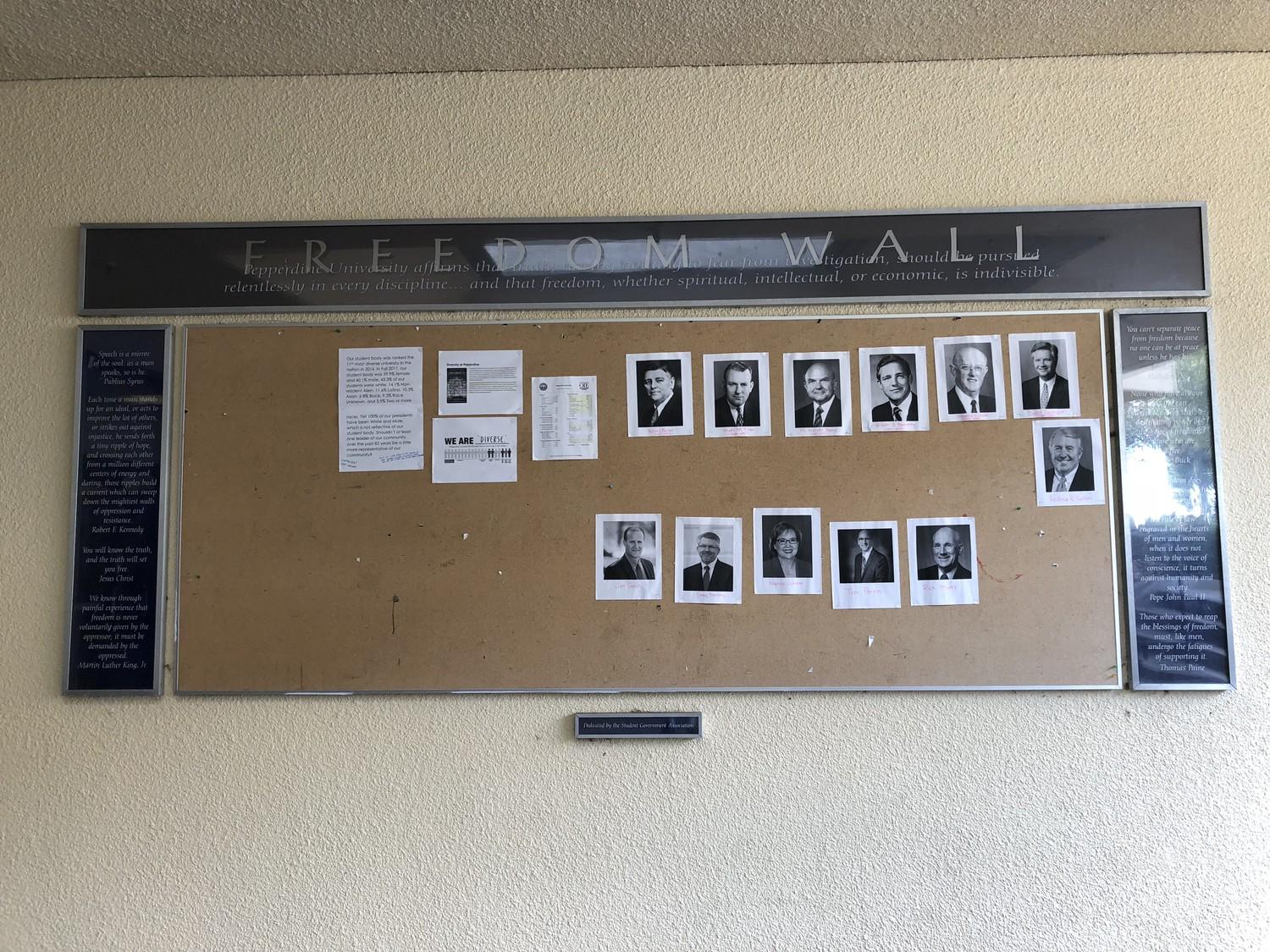
An anonymous display on the Freedom Wall in January 2019 criticizes the lack of diversity in Pepperdine’s past presidents and the then-recently announced finalist pool for the eighth president. Marnie Mitze, senior staff and committee liaison for the Presidential Search Committee, told the Graphic in 2019 that diversity was one among several factors in the search. File photo by Madison Nichols (‘21)
They held several meetings to narrow down the finalists before making their final recommendation to the wider Board of Regents, Mitze said. During that time, Shankle withdrew her name from consideration, leaving the regents with four candidates to decide between.
Soon after, the committee would narrow the pool down further, Mitze said. Although search committees generally recommend a single candidate to the board, the committee took the liberty of recommending two candidates so the wider board could play a greater role making the final decision.

The Westin Hotel at Los Angeles International Airport towers over a nearby parking garage in 2006. The regents gathered at the hotel to make its final presidential selection Feb. 13, 2019. Photo courtesy of Wikimedia Commons
Marrs said he remembered sitting in his TAC office one morning when Mitze, a colleague and close personal friend, gave him a heads up about a recent development in the search committee’s deliberations pertaining to his candidacy. She told him Biggers, another close friend of Marrs’, was on his way to his office to deliver the news.
Sure enough, Biggers walked in minutes later and informed Marrs he had been cut from consideration. Marrs said he was not surprised. It was now down to Gash and Perrin.
“I never really experienced being disappointed and relieved at the same time,” Marrs said.
That meant the remaining outside candidate, Sterling, was also out. Mitze said coming from the inside of Pepperdine could serve as a positive, given it meant familiarity with the institution, but it also meant everyone would know a candidate’s weaknesses. Former regent Susan Rice also said familiarity with Pepperdine was a plus.
“This is a sense of comfort of selecting people who have had some experience in Pepperdine and its mission and how committed the University is,” Rice said. “It’s hard to understand that someone who’s never been there, who’s never even been a student, would fully appreciate what was expected.”
There was a healthy, long debate at this stage, several former regents told the Graphic. Former Regent Marta Tooma said some regents were big advocates of Perrin, while others were pushing for Gash.
“It wasn’t 100% everybody for one person,” Tooma said.
But after a morning of deliberation on Feb. 13, 2019, the board made its decision inside the Westin, Mitze said. Within hours, Gash said, Biggers called him on the phone.
“I said, ‘Well, if this is an ask, I accept,’” Gash said. “He wasn’t saying, you know, ‘Are you willing to?’ He says, ‘You’re going to be the president.’”
The next morning, the board announced the next president of Pepperdine University would be Jim Gash.
A video uploaded to YouTube by Chelsea Audibert, then-content manager at the law school, captured the moment the 11 a.m. announcement went out to the Pepperdine community. Gash, smiling, emerged from his second-floor office in the law school to a crowd of law school staff lining up to exchange hugs and congratulations.
He walked to the other side of the law school auditorium as more staff poured out of their suites to applaud the spectacle of a man being propelled from one of their office colleagues to the pinnacle of Pepperdine. He hugged Paul Caron, dean of the law school, before repeatedly ringing a bell law students typically ring after securing post-graduate employment.
The next day, he wrote a letter to the Board of Regents, which he read portions of to the Pepperdine community on March 4, 2019.
“Yesterday was a whirlwind of joy and expectation, a day I’ll never forget,” Gash wrote. “I began my day today on my knees before a mighty God who provides strength, guidance and grace. I pledge to you that I will begin every day from this day forward submitting my will to His.”
The Appeal of Jim Gash
There is no single answer as to why regents selected Gash to lead the University into its next era, but phone interviews with several former regents reveal key factors that influenced the board’s decision.
Smethills said it was “foolhardy” to say any one thing was the reason.
“You’re looking, can someone lead and inspire the entire organization?” Smethills said. “Each board member I’m sure had different things that they look at, but this is the CEO of a huge, complex organization.”
Several common themes emerged through these conversations.
“They were all good, valid candidates,” former regent John Katch said. “Jim stood out among them all.”
Katch said he believed Gash’s leadership style — which he described as “open to discussion” — was a strength.
“He had a strong desire to be president of Pepperdine,” Katch said. “It was a life goal, literally almost, of his, I believe.”
Mitze, a non-voting member who was present at the decision meeting, said the Board wanted someone different from Benton’s leadership style, which she described as “slow and thoughtful.”
“He [Benton] was brilliant at a dinner table with 12 people,” Mitze said. “Hugely knowledgeable. Hugely knowledgeable. He was better in that environment than in, you know, commanding a room of 2,000 people in a lecture kind of thing. And I don’t see that as a weakness. I see that as a strength.”
Katch said he was also persuaded by Gash’s international reputation and connections, a plus for a potential president’s fundraising responsibility. That Gash was a “strong academic” only bolstered his standing.
“He could reach out and make a call to different places in the world at high levels that nobody else could,” Katch said.
Another factor, several regents said, was Gash’s commitment to Pepperdine’s Christian mission. Tooma said he was passionate about carrying out George Pepperdine’s vision.
“He seemed to be very conservative and he seemed to be very dedicated to the values of the founder of the University,” Tooma said.
In his 1937 dedicatory address, founder George Pepperdine outlined his goals for the University, including: “All instruction is to be under conservative, Fundamental Christian supervision with stress upon the importance of strict Christian living.”
The conservative nature of the school was largely why the Adamson family, who once owned hundreds of acres of Malibu land, gifted the property Pepperdine’s Malibu campus sits on today, according to former Pepperdine president William Banowsky’s memoir, “The Malibu Miracle.” It was also part of why Blanche Seaver, whose hundreds of millions in donations led to her late husband Frank R. Seaver becoming the namesake of Seaver College, said she supported the school in the 1960s.
Katch said American conservative, Judeo-Christian values are the foundation of the United States, and described Gash as “absolutely” a fighter for those values. He thought Gash was a faithful, moral Christian.
In general, the board’s president selection also reflected the direction they were taking with the University. Marrs, who frequently worked with the board as part of his role as provost, said he believed they wanted to feel “much more involved” in the operations of Pepperdine.
Gash’s Vision, in His Words
After the board announced him as the president-elect, Gash shared his three-pillar vision for Pepperdine on March 4, 2019 in an Elkins Auditorium address: faith, fundraising and footprints.
“Pepperdine is a Christian university, and I will never apologize for that,” Gash said. “I will never swerve from that core identity.”
As for fundraising, Gash said the University would need to raise more money than ever before, according to previous Graphic reporting.
“Our story will excite a new generation of benefactors who understand that the best investment in future leaders is to invest in Pepperdine,” Gash said.
And for “footprints,” Gash spoke about both national rankings and Pepperdine’s international reach.
“We do what we do because what we do has transcendent meaning, not because it improves us in the rankings,” Gash said. “But when we improve in the rankings, it increases our national reputation and that broadens and deepens our footprint.”
Gash elaborated on this in 2021 upon the launch of the Pepperdine 2030: Ascend Together strategic plan.
“And while I see this reputation enhancement translating into higher rankings, I also see us steadfastly resisting any sacrifice of our mission for the sake of rankings,” Gash said in his presidential vision statement.
The Gash Era
By April 2019, Lubbock announced Perrin was leaving his presidential position to start a new role as senior vice president of strategic implementation at Pepperdine in August, when Gash’s presidency would officially begin, according to the Christian Chronicle. Given their professional history, Gash and Perrin were close to one another, Tooma said.
That same month, Gash appointed Sara Young Jackson, at the time the senior vice chancellor, to be the chancellor of the school, according to a 2019 news release. He also appointed Danny DeWalt, a fellow associate dean at the law school who had been serving as chief counsel of the Sudreau Global Justice Program, to be his vice president and chief of staff. All three still hold these positions today.
Dee Anna Smith was appointed chair of the Board of Regents in June 2019 — a position she still holds today — according to a Pepperdine news release. At the same time, six regents — including Benton — concluded their tenures on the Board of Regents while Gash joined its roster, reducing the total membership of the board to 34 members.
According to Pepperdine’s website, that number has since dwindled to 20 regents, 13 of whom were on the board at the end of Benton’s presidency. Pepperdine amended its articles of incorporation to decrease the board’s minimum membership from 40 — the minimum since the Board of Regents formed in 1976, according to the 1976 amended and restated bylaws — to “no less than one” in 2021.
Gash officially took office on Aug. 1, 2019, with a formal inauguration ceremony held several weeks later on Sept. 25, according to previous Graphic reporting. The University Events team held a student celebration the next evening, featuring food trucks, a presentation involving real wolves and a pie-in-the-face game where students could pie Gash.
Broadly speaking, Gash’s presidency thus far has seen the creation of the Resilience-Informed Skills Education (RISE) Program, the Hub for Spiritual Life, the opening of the Switzerland chateau, the launch of the Kyoto, Japan abroad program, the opening of the College of Health Science and the construction of the Mountain at Mullin Park, according to previous Graphic reporting.
Fundraising reached a high during the first few years of Gash’s administration — in spite of the pandemic — with $80 million raised in new gifts and pledges during Gash’s first 100 days alone, according to Pepperdine’s website. A sizable chunk of that peak was thanks to a $50 million commitment to the law school by Rick Caruso and his wife Tina in October 2019, which Benton helped cultivate.
Infographic by Henry Adams
Pepperdine has dropped from 50th to 84th in the U.S. News and World Report Best National Universities rankings during Gash’s presidency — in part due to changes in U.S. News and World Report’s methodology that omitted class size and added research metrics in 2023. However, the University increased its academic footprint when it became an R2 research institution, which indicates greater scholarly output, according to previous Graphic reporting.
Undergraduate tuition also increased from $55,640 for the 2019-2020 academic year to $74,370 for the 2026-2027 academic year, according to Pepperdine’s website. Total direct costs, including housing, meal plans and other fees, rose from an estimated $75,348 to $99,260.
About 72% of Pepperdine’s revenue came from tuition alone in the fiscal year ending in July 2024, according to that year’s Form 990. Cost increases are partly a response to inflation, according to previous Graphic reporting.
Infographic by Henry Adams
Gash’s presidency has continued associating Pepperdine with conservatism through his appearances on conservative media outlets, guests hosted through the President’s Speaker Series, changes to spiritual life and other administrative actions. At the same time, Gash does not make explicit statements about his or the administration’s general leanings.
“Pepperdine is not a place that issues proclamations or declarations about truth,” Gash said in a 2024 interview with the Pepperdine Beacon. “It is a place that convenes conversations about truth. It’s a place where dialogue happens and so we’re not going to be a commentator on all the political issues of the time, but we will bring commentators and have our own commentators that engage in this conversation.”
Those commentators, at least in the President’s Speaker Series, have been almost exclusively conservative since 2024.
When conservative intellectual Jordan Peterson came to speak in April 2025, a few dozen students gathered just outside the John Tyler Drive entrance to protest the lack of ideological diversity of recent speakers. The previous four events hosted former U.K. Prime Minister Liz Truss, Anduril Industries founder Palmer Luckey, a conversation between Oklahoma Gov. Kevin Stitt and billionaire businessman Rick Caruso and Barbara Barrett, former secretary of the U.S. Air Force.
All five of those speakers — with the exception of Rick Caruso, who was a Republican until 2019, according to the Los Angeles Times — are conservatives. The three President’s Speaker Series events that followed Peterson’s continued the same trend, according to previous Graphic reporting.
Despite this, the University describes the President’s Speaker Series as “representing diverse points of view” on its website. Political Science Professor Robert Williams said the idea of “viewpoint diversity” at Pepperdine, a phrase that crops up across the University, is misleading.
“On the surface, viewpoint diversity means that you have a place and openness to all points of view,” Williams said. “As the term is deployed, here and in a lot of other political contexts, it actually means ‘Our side can say what it wants. Your side, not so much.’”
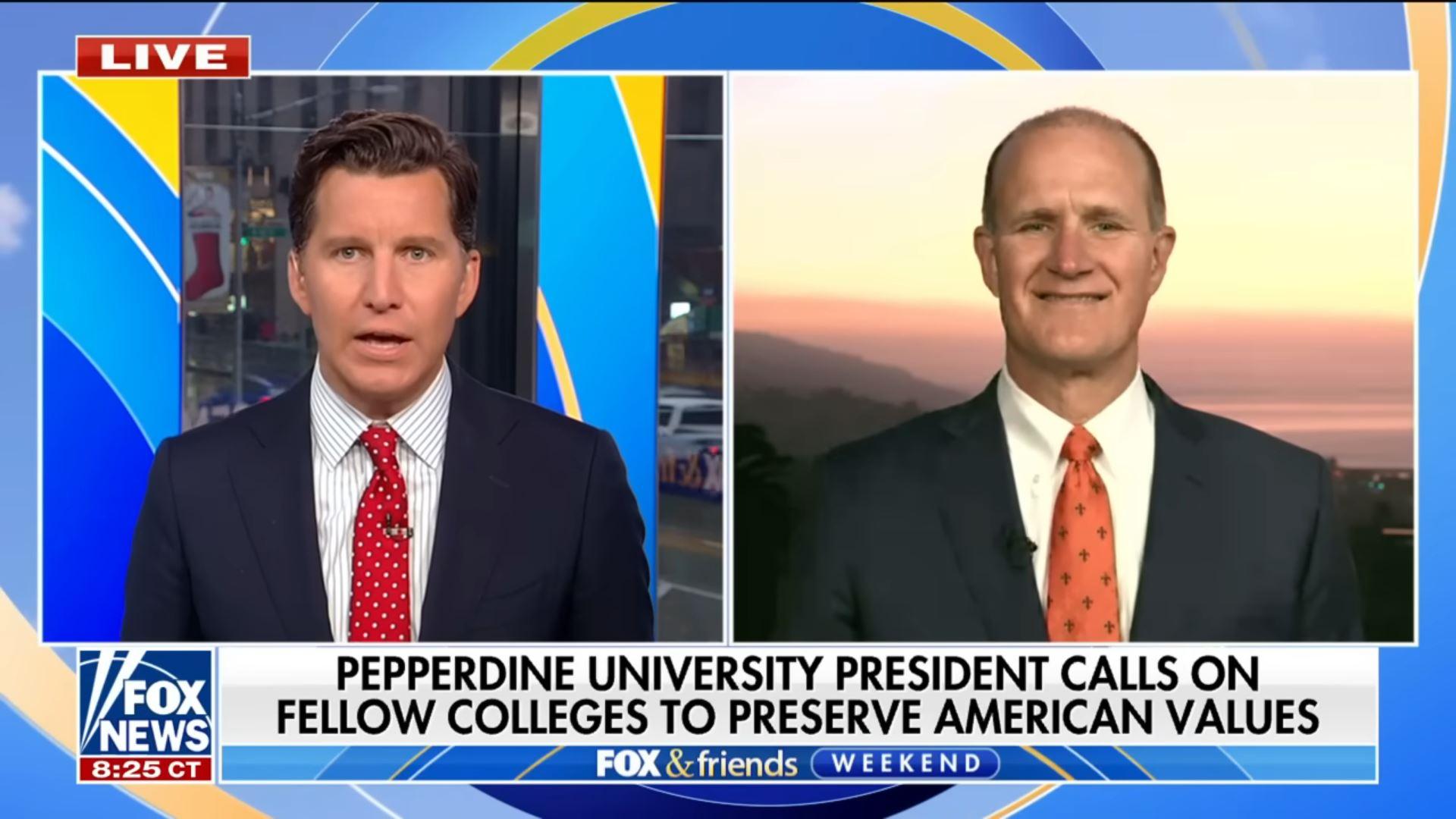
Gash speaks with commentator Will Cain (‘97), a Pepperdine alumnus, on Fox & Friends in December 2023. Gash’s appearance came days after he wrote an op-ed for the Messenger — now a defunct news outlet — titled “Universities Must Preserve American Values” after pro-Palestine protests gained prominence on college campuses. Photo courtesy of Fox Corporation
Recent speaker events in 2026 have associated Gash with conservative-associated educational frameworks.
The March 24 President’s Speaker Series featured Jeremy Wayne Tate, founder of the Classical Learning Test (CLT) for a conversation on “classical education.” The CLT is an alternative to the SAT and ACT, which has gained popularity with conservatives, according to Education Week.
Alongside Heritage Foundation President Kevin Roberts and other prominent conservatives, both Gash and Jessica Hooten Wilson, chair of Great Books at Pepperdine, serve on CLT’s board of academic advisors, according to its website.
Gash spoke at the University of Austin (UATX) on April 14, a private unaccredited university co-founded by Palantir founder Joe Lonsdale, conservative historian Niall Ferguson and Free Press co-founder Bari Weiss, according to the Chronicle of Higher Education. The school emphasizes the Great Books as part of its curriculum that emphasizes “what makes the West distinctive” and “why America succeeded,” according to its website.
Other events during the Gash era have drawn criticism, according to previous Graphic reporting.
This includes the board’s initiation of Waves Church in 2023, which some critics saw as partly political in nature. Waves Church does not take an official political stance.
In August 2025, the Graphic revealed Pepperdine hired Johnnie Moore, former executive chairman of the controversial Gaza Humanitarian Foundation, to serve as an administrator of a new School of Public Policy master’s program partnered with a pro-Israel think tank. Pro-Palestine demonstrators protested the decision in Washington, D.C.
In October 2025, Advancement censored two pieces of art that involved anti-ICE themes in the Frederick R. Weisman Museum of Art. The decision drew scrutiny from student protesters as well as the Fine Arts Division and Seaver Faculty Association, both of which made official statements calling for change.
Their Separate Ways
As for the other finalists, Shankle returned to Texas A&M in August 2019, where she became the University System’s associate vice chancellor and provost of the RELLIS Academic Alliance program, according to the Huntsville Item.
Sterling has continued his role as dean of Yale Divinity School. Under his direction last year, Yale opened an environmentally sustainable student residential complex called the Living Village. Had Sterling become president of Pepperdine, he said he would have pushed for more sustainable structures. Several current Pepperdine administrators, including the director of the school’s Center for Sustainability, deny climate change, according to previous Graphic reporting.
Perrin has remained in his vice president role, where he oversees implementation of Pepperdine’s 2030 Strategic Plan, which has guided the goals and direction of Pepperdine since 2022. Alongside Marrs, then-vice provost Lee Kats — now Seaver dean — and seven others from across the University, Perrin helped develop Pepperdine’s next decade of strategy, according to the plan’s preamble.
Marrs continued his position as provost through spring 2021, returning to teach religion courses before retiring in spring 2025.
Marrs said he believes the University has gone in a different direction than his presidential vision would have entailed, particularly in how administrators interpret the Christian mission.
“The ‘open table’ has been completely buried now because administration sees that as completely wrong,” Marrs said.
In a 2021 interview with the Pepperdine Beacon, Gash shared his view on the University’s mission. Instead of an “open table,” Gash described a “hosted table” philosophy.
“Non-Christians are invited and welcome to this hosted table and honored and valued in and accepted at this table,” Gash said to the Beacon. “But it’s a Christian table. And so that has certain aspects to it. Please come to our table. If you don’t like this food, well, we’re still going to serve that food. And we’d love to have you come. But you don’t get to decide which food we’re serving. It’s our table.”
That has tied into the differing academic vision Marrs had, too. Marrs said he wanted Pepperdine to aim high toward other premier universities, such as Yale, UC Berkeley and Vanderbilt. Today, Pepperdine’s vision has veered toward that of conservative Christian institutions.
“You listen now, and the vision is ‘We want to be in the same sentence with Liberty [University], Grand Canyon [University], Hillsdale [College] and Biola [University],” Marrs said. “I hear those four constantly.”
__________________
Follow the Graphic on X: @PeppGraphic
Contact Henry Adams via X: (@henrygadams) or by email: henry.adams@pepperdine.edu