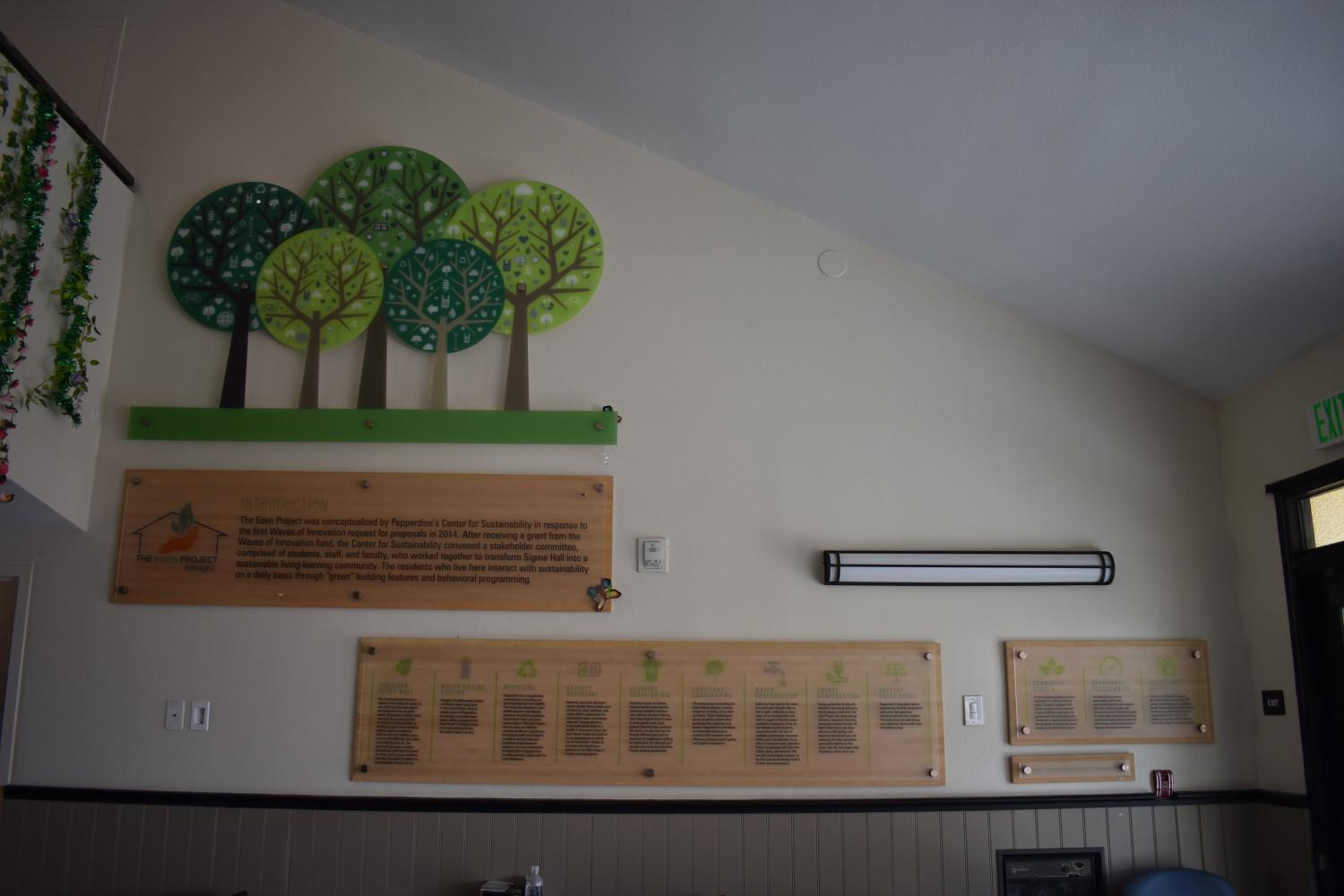
A wall covered with sustainability information panels sits in the common area of Eden House. Despite receiving a $150,000 renovation to make the house a sustainable living community in 2015, nearly no sustainability practices still exist in the house today. Photo by Amanda Monahan
In the outdoor seating area adjacent to the Rockwell Academic Center, Sustainability Program Coordinator Chris Doran’s class sat in the blazing heat. Two guest speakers, Ricky Eldridge, director of the Center for Sustainability, and Nicolle Taylor, senior vice president and chief operating officer, conversed with students.
Students in the class, held in spring 2023, asked Eldridge and Taylor about their backgrounds, quickly learning that neither had any sustainability experience. As the conversation continued, fewer and fewer students asked questions. The intense and unwelcoming space — along with the tone of the administrators’ responses — caused many to shut down, alumna Kathryn Horvath (’23) said.
Horvath said she remembers the administrators giving disrespectful responses to their questions regarding the University’s sustainability initiatives and showing a lack of interest in getting to know her and her classmates.
But things got worse when students asked administrators why Pepperdine University does not take a stance on climate change. Eldridge and Taylor told the group — which consisted of juniors and seniors who would soon be graduating with degrees in Sustainability — that there was no scientific evidence in support of climate change.
Some students froze up, some cried and some had the courage to respond. But everyone was shocked.
“You know, you read it on the website, or you hear it from other people, but having somebody directly tell me as a student graduating with a degree in Sustainability from the University that they can’t acknowledge that climate change is real and that the University’s stance is to provide an open discourse and debate,” Horvath said. “Is the University providing an open discourse and debate about gravity? Like, no. That would be dumb.”
Despite existing in a city that cares deeply about such issues as coastal erosion, climate change and water pollution, Pepperdine exists in its own world — one that refuses to take a stance on climate change. The school references its 1972 water reclamation system as a sustainable initiative on the Center for Sustainability website, but faculty and students said it has been slow to implement more contemporary sustainable practices, such as solar energy.
Alumna Belle Li (’26), who was a double major in Sustainability and Hispanic Studies, has known she wanted to study the intersection between social justice and the environment since she was young. However, in her past four years at Pepperdine, she has grown increasingly discouraged with the University’s own environment when it comes to these topics.
“I feel like the school deliberately tries to not be sustainable,” Li said. “The more I learn, the more I’m disappointed with the different things that we do — it’s both the lack of action and then the actions are actually unsustainable.”
Backgrounds
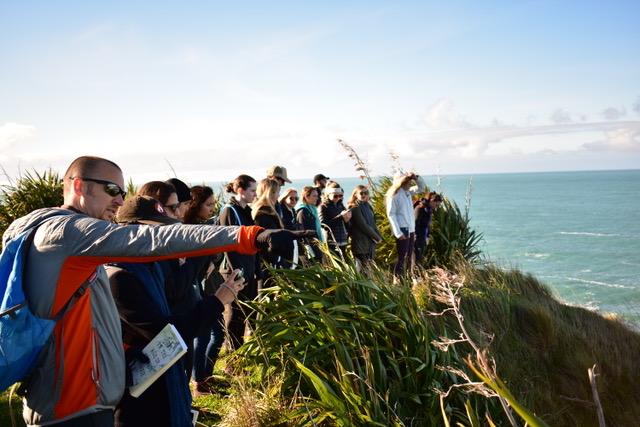
Sustainability Program Coordinator Chris Doran stands with a group of students on the bluff above Point Kean in Kaikoura, New Zealand in June 2018. Doran said this trip was a pilot program of bringing Pepperdine students to New Zealand. Photo courtesy of Chris Doran
Eldridge has no background in sustainability or environmental work or education. He is a licensed attorney, graduating from USC Gould School of Law in 2018. Horvath noted her frustration with this, having someone without relevant background in the position.
“That was frustrating as a student who was hoping to get a career in the environmental field,” Horvath said. “To see that even at my school, the folks who are in charge of our sustainability for the entire university don’t have that background that I’m trying to achieve and am now getting a master’s degree to achieve.”
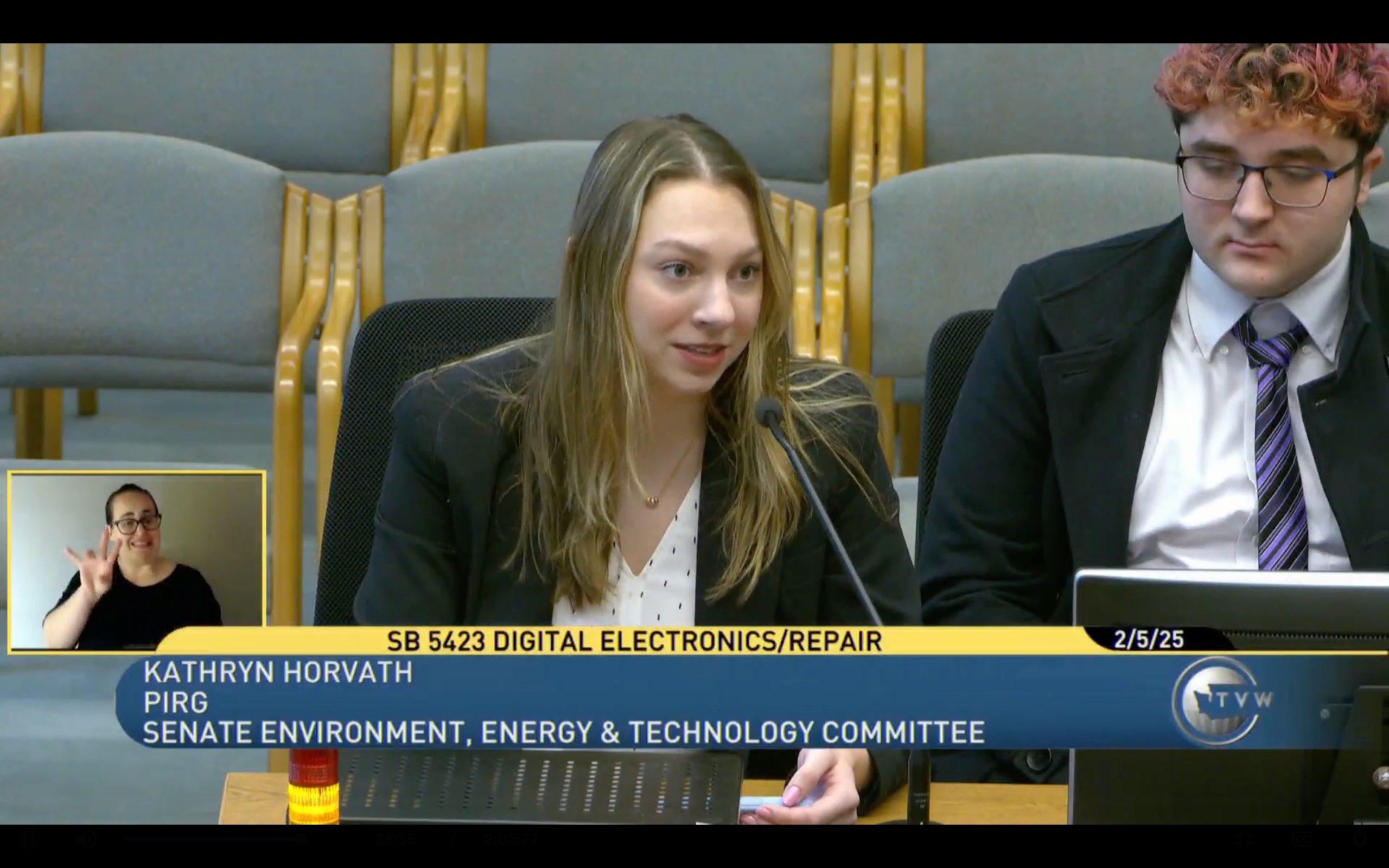
Alumna Kathryn Horvath (’24) testifies over sustainability issues in Olympia, Wash. Horvath said it was frustrating to see Pepperdine administrators hold high positions in sustainability without the relevant background. Photo courtesy of Kathryn Horvath
The Graphic spent weeks trying to schedule interviews with several members of the Pepperdine administration, including Eldridge and Taylor, about their stance on climate change and the University’s sustainability practices. Michael Friel, senior director of Communications and Public Relations, indicated the requested administrators would only respond to written questions.
Pepperdine Graphic Media’s interview policy requires real-time interviews for clarity and context to better understand a subject. In some cases, the Graphic accepts email responses for data, abroad travel and breaking news statements. This was not the case for this story.
Eldridge’s LinkedIn page indicates his position is the “Associate Vice President and Assistant General Counsel at Pepperdine University.” His “About” section has 57 words — the last two are “and sustainability,” the only time the topic appears in the section.
Rhiannon Bailard, founding director of the Center for Sustainability in 2007, worked in environmental regulation, land-use planning and community relations before helping found the center.
Though Bailard focused on what the University needed to do from a regulatory perspective, she said the excitement from students about “doing work that was greater than themselves” sparked her passion for her work.
“The purpose and function of the Center for Sustainability was to serve as a clearing house and conduit for highlighting what we were doing from a sustainability perspective on campus, looking to see areas for improvement, but then also being a connector across the institution,” Bailard said.
While at Pepperdine, Bailard helped cement clearer communication regarding Pepperdine’s off-campus recycling program, partially through the creation of “student champions,” where students with an interest in sustainability were selected within each school at Pepperdine to help spread communication from the Center for Sustainability. She said she thought this was important, as each school operated so independently from one another.
Though Doran, a religion professor, has no relationship with the current administration at the Center for Sustainability, Bailard and Doran had a strong, collaborative relationship before Bailard left the University.
After Doran critiqued Pepperdine’s sustainability practices in a Graphic article, Bailard reached out to Doran, asking to chat. Rather than feeling upset at the criticism, Bailard said she really just wanted to use it as an opportunity to collaborate.
“He had concerns, and you know, my response to him was there’s always room for improvement,” Bailard said. “He was willing to meet with me, and I said ‘Let’s partner,’ and we did. I’m really grateful for that, for his partnership and his incredible passion on the subject.”
Bailard said she was grateful to learn from Doran.
“[He is] one of the foremost experts on the overlap between Christianity and sustainability,” Bailard said. “And frankly, I learned most of everything I know about that from Dr. Doran.”
Bailard said the University declined to take a stance on climate change when she was at Pepperdine. While this can make doing sustainable work more complicated, she encouraged people to look past the overarching dialogue.
“My approach was to continue to do the good work to move sustainability forward,” Bailard said. “I do understand why individuals would be frustrated by that sentiment and by that perspective; at the same time, I would hate for that to stop the work and the partnership about what can we do from a sustainability perspective.”
Bailard had to leave the University for entirely personal reasons, however, she said she will always reminisce on doing work with students that fulfilled a greater purpose.
“I really did personally become quite passionate about it, and was just drawn to being able to something greater than myself,” Bailard said.
Two Sides of Sustainability
Doran said there are two ways of thinking about sustainability at Pepperdine: academically and operationally. The academic sense simply to the academic minor, which Doran founded in 2015, and major, which Doran founded in 2020.
The operations side, however, is far more complex. Doran explained that this side of the spectrum focuses on the things Pepperdine does to ensure its compliance with state and federal regulations in terms of the environment.
“I’d love to think that they [the two sides] would work together more cohesively,” Doran said. “But that’s kind of an up-and-down relationship in the past 19 years that I’ve been here.”
Since the incident involving Eldridge and Taylor in Doran’s class in 2023, Center for Sustainability staff have not responded to any of Doran’s invites to class or general emails. Further, several students in the Sustainability program said they have faced difficulty contacting Center for Sustainability staff.
This frustrates Doran, as he thinks that Pepperdine’s emphasis on being a small community should help bridge this gap — especially at the high price that students pay to be here.
“And you know, administration loves to say that they’re keenly involved with student engagement,” Doran said. “But it seems to me it’s on issues that administration finds to be part of their priorities, rather than issues that students find to be part of their priorities sometimes,” Doran said.
Li shares Doran’s sentiment, as Pepperdine administration has pushed her, along with her peers, away on several occasions.
“I think what administration does really well is say no, or say wait,” Li said. “They say wait until people leave, and then if the person who cares is not here, then it’s just not getting done, and that’s what they want.”
Li heard of many Sustainability students who faced hurdles before she hit a wall herself. For her fellowship, which she got from outside of Pepperdine, Li’s goal was to create a newsletter that focused on sustainability initiatives at Pepperdine. She reached out to the Center for Sustainability, as she figured their involvement made sense.
“They said no,” Li said. “I had multiple meetings with them. I wasn’t really allowed to talk to the director, Ricky Eldridge. He didn’t want to make time for me. I just talked to the assistant.”
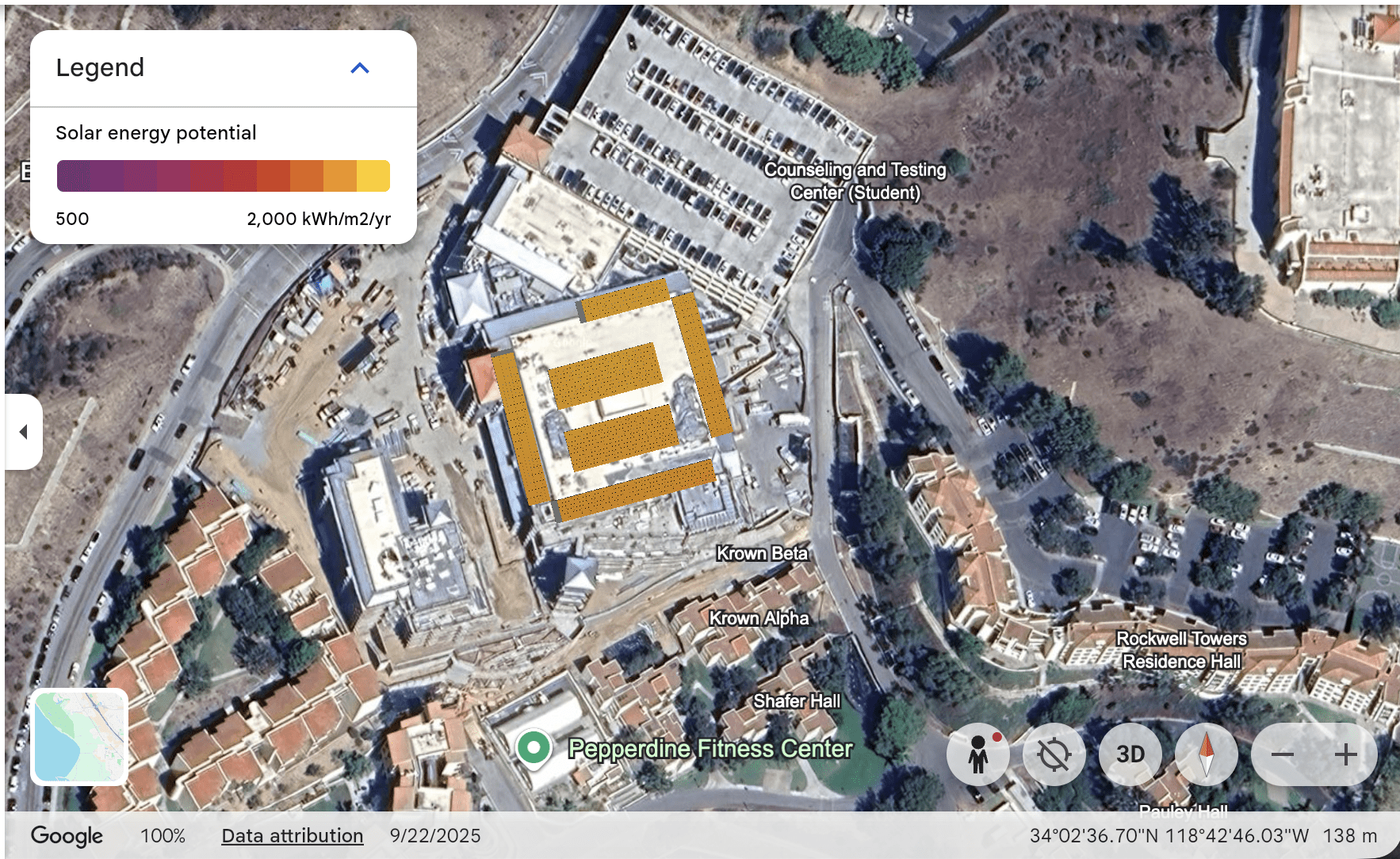
A Google Earth solar tool shows the Mountain at Mullin Park’s rooftop has very high solar energy potential. An installation like this would generate 704 megawatt-hours of solar energy per year and create zero carbon emissions.
The Mountain at Mullin Park, a new recreational center and gym that took 21 years of planning, is set to open this fall. In a 2023 video, Pepperdine states that “the University’s commitment to sustainability is demonstrated in every Mountain facility with a LEED silver certification for energy and environmental design.”
However, falling behind its neighbors, such as Malibu High School, there is no solar energy planned to be installed on top of the facility.
Considering how rare it is for a university to begin a building project entirely from the ground up, Doran said Pepperdine missed a huge opportunity to implement sustainable initiatives and student involvement in the planning process.
“You have four or five years of student engagement that is completely dismissed because no one on that side wanted to engage students and have them be a part of that process,” Doran said.
Given where the Mountain is located on campus, Doran said that at some times of the year there could be 8 to 10 hours of solar coverage per day.
“Building the Mountain would have been a perfect time to really explore solar panels on our roofs,” Doran said. “And as far as I know, it wasn’t even a part of the planning.”
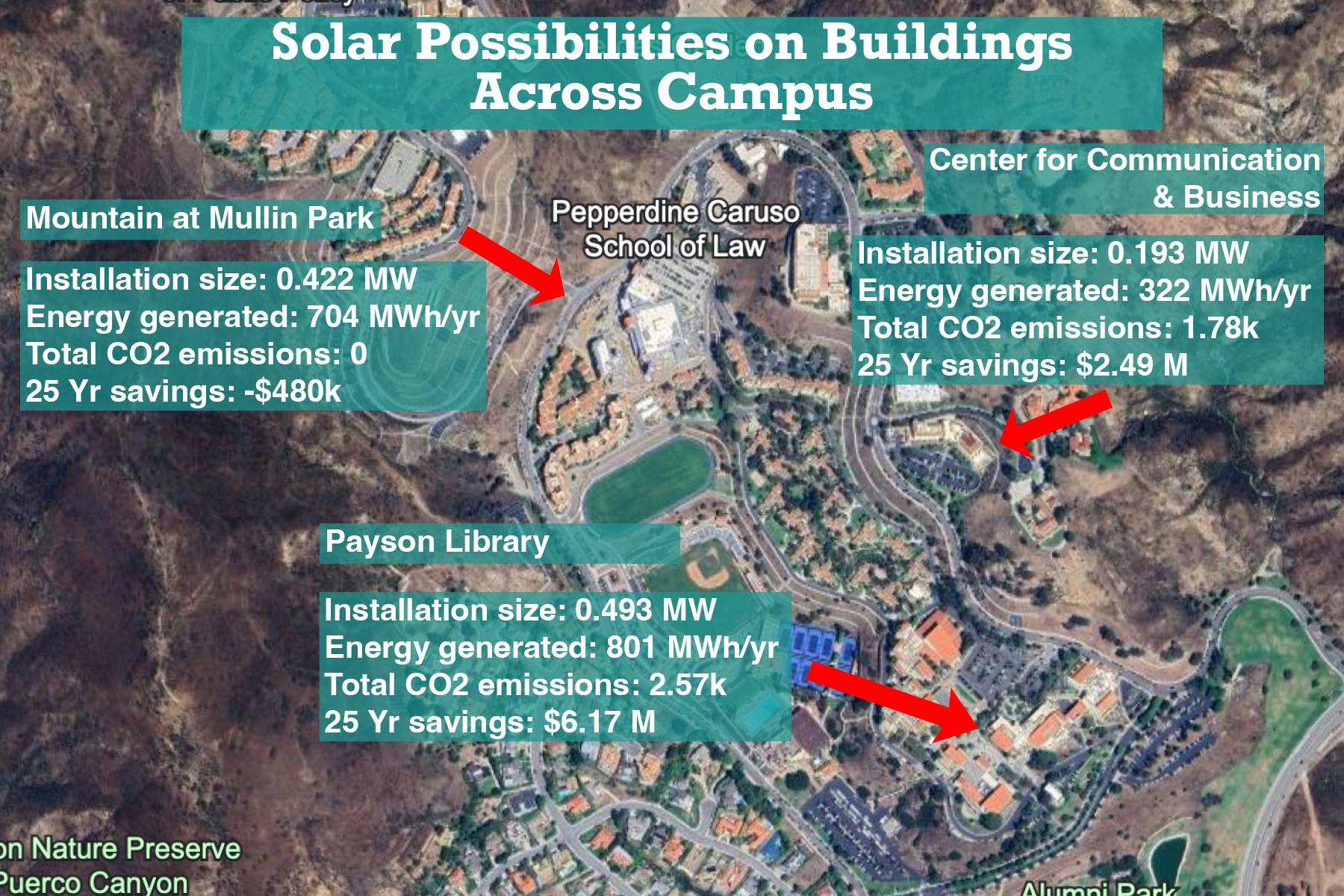
An infographic displays the possibility of solar arrays across campus. Infographic by Amanda Monahan
An analysis of the Mountain’s potential for solar energy showed that 704 megawatt-hours per year could be created with a 0.422-megawatt rooftop installation. While this analysis did not show a cost savings for Pepperdine’s energy, it would result in zero carbon emissions. With the installation of batteries, the University could also store energy in case of an emergency.
The Eden Project
The post-renovation sign for the Eden House lies outside the first-year residence hall April 15. While some of the signage still exists in the house, almost none of the practices are still active. Photo by Amanda Monahan
Bailard worked for weeks on an application for the Waves of Innovation Award under former President Andrew K. Benton. The proposal that ended up winning $150,000 was Bailard’s for the Eden Project.
“We had wanted to have an opportunity to have students not just hear about what we were doing from a sustainability perspective, but to really live and learn and experience and participate in sustainability,” Bailard said.
The renovation process was complete in 2015, and included the implementation of a garden, rain water catcher, interior lighting to grow plants indoors, kitchen and more. Bailard said this was intended to be both an academic and operational experience and living space.
In its early years, the Eden House required an application process for residents to live there. There was a panel process, which both Bailard and Doran were on.
“The idea was you didn’t just get assigned to it [Eden], like anybody ended up there like another residence hall,” Bailard said. “You actually had to write why you were interested. The criteria was your commitment to sustainability or interest, how you would contribute to those types of things.”
Residents of Eden used to coordinate an energy conservation competition among the residence halls, among other practices.
However, in the past 11 years, this has drastically changed.
Eden no longer requires an application process to live in the house. The house is now a first-year residence for women, with primarily female athletes living there.
When alumna Hannah Duffee (’26) began her first week as the resident advisor (RA) of Eden, she took a walk around the house before her residents arrived. She noticed a large wall in the entryway describing the sustainability practices of the house, as well as a kitchen and a water bottle filling station.
“Me and my fellow RA and SLA [Spiritual Life Advisor] just kind of found out [that Eden was a sustainability house] then and there,” Duffee said.
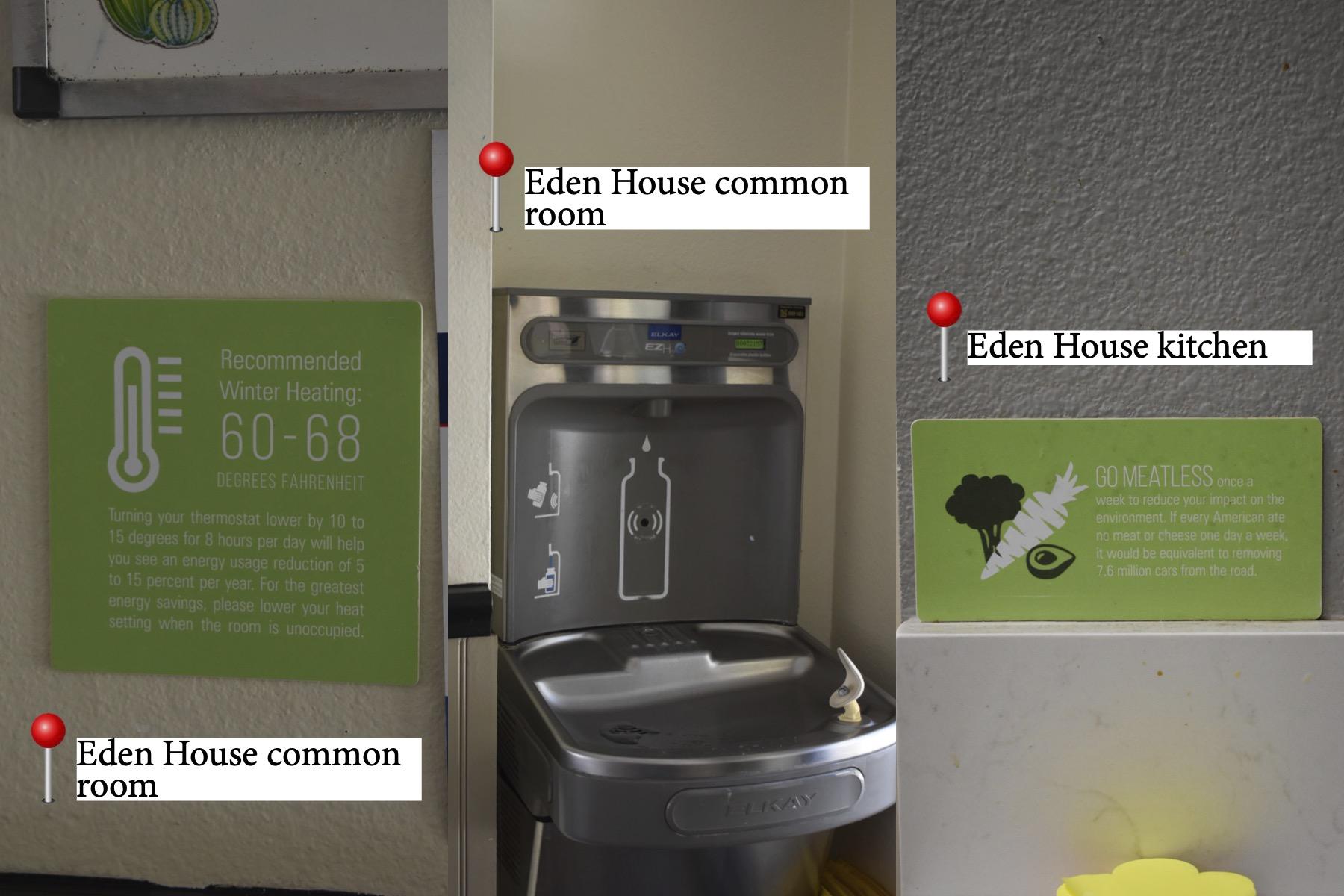
A collage of some of the few remaining sustainable practices in Eden House. Eden Resident Advisor Hannah Duffee said the water bottle filling station is the only thing most residents know about. Photos and infographic by Amanda Monahan
Duffee did not know the deeper renovation history behind the house, and said it is hard to tell what is left beyond the kitchen, water filler, low-pressure water system, motion-activated sinks and ability to turn off more lights than other houses.
She noted that there is not enough of a difference from other first-year houses, such as DeBell, where she lived her first year, that would make her residents really feel like they are living in a sustainable house.
“If they [residents] don’t have a lot of friends at other houses, I think they just assume that this is the norm for the freshman house,” Duffee said.
The Discovery
Students in the Sustainability program said they remember the moment when they realized Pepperdine had a larger issue regarding sustainability.
“I knew in the back of my head from the very beginning,” Li said.
Early on during her time at Pepperdine, Li noticed the trash cans and recycling bins were actually one conjoined bin that had no divider. Rather than being separate bins, there was one bin with two sides painted differently.
Alumna Anna Benjamin (’26), who was a Sustainability major and did not join the program until after her first year, said discovering the behind the scenes of Pepperdine sustainability led to a moment of disarray.
“The first time I learned about that [Pepperdine’s lack of sustainable practices], I was definitely pretty disappointed and also kind of confused,” Benjamin said. “It’s like, how am I studying this issue at this University, but the University itself doesn’t even believe that this is real?”
Beyond the discouraging moment she faced in class, Horvath felt a larger sense of defeat in connecting the two sides of sustainability at Pepperdine.
“It was just disappointing to see that the part of the University that we could really connect most to, and ideally would be really excited to have a lot of students do free work, and great ideas and a lot of creativity and energy that they could have utilized,” Horvath said. “They never took the opportunity to collaborate with us, despite both students and Dr. Doran and other professors extending that relationship offer.”
Despite the obvious disconnect between administration and the Sustainability program, Doran has students taking his Christianity and Sustainability course write a letter to President Jim Gash arguing why Pepperdine, a Christian university, has a duty to address climate change.
Horvath had hope while writing this letter just weeks after the interaction with Eldridge and Taylor. But her hope quickly deflated.
“So not only to have people come to class and tell me to my face that my degree is in some words or another a hoax and worthless, and then to not get a response after a personalized message to the president, was just all really frustrating and very dismissive of the degree that I was obtaining at their university,” Horvath said.
While watching administrators essentially tell his students that climate change is a hoax was upsetting, Doran said the concept is not entirely shocking, given the University’s values.
“There is certainly an attempt to cast our institution as a conservative or, not even right-leaning but right wing, political and ideological place,” Doran said. “And it’s just very uncomfortable for people in that framework to say that climate change is real because it has a lot of other things that come with that.”
Malibu’s Care for Nature Beyond Pepperdine
Beyond the Pepperdine bubble, there is something intrinsic to Malibu’s nature where residents show great concern toward climate-related issues. At least one agenda item at nearly every city council meeting concerns an environmental problem and residents often line up to make public comments.
Farah Stack, environmental sustainability analyst for the City of Malibu, emphasized the Malibu community’s deep care for the environment.
“We are 21 miles of scenic beauty along the coast,” Stack said. “That love for our coast, that love for our beaches, that love for the water, that love for the mountains — it’s so embedded in the history and culture of Malibu and of people that have lived here for generations.”
Stack said she believes it is this immersion in nature that causes residents to be passionate about protecting Malibu’s natural spaces. Having grown up in Malibu, she said caring for the environment is in the city’s DNA.
Before it was called Malibu Elementary School, Stack attended the school as Point Dume Marine Science Elementary School. She remembers going to the beach and tide pools, as the curriculum at the school was marine science focused.
Stack lost her family home to the Woolsey Fire in 2018. Though she had grown up immersed in Malibu’s concern for the environment, this moment ultimately led her to graduate from the University of Southern California with a bachelor’s and master’s degree in Environmental Studies, focusing on environmental law and climate policy.
Despite her office being less than a mile away from Pepperdine, Stack said the only communication she has received regarding sustainability from Pepperdine is invitations to Earth Day and Climate Calling. While she enjoyed connecting with students and hearing from Climate Calling 2025 keynote speaker Bill Weir, Pepperdine alumnus (1990) and CNN’s chief climate correspondent, there has been little outreach from Pepperdine to the City of Malibu. This is something she wishes could be improved, but she acknowledged the city’s intense focus on fire recovery for the past year.
Malibu resident Julie Blunden, board member at Nextpower, formerly Nextracker Inc., which is a clean technology provider that does solar tracking, said she has seen firsthand the difference between Pepperdine and Malibu’s journey toward cleaner energy.
“You may see people with solar on their roofs [in Malibu], or if you fly into LAX you might have seen solar-powered canopies over parking lots,” Blunden said. “Pepperdine could do all that if it wanted to.”
While Blunden believes Pepperdine did a great job in the fundamental layout of the campus for fire resilience, there is more that can be done, such as implementing solar battery generators. She recalled the Palisades Fire, when SoCal Edison shut off gas to West Malibu.
“Everybody that had gas generators couldn’t use them; so they thought they had a backup power supply when the power went off but they didn’t because they didn’t have gas,” Blunden said. “So a lot of people in my neighborhood in Malibu have put solar batteries on their house even though they already had a gas generator, because the gas generator wasn’t a sure thing.”
Though Malibu residents are increasingly turning to cleaner energy sources, whether for disasters or everyday use, Blunden said she does not see Pepperdine as a part of this — and neither does the Malibu community.
“I don’t think your average Malibu resident sees Pepperdine as a leader in the Malibu community,” Blunden said.
Santa Monica-Malibu Unified School District Sustainability
Santa Monica-Malibu Unified School District (SMMUSD) prioritizes sustainability, the district’s Sustainability Manager Austin Toyama said. Beyond complying with state and federal laws, SMMUSD also follows Collaborative for High Performance Schools (CHPS) — a collaborative that strengthens the vision for green schools across the United States. Toyama said the district adheres to CHPS “plus 25%,” meaning they go 25% above the minimum threshold to be considered CHPS-designed.
Toyama said SMMUSD also educates students about sustainable practices. A common approach for this is to connect the issues to the students’ communities.
“We see these impacts locally — we always tie it back to, ‘You live near the beach, who sees trash on the beach?’” Toyama said. “They all raise their hands, and then we talk about ‘This is why it’s important. Your campus is connected in the community all the way out to the beaches, the storm drain systems, the ocean health and the wildfires.’”
Having studied sustainability and environmental science throughout college, Toyama said he believes education on climate issues is important regardless of students’ career aspirations.
“It’s more personal [to students] when we can say, ‘This is what’s happening, this is how it affects your community,’” Toyama said. “We are trying to teach these kids to be stewards for the future, whether or not they go into an environmental or green job position, just to have that in their mind as future leaders and adults that their actions every day have consequences.”
Malibu High School installed solar panels on its Administration Classroom Building, which currently powers a portion of that one building. SMMUSD is currently working on a project that will be able to power the entire middle and high school campus: a hillside solar panel installation.
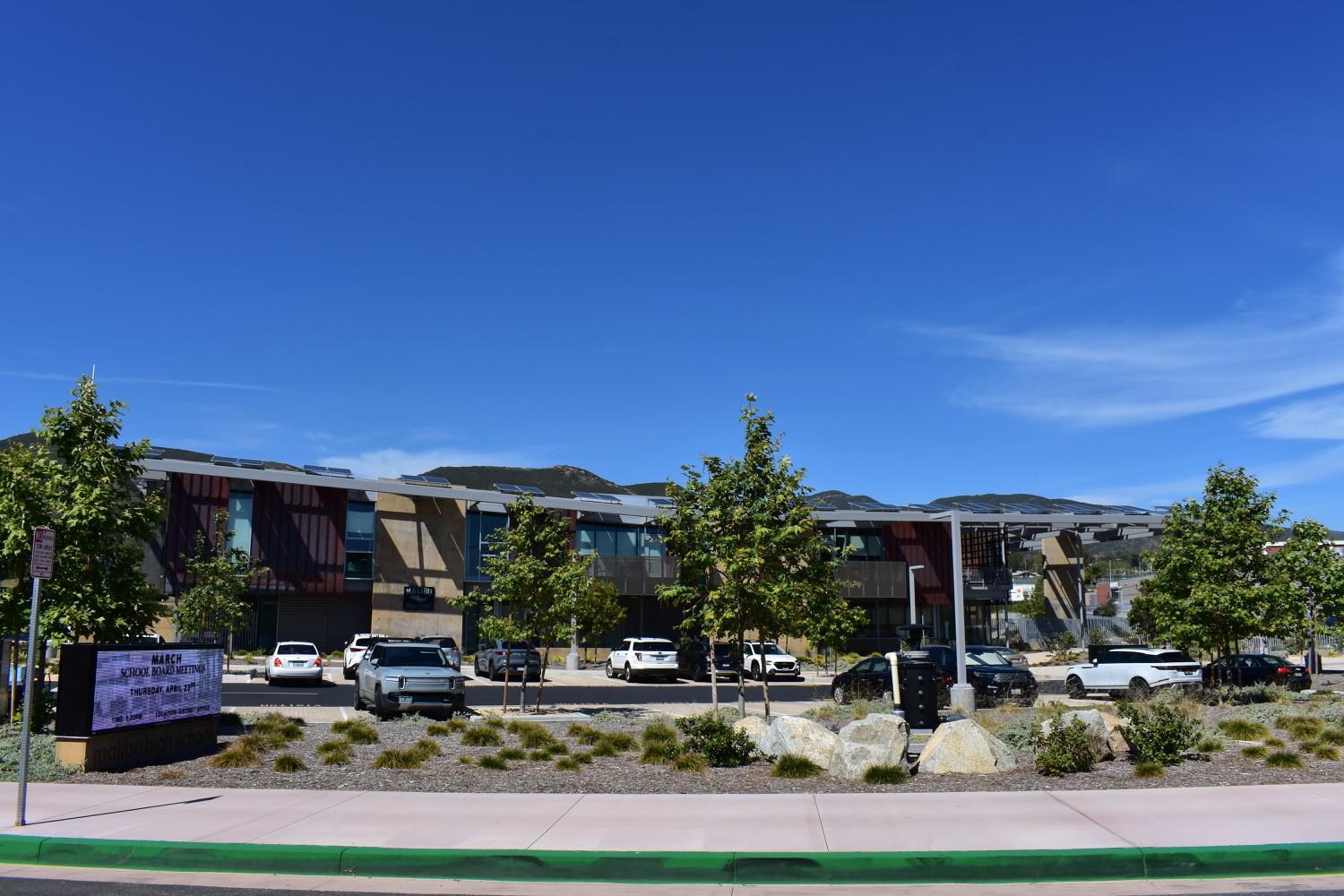
Solar panels lie on top of Malibu High School’s administration building April 15. The panels, which were fully installed in 2022, currently power a portion of the building. Photo by Amanda Monahan
This project will entirely power the school through solar energy, but it will also connect to a one megawatt battery that will be able to store energy.
“Worst case scenario, in the case of a huge outage or another wildfire event, we’d be able to power the site with that battery for several days,” Toyama said. “All the buildings at the campus — not just one or two, and not just what they call critical load, which is emergency lights or refrigeration, but it would be able to power everything.”
Both Malibu and Webster Elementary already have rooftop solar installations, and Toyama said another part of the solar plan for the next few years at SMMUSD includes installing a battery at each of these schools so they can store their own energy as well.
Toyama expects the project at the elementary schools to be done by mid-2027, and the middle and high school project by early 2028.
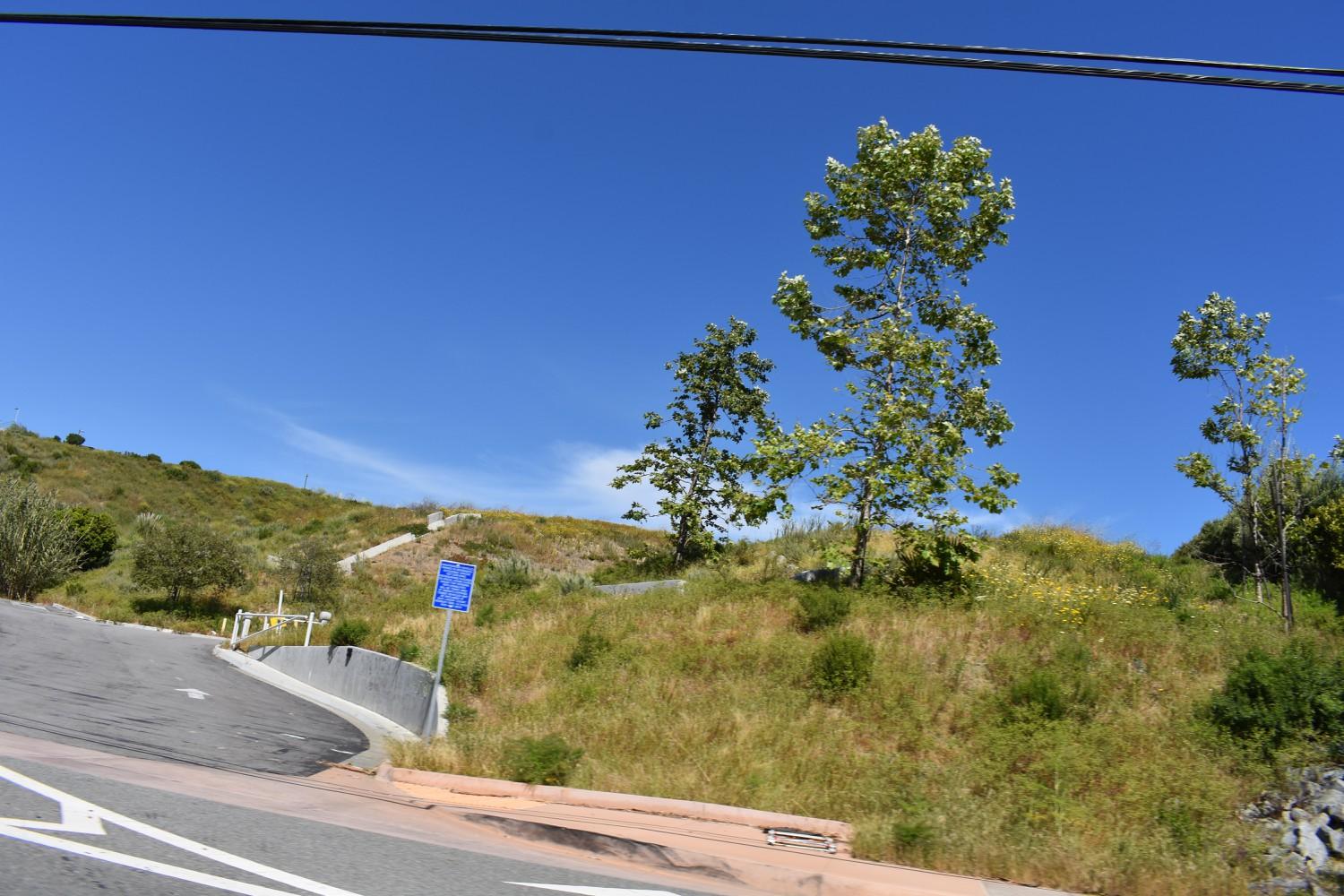
The empty hillside that lies next to the Malibu Middle and High School campus. Santa Monica-Malibu Unified School District said a solar array installation will be complete by early 2028. Photo by Amanda Monahan
Toyama was surprised at Pepperdine’s lack of sustainable initiatives and the complete absence of solar energy on campus. While he acknowledged that upfront cost is a common deterrent to solar installation, he said in a community like Malibu, the cost is worth it.
“The benefits of installing solar is so much greater than any drawbacks,” Toyama said. “Especially just being situated in Malibu, in that area alone, and going through the Palisades Fire and the Franklin Fire.”
Several SMMUSD schools serve as disaster shelter areas for the community to charge their phones, plug in medical machines, have access to refrigeration and more. Considering Pepperdine also opens its doors to the community in times of disaster, solar would be a way to provide energy access without the use of gas.
Further, the new solar batteries will allow Malibu High School to keep power during shutoffs, which are common in Western Malibu. In 2025, Malibu Elementary School faced 24 days without instruction due to SoCal Edison (SCE) power outages, according to The Malibu Times.
“If the school’s focus is to educate students and keep students learning, that’s a main way of doing so because we’re in an area where the grid is really volatile and it shuts off,” Toyama said.
Sustainability Encounters Beyond Pepperdine
Despite the environment he faces at Pepperdine, Doran has found a much different community outside of Pepperdine’s campus.
A few years ago, Doran was appointed as an associate director of the Resource Conservation District of the Santa Monica Mountains, a board which is part of County Supervisor Lindsay Horvath’s office. He remembers a Pepperdine administrator briefly congratulating him before they quickly moved on to asking him to connect Pepperdine more deeply with the county office.
“I was being asked by an administrator who’s dodged my emails for several years to further their connection with the county supervisor,” Doran said. “And it just struck me as I just don’t understand what the priorities are of a place that would do something like that.”
As he has continued his work outside of Pepperdine in the Los Angeles area, he has encountered several people who shared their own past experiences with Pepperdine administrators.
“There’s scientists that work in this organization, there’s policymakers, etc. and very few of them have a positive understanding of Pepperdine until they met me,” Doran said. “They’re like, ‘You’re the first Pepperdine person that we’ve ever been around that talks like this, like, takes science seriously.’”
As students from his program have graduated and moved on to careers and graduate schools in sustainability and environmental policy, Doran has received countless messages, phone calls and emails from students recounting experiences regarding their history at Pepperdine.
One of Doran’s students, who attended graduate school for climate policy, had an administrator ridicule them in front of 30-40 other grad students. The administrator asked why the student went to a school that does not accept the reality of climate change. While Doran did not agree with or appreciate the administrator doing this, he believes this speaks to the greater issue at hand.
Benjamin will be attending UC Santa Barbara for graduate school starting this fall, as she hopes to get a Master of Science in Environmental Science and Management. She had an interview with another graduate school, which she is not attending, and she was asked what it was like to learn about climate topics at a school that essentially does not believe in climate change. This moment made Benjamin realize Pepperdine’s issues with sustainability extend beyond the Pepperdine and Malibu communities.
“I know that other universities are definitely watching too,” Benjamin said.
Similarly, Horvath began her graduate school application process this spring. As she filled out the educational experience boxes by saying she was a Sustainability major at Pepperdine, she started to feel uneasy.
“It’s hard to go out post-grad with a degree in Sustainability from Pepperdine University when some people may know that Pepperdine University doesn’t even acknowledge climate change,” Horvath said.
Through roughly 20 years of push back and ignorance from Pepperdine administration, Doran said there have been times where he and his wife, Amy Doran, have talked about whether this is still the right place for him. However, getting to teach students about sustainability is one thing he has always been able to do.
“No one has stopped me from creating the Sustainability program,” Doran said. “I think students kind of think that administrators get in the way of stuff like that more than they actually do — no University administrators want to be known for stopping academic work.”
Further than his students, Doran also believes that his colleagues who acknowledge the importance of sustainability help keep his morale alive.
“I have colleagues who know that this is an important space and sometimes don’t always have the voice to articulate that because of the pressure that comes with it,” Doran said. “But working with them, even if they’re not as vocal as I am — it’s been really encouraging.”
The Dorans also grant an annual $7,500 climate fellowship at Pepperdine that funds a student’s efforts toward educating the Seaver College community about climate change.
Doran said if he could have the University implement anything related to sustainable initiatives, two things come to mind: solar arrays, which he believes is a practical option, and more sustainable food selections in dining halls on campus, which he said can be trickier but just as important.
“We just have too many rooftops that are facing in the correct direction to have a considerable amount of our power collected by solar,” Doran said.
‘A People Issue’
The Trump Administration has pulled back on all climate efforts, including solar and wind power, according to Climate Action Campaign’s “Trump’s Climate and Clean Energy Rollback Tracker.” The New York Times also reported the major regression in climate change progress in an April 9 article.
Members of the Sustainability program believe climate change should be nonpartisan.
Doran said part of the Trump administration’s resistance to climate efforts comes from large donations from oil companies during the president’s campaign. Additionally, the Trump administration has a fascination with the “beautiful clean coal industry,” Doran said.
“When you really think about the issue of climate change, it comes down to being a people issue,” Benjamin said. “I feel like that’s something that we should all be able to connect over at the end of the day, especially at Pepperdine, being a faith-based community and preaching purpose, service, leadership.”
Blunden said that while fighting for change in terms of climate conversations and sustainable practices can feel like a losing battle at Pepperdine, it is never worth giving up on.
“In this current political climate, the opportunity to budge the current leadership at Pepperdine on this subject is close to zero, even if we had another fire this fall, even if we just had the hottest March of all time in Los Angeles, which, by the way, did just happen now,” Blunden said. “However, the opportunity is at moments of change, and it matters for there to be a communicated drumbeat of attention.”
As her time at Pepperdine comes to an end, Benjamin believes that Pepperdine can play an integral role in helping Christian neighbors across the world.
“If we could just look above the politics of it all and see that this is an issue affecting us now, we can help other people all around the globe by acting in more sustainable ways — there could be such a great impact here,” Benjamin said.
_________________________________
Follow the Graphic on X: @PeppGraphic
Contact Amanda Monahan via email: amanda.monahan@pepperdine.edu or via Instagram: @amandamonahanjournalism