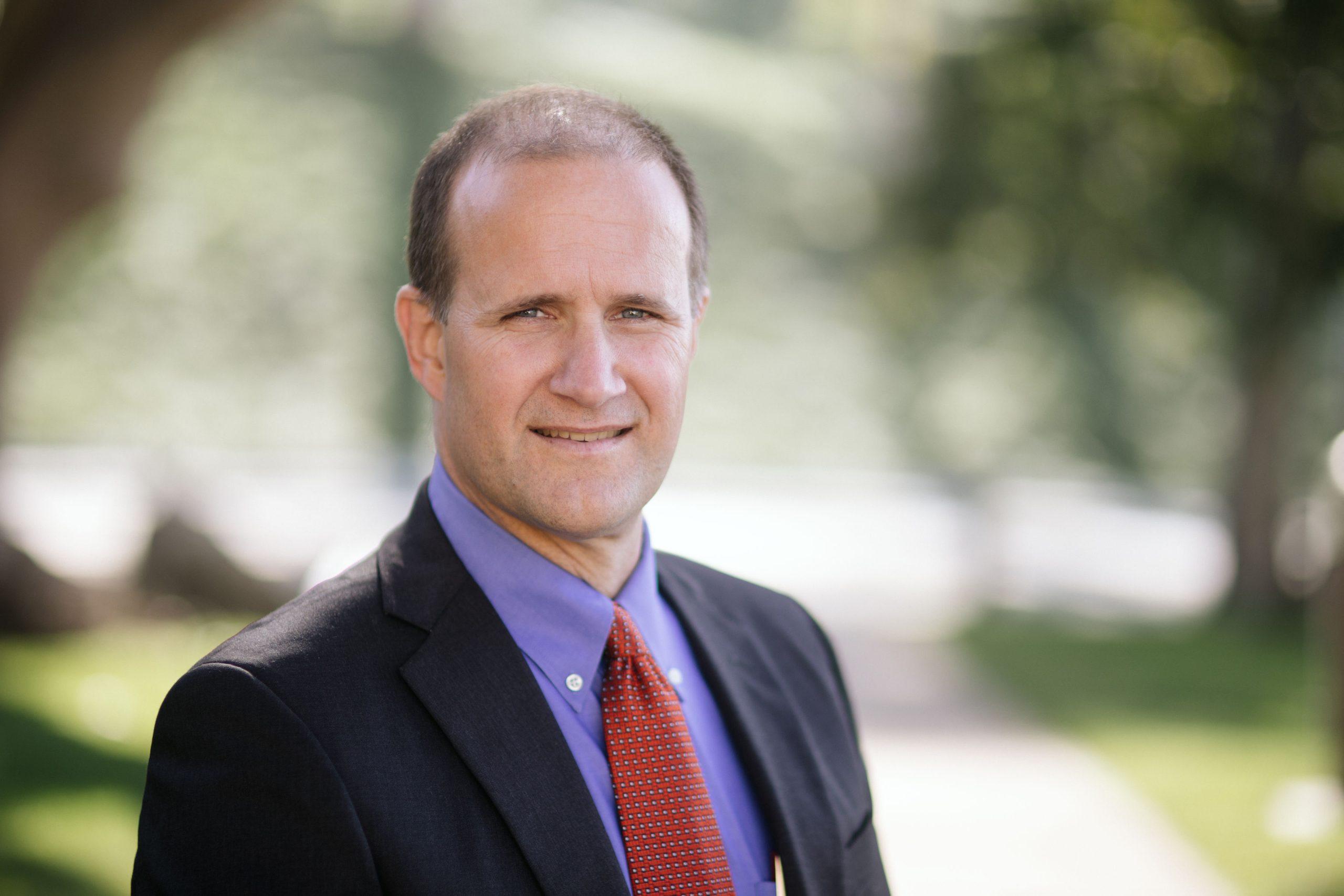
 President Jim Gash smiles for a headshot in 2019. Gash said he sees a bright future ahead for Pepperdine. File photo courtesy of Pepperdine Graphic
Editor’s Note: Alicia Dofelmier was Life & Arts editor of the Graphic in the spring semester. Dofelmier completed the reporting and writing of this story before her graduation in May.
Jim Gash is the 8th president of Pepperdine University. He began his term Aug. 1, 2019, and in August 2025 the Board of Regents voted to extend his contract.
He grew up in a tight-knit family with faith at the center, Gash said. One of his formative influences growing up, Ron Phillips, senior vice chancellor of Pepperdine Caruso School of Law, inspired his work in administration, eventually leading him to become president of Pepperdine.
Growing up in a tight-knit family with faith at the center of everything, Gash spoke with the Graphic about his upbringing, influences and his hopes for Pepperdine’s future.
Q: What was your family like?
A: [I] grew up in an incredibly close-knit, warm, loving family. My parents had both gone to Pepperdine, and faith was at the center of their lives. My siblings and I were, and are to this day, as thick as thieves. We like each other, we love each other and we love spending time together.
My parents were both schoolteachers, and we were not allowed to work over the summer. That was family time. Summer was family time. So we got to travel. We traveled by car. We couldn’t afford to fly. We often stayed in campgrounds because we couldn’t afford hotels. So we just didn’t know any better. It was a time when we just did life together as a family.
When we went out to dinner, we would eat at a place called Sizzler, which is essentially like a Denny’s, and to us, that was like — could it possibly get any better than this? We just grew up not having high expectations as to comfort, and yet we just loved it. We loved being together.
That’s kind of how Joline and I have decided to try to be with our family as well. It’s just, let’s spend time together and not worry about trying to have expensive tastes. I think that’s so important.
Q: Who were your formative influences growing up?
A: Certainly, both of my parents. My dad coached every team I played on. Since he didn’t have to work on the weekends, they drove us to the track meets, to the soccer games, to the baseball games, and so he was the most formative influence in my life. But I have been blessed to have incredible mentors in my life, people who showed me what it looked like to be a follower of Jesus, to be a husband, to be a father, to be someone dedicated to excellence in whatever you did.
Edith Jones is a judge on the 5th Circuit Court of Appeals, and she was a formative influence in my life because when I graduated from law school, I worked for her for a year. I was blessed to have a year of being trained, mentored, loved and disciplined — discipline not as in punishment, but discipline in the best sense of that, ensuring that you are dedicated to the task before you and that you deliver only excellence. To watch her do that was a formative part of my time between law school and my ultimate career.
And then the third one I will say, a huge influence in my life, is a guy named Ron Phillips. Ron was the founding dean of Pepperdine Law School. He was the one who told me about this Institution in ways that I didn’t know. So my parents went here — they loved it. My dad became a Christian here, and it changed everything in his world. And so my siblings, we all wanted to come here. That was our school. We were going to Pepperdine.
But unfortunately, the sports we were involved in were a huge part of our lives. We were a year-round sports family — that was what we did outside of our faith and our academics. My brother was a pole vaulter — no pole vault program here — so he went to Stanford University. I was a football player, and there was no football team here. My little brother was also a football player. We both went to Abilene Christian University.
But when I was a senior at Abilene Christian, my business law professor put what was called a transparency, what you all would call a PowerPoint slide, on the screen, and he said the dean of the Pepperdine Law School is visiting campus next week. If you’re thinking about law school, you can sign up for a 30-minute interview slot. There’s one scholarship that Pepperdine gives to an Abilene Christian grad each year, and it can range in size depending upon your LSAT score and your GPA.
And I was like, man, I really like this business law class. I was a finance major. I’m going to go meet with that guy. He had gone to Abilene Christian for undergrad, and at that time, he was in about his 20th year as dean of the Pepperdine Law School. We hit it off, and when we were done with that, I was going to law school, and I was going to Pepperdine, God willing.
So I came out and visited when I graduated in December. I visited campus, and he gave me a tour, and I sat in on a class. And I could picture myself coming to the school I’d always dreamed of going to. So it was the only school I applied to, and thankfully, I was granted the scholarship.
Ron Phillips coming to Pepperdine [Abilene] to interview people who were potentially interested in going to law school changed everything for us. And then when I became a professor, he was a mentor for me. He had moved on to a full-time advancement role — meaning fundraiser — but he continues to still be a mentor. He’s in his early 90s and still works at Pepperdine, and still is someone whose voice I trust as much as anybody’s.
So my dad, Edith Jones and Ron Phillips, I would say, are the three most important people in terms of influencing my development. Of course, my mom was as well.
Q: How did you decide you wanted to work in administration/leadership?
A: Yeah, so what happened was, in 2004, the dean of the law school was stepping down, and there was a new search for a dean. And so when Ken Starr became the dean of Pepperdine Law School in ’04, he asked me to join his administration. He asked me to join his administration right after I got tenure. You’re up for tenure after your sixth year, and for me, that was ’05. So he started in ’04, I joined in ’05. We had worked together in private practice, and he was another really important mentor in my life and continued in that way until he passed four years ago.
But when he became dean, he asked me to join the administration of the law school in the role of associate dean for student life. I had gotten tenure, and so me pulling back from full-time teaching to be essentially a half-time administrator was my first taste of administration. I did that with him for the next five years. I was his associate dean.
Then, when he left to go to Baylor to become president there, the new administrator, the new dean, Tom Bost, was the interim dean, and Tom asked if I would serve one more year. I had told Ken I would do this as associate dean as long as he was dean, but that I would go back to full-time teaching and writing after that time. So when Tom came in for a one-year interim role, he asked me to stay for that one year, so I said OK, I’ll stay for one more year.
When the new permanent dean, Dean Deanell Tacha, came in, she asked me to stay for one more year for the transition, and I said I would stay for one more semester. But at that point, I had already secured a sabbatical where my family and I would move to Uganda for six months. The kids were 11, 13 and 15. At that time, I was leading the Sudreau Global Justice Institute, so that was part of another administrative role.
When I got back from that six-month sabbatical in Uganda, I returned to full-time teaching and writing and did that for a few more years while continuing my work with Sudreau. Then, in ’17, when Paul Caron became dean, he asked me to rejoin administration as associate dean for strategic planning and external relations. That included advancement, fundraising and alumni relations.
During the beginning of my second year as associate dean for Paul, my predecessor, Andy [Benton] announced he was retiring. That began the question everyone in the Pepperdine community was asking: Who’s next? People tend to serve a long time as president here, and we all thought we knew who it was going to be. We thought it would be Gary Hanson.
The reason we knew that was because Gary was the executive vice president. The third president was Norvel Young and his executive vice president was Bill Banonswky, who became the fourth president. Bill’s executive vice president was Howard White, who became the fifth president. His executive vice president was David Davenport, who became the sixth president. His executive vice president was Andy Benton, who became the seventh. And so, Gary — and everybody loved Gary, everybody still loves Gary — Gary would have been a phenomenal president, and there would have been, like, no one else would have been considered. He was that good. He was that respected. But then, unexpectedly, Gary announced that he would retire before that transition. That changed everything and opened the search process.
They hired a search firm, Korn Ferry, which works on major executive searches, including Pepperdine’s. Working with the Board of Regents, they created a prospectus outlining the attributes, skill sets and experiences they were looking for. There were two ways to be considered: you could apply, or you could be nominated.
I had people who were kind enough to encourage me to apply, but I decided not to. My reasoning was that if I were the only one who thought I should be president, then I shouldn’t be president. A few weeks later, Korn Ferry reached out and said I had been nominated and asked if I would be willing to consider it.
My wife, Joline, and I spent a lot of time praying about it. Then we spoke with each of our three kids individually. They essentially had veto power because stepping into that role would significantly change their lives. One had just graduated from Pepperdine, one would be a senior and one a sophomore if I started. All three were supportive and encouraging, as long as they could still live their own lives without being constantly in the spotlight.
From there, the process moved forward. Ten candidates were selected for the first round, which was an off-campus 90-minute interview with the committee. Five were then selected for a full-day interview on campus. After that, the pool was narrowed to two.
On February 13, the day before Valentine’s Day, I got a call from the chair of the board, who told me I would be the eighth president of Pepperdine. It wasn’t framed as a question — it was a statement. I said, if this is an ask, I accept. He wasn’t saying, you know, ‘Are you willing to?’ He says, ‘You’re going to be the president.’
We spent time continuing to pray for guidance — for God to guide the Institution and our steps. That’s how it all came about.
Q: With your contract being renewed, are there any specific things you want to do differently/accomplish going into this next chapter?
A: I like the trajectory we’re on and the people who are leading the various aspects of it. And so I would say higher still — to continue to ascend, to climb more mountains. Pepperdine has an incredibly bright future ahead of us.
We are an excellent academic school with a serious commitment to Christian faith and an incredible location. We’ve got a vision and an opportunity that’s unparalleled. We believe in higher education, and so we’re going to continue to pour into what we’re doing.
So there’s no new direction. There’s a strategic plan that will carry us through 2030, but we’re already starting to think about the next strategic plan. And I will tell you that when Pepperdine turns 100 in 11 years, that’s going to be a big moment in the history and life of the University.
And so, I suspect, probably in 2029 or 2030, we’ll be rolling out the next seven-year plan of what we’re going to try to accomplish. But, you know, Kyoto is new, The Mountain is new. There’s no direction shift, it is continuing to push the accelerator on what we’re doing.
________________
Follow the Graphic on X: @PeppGraphic
Contact Alicia Dofelmier via email: alicia.dofelmier@pepperdine.edu or via Instagram: @aliciadofelmierjournalism