
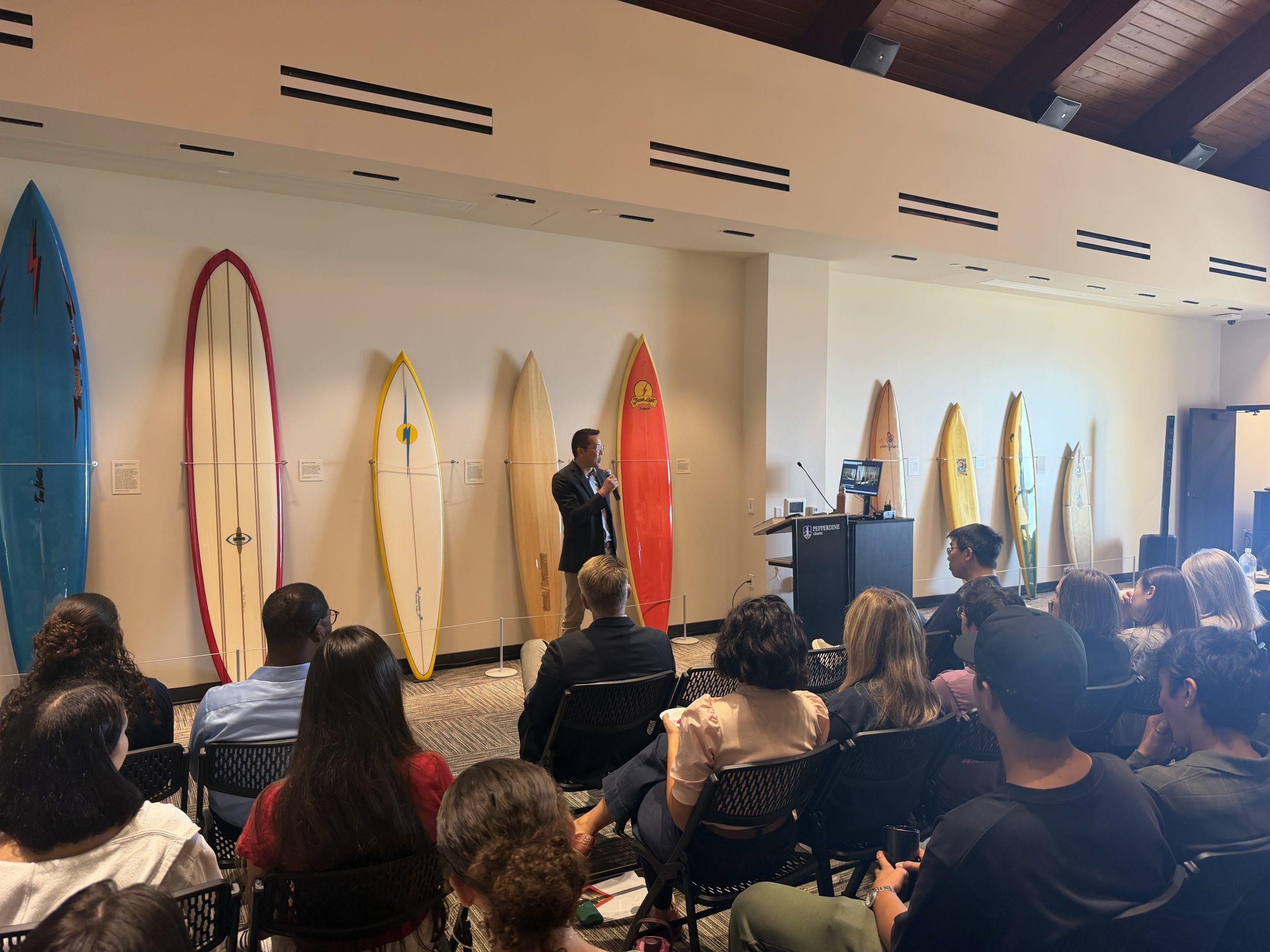
Jonathan Cheng, author and Wall Street Journal China bureau chief, stands at the front of the Surfboard Room in Payson Library. Cheng said he has been a journalist for 21 years. Photo by Oliver Evans
The International Studies and Languages Division partnered with Pepperdine Libraries to host a book talk with Jonathan Cheng, China Bureau chief for the Wall Street Journal (WSJ).
Cheng talked about his book, “Korean Messiah: Kim Il Sung and the Christian Roots of North Korea’s Personality Cult.” The book focuses mostly on Kim Il Sung, a communist revolutionary and founder of North Korea. Cheng reveals that Christian Korea was actually once North Korea.
He asks: Is there a connection between old Christian Pyongyang, the capital of North Korea, and Pyongyang now?
“This is a labor of love,” Cheng said. “It took me 12 years to research and to write.”
George Carlsen, divisional dean of the International Studies and Language division, welcomed the audience before professor of Asian Studies Jonathan Tang introduced Cheng.
Cheng said he was sent to Korea in 2013 for the WSJ, and when he went, he had a couple of things in mind. He had been learning Korean for a few years and one question kept sticking in his mind: Why are so many Koreans Christian?
“There’s something about Korea and the church that’s a little bit different from other countries in Asia,” Cheng said. “I always thought that Christian Korea was South Korea.”
Christian Korea is what we would call North Korea today, Cheng said. Centered in Pyongyang, the region grew so overwhelmingly Christian that it earned the nickname “Jerusalem of the East.” Cheng said the movement was the world’s most successful missionary story of the 19th and 20th centuries.
“If you wanted to find the largest Presbyterian seminary in the world a century ago, it was not in the United States,” Cheng said. “It was in Pyongyang.”
Cheng said Ruth Bell Graham, the wife of Billy Graham, an American Evangelist who rose to international prominence between the 1940s and early 2000s, attended high school in Pyongyang in the 1930s while her parents served as missionaries to China. Because of its large Christian community, Pyongyang was home to the world’s largest Presbyterian seminary.
“When I was reading all this, my mind was blown,” Cheng said.
When Cheng visited North Korea in 2014, he said he was surprised. Despite its gray, socialist blocs, there was a distinct environment present that he described as “religiosity.” When visitors walk into any room in North Korea, the most prominent wall has a portrait of Kim Il Sung and his son, Kim Jong Il.
Juche, or “self-reliance” in English, is North Korea’s official ideology. It differs from traditional Communist theory because it justified one-man rule under Kim Il Sung; it is a personality cult institutionalized. North Korea embraced the ideology after the Soviet Union moved away from the Stalinist model.
“If you pick up the daily newspaper, it will always be his picture on the front,” Cheng said. “It will have a quote from Kim Il Sung in the top right corner every day.”
Cheng said that, in his mind, the Pyongyang of 100 years ago is just as religious as the Pyongyang of today; it’s just built around a different God. Cheng raised the question of whether the two realities are connected or if it’s a coincidence.
Cheng then elaborated on the story of Samuel Moffett, a Christian missionary from Indiana who helped turn Pyongyang into an incredible Christian center. He said that in the 1880s, Korea was among the hardest places to reach. Moffett did not have much initial success, as Pyongyang was then known as the Sodom and Gomorrah of Korea.
“Pyongyang was famous for a couple of things,” Cheng said. “Its bars and saloons.”
Cheng said that when Moffett went to Pyongyang, it wasn’t a very promising place for the 26-year-old from Indiana. But within a couple of months of Moffett’s arrival, he began sending letters asking for more missionaries because he couldn’t keep up.
“Not only were these Koreans becoming Christian — they were becoming pretty hardcore Christian,” Cheng said.
Cheng said Kim Il Sung’s grandparents were very devout Christia. Kim Il Sung knew the church inside and out.
During a subsequent Q&A session, Cheng addressed the role of women, the regional influence of Pyongyang and how North Korean religiosity shapes its geopolitical strategy.
“I would say that despite Kim Il Sung being raised in a Presbyterian family in the church, he was perhaps the greatest persecutor of Christians in the 20th century,” Cheng said.
Cheng said his job is to help people better understand North Korea within current news coverage. Should former President Donald Trump meet with Kim Jong-Un, people will recognize that the supreme leader is the great-great-grandson of devout Presbyterian converts, he said.
Cheng said that despite North Korea being a traditionally patriarchal society, Kim Jong Un’s daughter appears to be a viable successor, though he could not say for sure. Cheng added that Kim Jong-Un has access to excellent medical care and that previous supreme leaders have lived very long lives.
“This is a system where the kings are living deities,” Cheng said. “If they want to tell them that the next ruler of North Korea is going to be a woman, they can make it happen.”
Cheng said the Presbyterian missionaries of the 1880s were very progressive, and although women could not serve in formal leadership positions, Kim Il Sung’s great-grandmother served as a Bible Woman, distributing scripture to help build the early Presbyterian Church in Korea. Toward the end of his life, Kim Il Sung built two Presbyterian churches in North Korea, with one at his mother’s birthplace.
“I don’t think they’re trying to export their ideologies so much these days,” Cheng said.
Cheng said that nuclear arms have essentially neutralized external threats to North Korea; there’s a reason why the United States thinks twice before attempting anything. He said part of his hope is that people understand that the religious society centered around the veneration of Kim Il Sung insulates North Korea from internal threats.
“The first words you learn in North Korea are ‘Thank you, Father Kim Il Sung,” Cheng said. “They all know the lives of each man because they are gods in North Korea.”
This story was copy edited by Lila Rendel.
______________
Follow the Graphic on X: @PeppGraphic
Contact Oliver Evans via email: oliver.evans@pepperdine.edu