
Editor’s Note: Henry Adams was News editor of the Graphic in the spring semester. Adams completed the reporting and writing of this story before his graduation in May.

Members of the Board of Regents pose for a group photo in December 1984. Thomas Bost, then-chair of the Board, is seated fourth from right between Helen Pepperdine and former president M. Norvel Young. Photo courtesy of Pepperdine Libraries Digital Collections
Since its founding in 1937, Pepperdine has been governed by a chief policy board, once known as the Board of Trustees and today named the Board of Regents. Pepperdine does not publish the documents that govern the regents — known as its bylaws — nor its meeting agendas or minutes.
While the Graphic was unable to obtain a copy of Pepperdine’s current governing documents, the Graphic obtained and is publishing previous iterations from the 1970s through 2020 for the first time. University spokesperson Mike Friel wrote in an April 3 email to the Graphic there has been one formal amendment since the 2020 bylaws, and subsequent public disclosures about the latest version’s differences paint a picture of the Board of Regents’ current governance policies.
“The University maintains its current bylaws internally and does not publicly catalogue each revision,” Friel wrote in an April 3 email to the Graphic.
The Documents Themselves
Before the Board of Regents existed, Pepperdine’s chief governing board was named the Board of Trustees, a 30-member board solely consisting of “members in good standing of the Church of Christ,” according to a March 1975 copy of the Amended and Restated Bylaws of Pepperdine University. Founder George Pepperdine served as the first head of the trustees, according to an archived photograph.
Pepperdine’s governance structure changed in 1976 when the Board of Trustees expanded itself to become the Board of Regents. The total membership increased from 30 to 40, and only 60% of members were required to be members of the Church of Christ, according to a January 1976 draft of the bylaws. This requirement would change to a simple majority by 1978.
The Graphic obtained drafts of the bylaws from both the Board of Trustees and Board of Regents from this time through Abilene Christian University’s library archives, which hold a collection of papers from former regent Reuel Lemmons. Copies of each document are linked below:
- Draft of Amended and Restated Bylaws, dated March 17, 1975 (Board of Trustees)
- Draft of Amended and Restated Bylaws, dated Jan. 9, 1976 (Board of Regents)
- Amended and Restated Bylaws, dated March 26, 1978, possibly a draft
It is unclear how many times the Board of Regents amended their bylaws between 1978 and 2006, or if they amended them at all, as revisions are not publicly catalogued. But through various sources who asked not to be named out of fear of personal and professional retaliation, the Graphic obtained copies of the regents’ bylaws from 2006, 2015 and 2020.
- Third Amended and Restated Bylaws, dated June 13, 2006
- Fourth Amended and Restated Bylaws, dated Sept. 22, 2015
- Fifth Amended and Restated Bylaws, dated June 4, 2020
Since 2020, the Board of Regents have made further amendments to their bylaws. A University spokesperson wrote in an email to the Graphic that the Sixth Amended and Restated Bylaws of Pepperdine University are the most recent version of the bylaws.
“Like other institutions, Pepperdine periodically reviews and updates its bylaws to reflect evolving needs and best practices,” a University spokesperson wrote in an April 3 email to the Graphic.
The Office of the General Counsel did not provide a copy of the Sixth Bylaws to the Graphic after four requests made via email.
However, the content of subsequent amendments to the bylaws since 2020 are revealed in mandatory disclosures of “significant changes” to Pepperdine’s governing documents in several Form 990 filings, which are annually filed and publicly disclosed Internal Revenue Service documents, according to the IRS.
Infographic by Henry Adams
Why They’re Not Public
Public university systems in California are legally required to disclose their governing boards’ meeting agendas and all “other writings” distributed to most regents or trustees, according to the Bagley-Keene Open Meeting Act, which applies to most state bodies.
For example, the University of California’s Board of Regents publishes their bylaws, meeting agendas and meeting minutes on its website, with minutes from before 2000 accessible through public records requests, according to its website.
However, governing boards at private universities like Pepperdine are not legally required to publish their bylaws, agendas, minutes or allow public participation in their meetings.
“The University maintains current governing documents internally and ensures full compliance with all applicable laws and regulatory standards,” a University spokesperson wrote.
This is a common practice among private universities, the spokesperson said. However, other private California universities, including University of Southern California, Chapman University, Santa Clara University and University of San Francisco publish the bylaws of their respective governing boards on their websites. None of these schools publish their meeting minutes.
“The confidentiality of board proceedings is a standard and necessary practice among private universities,” a University spokesperson wrote. “Board discussions routinely involve sensitive matters — including personnel, legal, financial and strategic issues — that require discretion. Maintaining the confidentiality of minutes enables candid deliberation and supports the Board of Regents in fulfilling its fiduciary duties responsibly and effectively.”
Public university systems in California hold some closed sessions in accordance with the Bagley-Keene Open Meeting Act to discuss sensitive matters including personnel issues, though they still must publish agendas for these closed sessions.
Chris Doran, Religion and Sustainability professor, said he wished the regents were more transparent and could build more trust in the Pepperdine community through publication of their bylaws and minutes.
“Not being forthright with what the Board is or is not meeting about on a regular basis seems to me to erode community trust rather than enhance it,” said Doran, who also serves as president of the Seaver Faculty Association and Seaver Faculty Senate.
The 2020 Bylaws
The Board of Regents amended their bylaws on June 4, 2020, according to the Fifth Amended and Restated Bylaws. The Fifth Bylaws are the most recent version the Graphic obtained in full.
The Fifth Amended and Restated Bylaws of Pepperdine University.
Broadly speaking, the 2020 bylaws outline the legal purposes of the University, the powers delegated to regents through several committees, how often and where meetings are held, the formal roles of Board officers and some senior administrators and other operational procedures. The bylaws consist of 63 total sections throughout 10 articles across 44 pages.
Articles 1 and 2: Location and Purposes
The first article, titled “Offices,” establishes the “principal office for the transaction of the business” of Pepperdine at the address of its Malibu campus, noting that Pepperdine may also have other offices and campuses across the globe.
The second article, titled “Purposes,” outlines the general educational purposes of Pepperdine: “to own and operate a Christian university.” These purposes are “pursued within a context which celebrates and extends the spiritual and ethical ideals of the Christian faith.”
Article 3: Powers and Regent Procedures
The third article, titled “Regents,” outlines the powers the Board of Regents holds, procedures for the election and removal of regents and the duties of the nine committees.
Broadly speaking, the regents’ powers include, but are not limited to:
- Selection and removal of any officers, agents and employees
- Fixing of compensation of any officers, agents and employees
- Conducting, managing and controlling the affairs and business of Pepperdine
- Making contracts on behalf of Pepperdine
- Appointing fellow regents to the Board’s committees
The 2020 bylaws state there shall be 40 regents serving on the Board. Since 1978, Pepperdine’s bylaws have required the majority of regents be members of the Church of Christ; the 2015 amendment added the language “in good standing.”

The Board of Regents pose for a group photo in 1977. Pepperdine’s fourth president William S. Banowsky is pictured in the bottom right, with Helen Pepperdine and Blanche Seaver seated to his right. Photo courtesy of Pepperdine Libraries Digital Collections
Regents — whose terms are staggered — are generally elected and re-elected annually for three-year terms, with each term expiring on June 30. For someone to become a regent, they must be nominated by an existing regent and approved by 75% of all regents present at a given meeting through a secret ballot vote. There are no codified requirements for someone to become a regent; as long as existing regents vote for their membership, they can join the Board. There are no term limits.
A majority of regents in office can vote to remove a regent without cause, and a majority of regents present at a given meeting — where not all regents are necessarily present — can vote to remove any regent with legal cause or due to lack of attendance. Regents may also resign at any time.
Any regent who isn’t removed from the Board is eligible to be elected by 75% of regents to become a “life regent,” a role that has no power on the Board other than the ability to attend their meetings. There are currently 18 life regents, according to Pepperdine’s website.
Article 3: Regent Committees
The Board of Regents codifies nine standing committees in its 2020 bylaws, whose duties include but are not limited to:
- Executive Committee: transacts all business
- Academic Affairs Committee: reviews tenure candidates, “major” academic programs and schools and enrollment figures and demographics
- Advancement and Public Affairs Committee: oversees fundraising and reputation-building programs
- Audit Committee: reviews Pepperdine’s financial reporting and auditing processes
- Faith and Heritage Committee: delegated ultimate authority to oversee policies, practices, programs, curriculum and faculty related to religion and spiritual life
- Finance and Administration Committee: reviews financial, operational and administrative planning and development of “campus capital projects”
- Governance Committee: oversees the composition, orientation and practices of the Board of Regents and the compensation program for “key” employees
- Investment Committee: reviews Pepperdine’s asset management
- Student Life Committee: reviews “student life interests” of Pepperdine
Prior to the 2015 amendment, only the Executive Committee and Faith and Heritage Committee — previously named the Religious Standards Committee — were codified in the Board’s bylaws.
Each committee consists of at least five members, including a chair and vice chair. Eleven regents sit on the Executive Committee and nine regents sit on the Faith and Heritage Committee.
The Faith and Heritage Committee holds significant authority over Pepperdine’s Christian mission, and can expand to include every regent who is a member “in good standing” of a Church of Christ through a majority vote by all regents who are “members in good standing of Churches of Christ.” Its purpose is to “ensure a continuing and meaningful relationship between the University and Churches of Christ,” according to the 2020 bylaws.
Its specific powers include overseeing religiously-oriented programs — such as chapel assemblies and Bible lectures — the religion curriculum, required religion courses, the selection of religion faculty and the setting of policies concerning “religious and moral practices and beliefs” used in the selection and retention of all students, administrators, faculty and staff.
The Western Association of Schools and Colleges (WASC) Senior College and University Commission (WSCUC) is responsible for Pepperdine’s accreditation status and in general, they review institutional bylaws as part of the accreditation process, a WSCUC spokesperson wrote in a March 26 email to the Graphic. WSCUS wrote they do not comment on specific institutions.
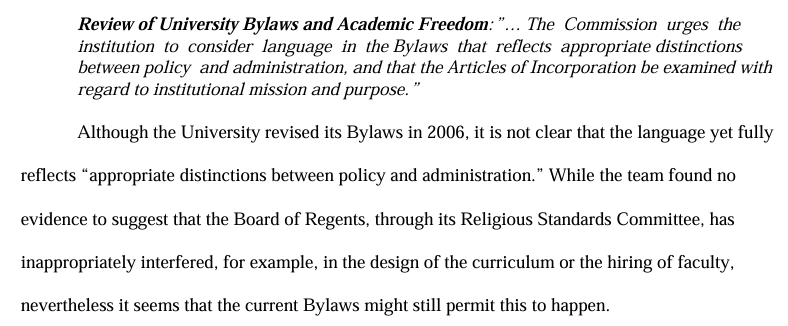
A section of a 2010 report regarding Pepperdine’s bylaws and academic freedom written by a Western Association of Schools and Colleges (WASC) visiting team.
A 2010 report by a WASC visiting team noted that the language in the 2006 bylaws’ section on the Religious Standards Committee could allow for inappropriate interference in the design of curriculum of the hiring of faculty, in accordance with WSCUC accreditation principles. The language surrounding the Faith and Heritage Committee’s authorities in the 2020 bylaws are identical to that of the Religious Standards Committee in 2006.
Regents have interpreted the Faith and Heritage Committee’s powers to constitute involvement in the selection process for the Religion and Philosophy Division’s divisional dean, unlike other undergraduate divisions, according to previous Graphic reporting. The Board exercised this power in spring 2024, to the alarm of some Seaver faculty.
The bylaws also empowered the Faith and Heritage Committee to establish Waves Church in 2023, according to previous Graphic reporting. The committee asked then-regent Alan Beard, who was vice chair of the committee at the time, to help lead the church’s formation.
Articles 4 and 5: Meeting Procedures and “Members”
The fourth article, titled “Meetings,” outlines the Board’s meeting procedures, including quorum and adjournment requirements.
The Board of Regents may meet anywhere in or outside California as designated by the Board, but in general, they meet on Pepperdine’s Malibu campus. The regents normally meet in the Seaver Board Room on the fourth floor of the Thornton Administrative Center, according to Pepperdine’s website. With approval by the chair, regents may also participate remotely through electronic means.

The sun shines through the windows of the Seaver Board Room, the meeting place of the Board of Regents. Photo courtesy of Pepperdine University
The Board holds regular meetings, the dates of which aren’t codified in the 2020 bylaws, but have historically been held quarterly in September, December, March and June, according to previous Graphic reporting and a draft of the 1978 bylaws which specifies the dates. The June meeting, called the “annual meeting,” is when the Board typically elects regents and officers, according to the 2020 bylaws. The Board chair may also call a special meeting at any time.
One-third of all regents, and no less than eight total, constitute a quorum, the number of regents needed to transact business.
The fourth article also outlines the Board’s “interested persons” policy, in which no more than 49% of regents may be an “interested person.” This is defined as anyone compensated for services related to Pepperdine within the past year outside of “reasonable compensation paid to a regent as a regent” or certain familial connections.
Alan Beard left the Board after his wife, Sharon Beard, was named interim vice president of Student Affairs in June 2025, according to previous Graphic reporting.
The fifth article, titled “Members,” outlines the regents’ legal role in Pepperdine as a corporation.
Article 6: Board Officers
The sixth article, titled “Board of Regents’ Officers,” describes the roles of the Board’s overall chair, one or more vice-chairs, secretary and assistant secretary. Regents annually elect each officer by a majority vote.
The chair, required to be a “member in good standing” of a Church of Christ congregation, presides over meetings, serves as an ex officio member of all committees and proposes nominees for committee appointments. The vice-chair or vice-chairs are responsible for fulfilling the chair’s duties if the chair is unable to do so.
The secretary is responsible for keeping meeting records, including written reports and minutes of committees, among other related duties.
Article 7: University Officers
The seventh article, titled “University Officers,” outlines specific duties of five senior administrative roles: president, chancellor, vice presidents, provost and chief financial officer (CFO).
The Board is responsible for appointing the president, though the precise procedure — historically through a presidential search committee — is not codified in the bylaws. Subject to control by the Board of Regents, the president has “general powers of supervision and control over the business, financial and all other affairs of the University” and holds “primary responsibility” for the administration of Pepperdine. The president, like the chair, must be a “member in good standing” of a Church of Christ.
If the president is absent or otherwise unable to fulfill their duties, the Board can appoint another individual to act as the president.
The president may appoint the chancellor, who advises the president and has “major responsibility” for development and representing Pepperdine in the community. The president may also appoint any vice presidents, including executive and senior vice presidents, one or more provosts and a CFO.
The president’s selection of most roles are done through simple appointments. In 2021, President Jim Gash appointed Biology Professor Jay Brewster as provost after initiating a nationwide search and a provost search committee co-chaired by Tim Perrin, vice president for strategic implementation, and Hispanic Studies Professor April Marshall, according to a Pepperdine news release. The provost is primarily responsible for overseeing and directing academic programs across Pepperdine’s six schools, including academic development and faculty recruitment.
Articles 8, 9 and 10: General Provisions, Emergency and Amendment Procedure
The eighth article, titled “General Provisions,” outlines several Board policies, including outside auditing and the creation of annual financial reports, execution of documents, regent compensation, conflict of interest, stocks and indemnification of regents by Pepperdine.
The ninth article, titled “Emergency Bylaws,” outlines alternative Board procedures in the case of an emergency that prevents a quorum of the Board — one-third of regents or no fewer than eight — from convening. The article lists natural disasters, enemy attacks on U.S. soil, terrorism or a government-declared state of emergency as examples of emergency scenarios.
One-fourth of the regents can transact business without the rest during an emergency, and the executive vice president, provost and chancellor may be deemed regents to achieve a quorum.
The tenth article, titled “Amendment Procedures,” describes how amendments and the repealing of Pepperdine’s bylaws required a vote of 75% of all regents.
Changes Throughout the Gash Era
Since its formation in 1976, Pepperdine has intended for its Board of Regents to consist of 40 members, according to a draft of the 1976 bylaws and articles of incorporation. The articles of incorporation and its amendments are filed with the California Secretary of State and are public records; the articles legally document the creation of a corporation, according to Investopedia.
But that number hasn’t always maintained over time. The Board of Regents’ membership dipped below 40 several times during the Andrew K. Benton presidency, according to annual president’s reports from that time.
The Amended and Restated Articles of Incorporation of Pepperdine University, filed with the California Secretary of State on July 11, 2006. The articles of incorporation were later amended in 2021 and previously amended in 1980, 1978 and 1976, according to public records available through the California Secretary of State.
The total number of regents dropped from 39 to 34 during the Board’s annual June meeting in 2019, as the transition from Benton to Gash was taking place, according to a 2019 news release. By January 2021, the membership dipped to 29, according to an archived Pepperdine web page.
Infographic by Henry Adams
That month, Pepperdine filed an amendment to its articles of incorporation which changed its language to indicate the Board of Regents’ membership “shall be no less than one” and “no more than forty.” Today, there are 21 regents — about half of its initial headcount — out of which 13 had been serving prior to Gash’s administration, according to analysis by the Graphic.
Pepperdine’s Board of Regents also amended their bylaws to incorporate this change sometime between June 2021 and June 2022, according to a mandatory disclosure on the University’s Form 990 for the fiscal year ending July 2021.
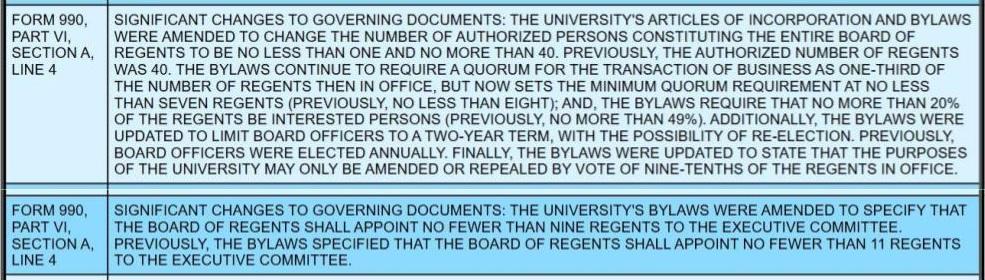
Explanations of “significant changes” made to Pepperdine’s governing documents disclosed in the University’s Form 990 for the fiscal years ending July 2021 (top) and ending July 2022 (bottom).
In that same time period, the Board of Regents amended its bylaws to decrease its maximum proportion of “interested persons” on the Board from 49% to 20%, according to the disclosure. The new amendment also introduced two-year terms for Board officers — such as the chair — with the possibility of re-election, as opposed to holding office until resignation or removal by default, and updated the bylaws’ amendment procedure’s vote to require 90% of regents, as opposed to the previous 75%.
The quorum was also reduced to no less than seven regents, one less than the 2020 bylaws require.
Sometime between June 2022 and June 2023, the Board of Regents amended their bylaws to specify the Executive Committee should appoint no fewer than nine regents, as opposed to no fewer than 11, according to the University’s Form 990 for the fiscal year ending July 2022.
It’s possible there may have been other changes between the 2020 amendment and today not deemed “significant” and therefore not disclosed in Pepperdine’s Form 990s.
__________________
Follow the Graphic on X: @PeppGraphic
Contact Henry Adams via X: (@henrygadams) or by email: henry.adams@pepperdine.edu