
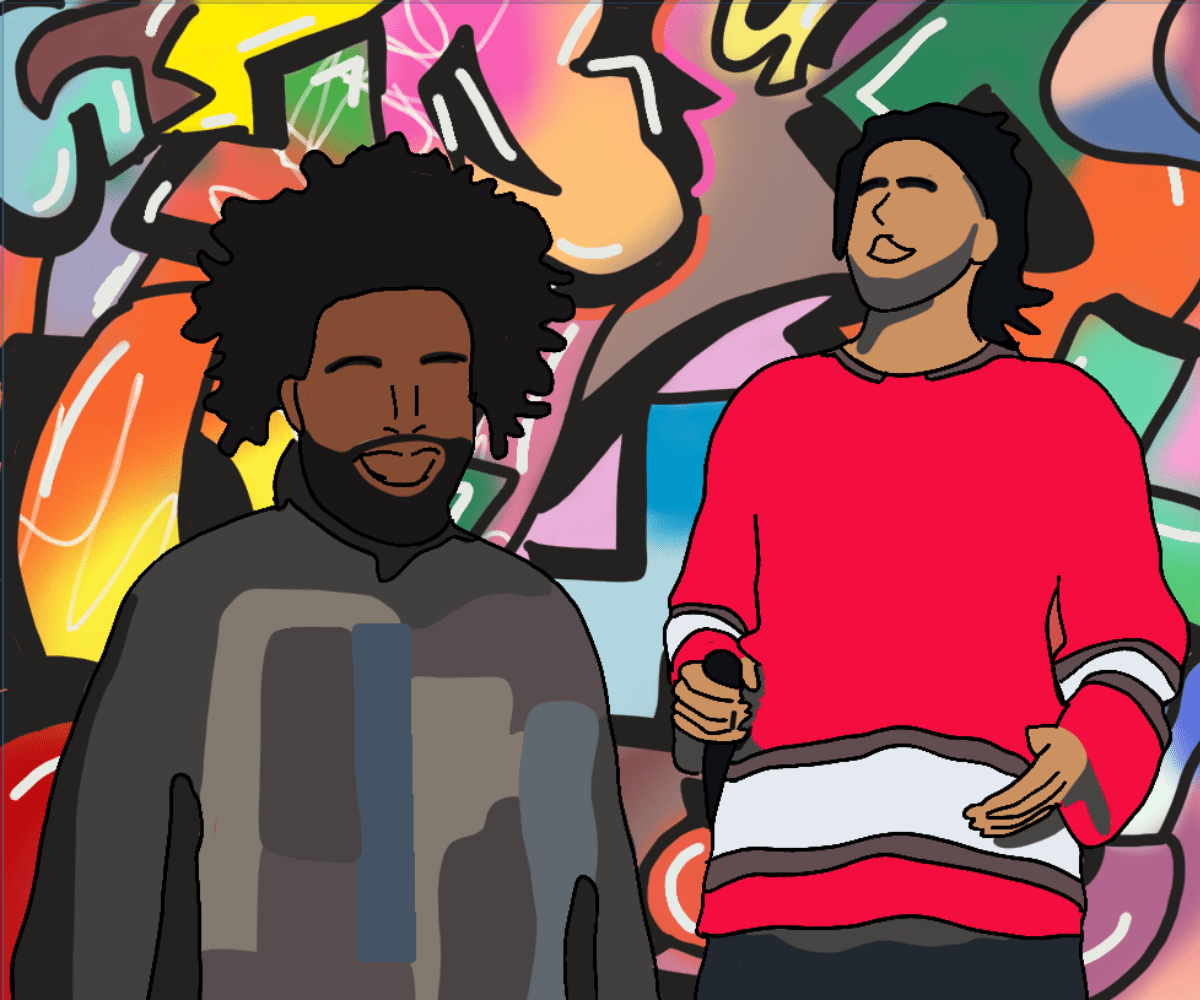
Art by Sofia Cifuentes
Transparency Item: The Perspectives section of the Graphic is comprised of articles based on opinion. This is the opinion and perspective of the writer.
“Inevitably, hip-hop records are treated as though they are disposable/They are not maximized as product even, you know, not to mention as art.”
Those words close out the intro of hip-hop band The Roots’ 1999 album, “Things Fall Apart.” In a time before the ringtone era — far before the TikTok era — one of the most artistic groups in the genre was clear about the state of hip-hop music.
This decade, good albums have been hard to come by in the genre. It’s not like there haven’t been good albums, there definitely have — “Learn 2 Swim” by Redveil, “Adjust to the Game” by Larry June, “Few Good Things” by Saba and more — but the broader focus of the genre seems to be on hit singles and viral songs rather than the album.
When I was a child, from the early 2000s up until the 2010s, hip-hop was dominated by catchy singles and choruses perfect for cell phone ringtones.
“Things Fall Apart” came out before I was born, and I have no real memory of the ringtone era outside of being a child at the tail end of it.
In the 2010s, the genre collectively seemed to shift to a focus on technical rapping ability, the production blended elements of older hip-hop and other genres and the topics were far less materialistic than the decade preceding it. I call this the genre’s Renaissance.
With the emergence of TikTok in 2016, and a natural decline of the Renaissance era, hip-hop blended the elements it had gained from the previous era — notably alternative, genre-bending exploration — with the catchy hooks and instrumentals that dominated the 2000s. I call this the TikTok era. This era has been observed in online discussions as well.
I came to hip-hop consciousness in the genre’s Renaissance: J. Cole and Kendrick Lamar had emerged as the new faces of the genre, the mixtape era had brought a focus on putting the quality of music back on the pedestal and rappers were going back and forth over lyricism and flow — the fundamentals of the genre.
In the years that followed, hip-hop began to focus more on instrumentals and the overall music, and trap rap dominated the mainstream. Simultaneously, the artists from the Renaissance era continued to flourish and release some of my favorite albums from the decade, with a more mature touch than their earlier work — “4 Your Eyez Only” by J. Cole, “Some Rap Songs” by Earl Sweatshirt and “4eva is a Mighty Long Time” by Big K.R.I.T, to name a few.
However, towards the end of the Renaissance era, the value of the album had begun to decline.
We could be due for a new era. While TikTok seems to be alive and well, hip-hop music seems like it’s not as focused on “TikTok-ready” music, not like how it was three to five years ago. Like the genre’s Renaissance, the future is unclear.
There are plenty of veterans still putting out quality music, and up-and-coming artists show plenty of potential. However, there’s no clear “next one up.” The situation is oddly similar to the early 2010s.
As a fan of the genre — who is also anticipating a new era of hip-hop — I urge my fellow fans: Don’t forget about the album.
Albums keep hip-hop music from being disposable. It’s no secret polished songs from polished albums tend to have more replayability, and a cohesive, developed feel makes listeners come back to find more.
Fast fashion’s cousin — fast music — is alive in hip-hop. As listeners, it’s our responsibility to show how much we appreciate quality.
Hip-hop will likely continue regardless of the album’s success. In a bizarre — but completely possible — future where rappers hardly release albums, music will still come out and the culture will probably carry on beyond just the music. But don’t overlook the impressive history and heritage of albums in the history of hip-hop.
Don’t forget about the album.
__________________
Follow the Graphic on X: @PeppGraphic
Email Nick Charkhedian: nareg.charkhedian@pepperdine.edu or via Instagram: @nickcharkhedianjournalism