
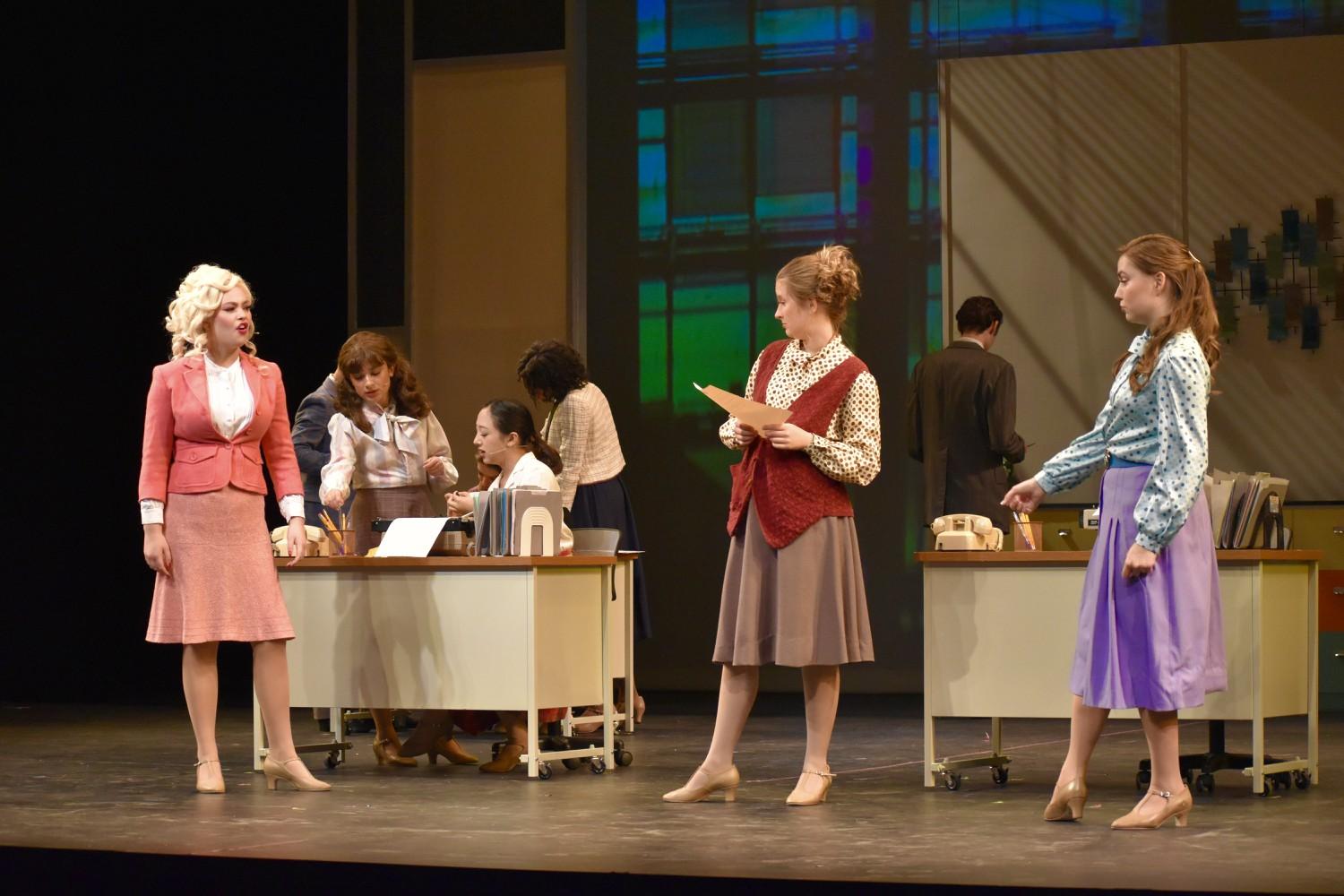
Theatre students perform “9 to 5: The Musical” for a November 2024 dress rehearsal in Smothers Theatre. The show, directed by Theatre Professor Kelly Todd, is about a group of women who rise up against sexual harassment from their boss. File photo by Mary Elisabeth (’25)
Months of work go into producing Pepperdine’s Theatre productions each year. But before auditions even begin, the Theatre Program spends months trying to determine its next lineup of shows.
The process involves figures from across the University: students, staff, faculty and — in some instances — administrators come together to decide on the season. Though administrators’ involvement has historically led to preemptive censorship of productions on the bases of profanity or LGBTQ+ portrayals, the Theatre Program has still been able to produce a wide range of shows that address themes of social change throughout the years.
“We want to put forward things that excite us as a department and that we think is educationally correct for our students,” Theatre Professor Kelly Todd said.
Season Selection Committee
Every year, the Theatre Department determines its upcoming slate of productions through the Season Selection Committee, made up of Theatre faculty, staff and three student representatives, Theatre Professor Hollace Starr said. The Committee typically meets at least four times a year and announces the next academic year’s shows before the spring semester ends, allowing time for auditions to begin.
Each season, there are typically four shows produced by the Theatre Department: a fall and winter play, typically performed in the smaller black box Lindhurst Theatre, and a fall musical and spring play in Smothers Theatre. On top of these shows, the Committee also discusses the Music Department’s annual opera and senior directing theses, Starr said.
There are five Theatre faculty, including Starr, who are in regular rotation for directing the Department’s productions. When planning out a season, the Committee already has a good idea of which season slot each professor will direct for, Starr said. Those professors are tasked with launching the Committee’s conversation around the slot they’re directing for.
When selecting its shows, the Committee considers learning outcomes for students involved in the productions and tries to ensure they’re not skipping over major categories of theatre for long stretches of time, Starr said.
“We try to account for, ‘What have we done recently?’” Starr said. “’What have we not done in quite a while? What’s happening in contemporary American theatre, theatre globally?’”
The Committee is also responsible for obtaining performance rights for each show, Starr said.
The student representatives are on the Committee mainly to bridge the gap between students and faculty, said Kysiah Tapia, junior Theatre and Screen Arts major. She became a student representative this academic year after faculty nominated her and fellow students voted for her.
“There’s sometimes things that we just bring to their attention that the students are wanting, but they [faculty and staff] weren’t necessarily aware of,” Tapia said.
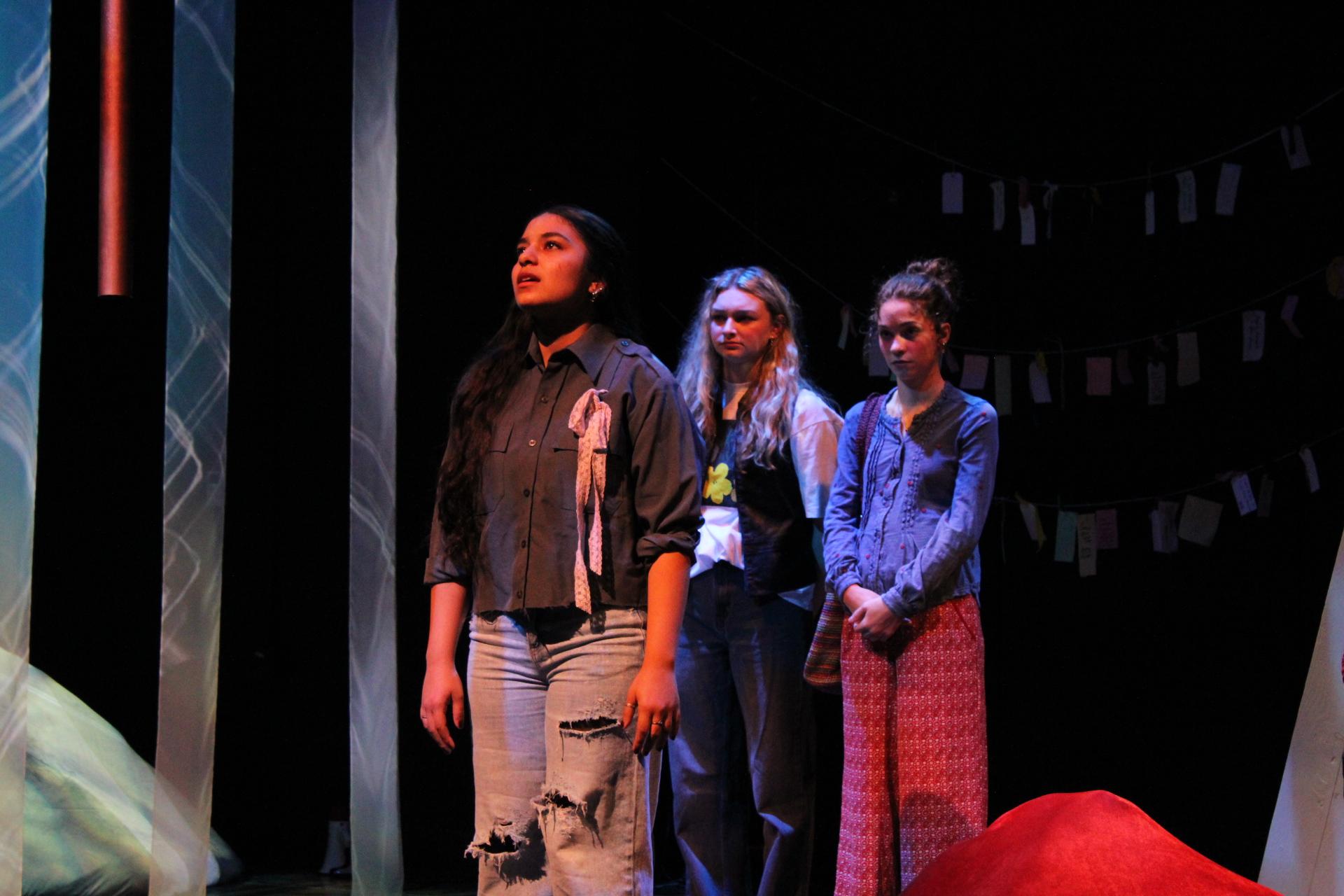
Kysiah Tapia (left), junior Theatre and Screen Arts major, plays Lily during a January dress rehearsal of “no one is coming to save us” in Lindhurst Theatre. Theatre Professor Hollace Starr directed the show, which addresses climate change. Photo by Clementine Metz
Grace Sardar, senior Theatre major with a Directing emphasis, said faculty and students sometimes have to balance their preferences during show selection.
“Sometimes it swings one way and sometimes it swings the other,” Sardar said.
Sardar directed her thesis show, “The Half-Life of Marie Curie,” at the end of February. She said she was “super happy” with the show and ultimately loved how it turned out, but her initial choice was to direct an original script she wrote while studying abroad in Buenos Aires her sophomore year.
“There’s been a need for original work in our department,” Sardar said.
Speaking generally, Todd said original scripts aren’t produced because of the time it would take for the Program to help students strengthen their work.
“It’s hard for us to use a script that is not a strong, solid script for one of our shows,” Todd said.
Center for the Arts
The Theatre Department crosses over with the Center for the Arts (CFA) in several ways, with collaborations between the two essential to producing Theatre productions.
For instance, because both Smothers Theatre and Lindhurst Theatre are venues operated by CFA, the Department works each year with CFA to book the spaces in advance, Starr said.
There are also CFA employees — namely, Technical Director Rick Aglietti and Scene Shop Foreman Stewart O’Rourke — who simultaneously work as adjunct Theatre professors.
“Some of us are through CFA and some of us are through Pepperdine [Seaver College], but we’re all collaborators,” Starr said.
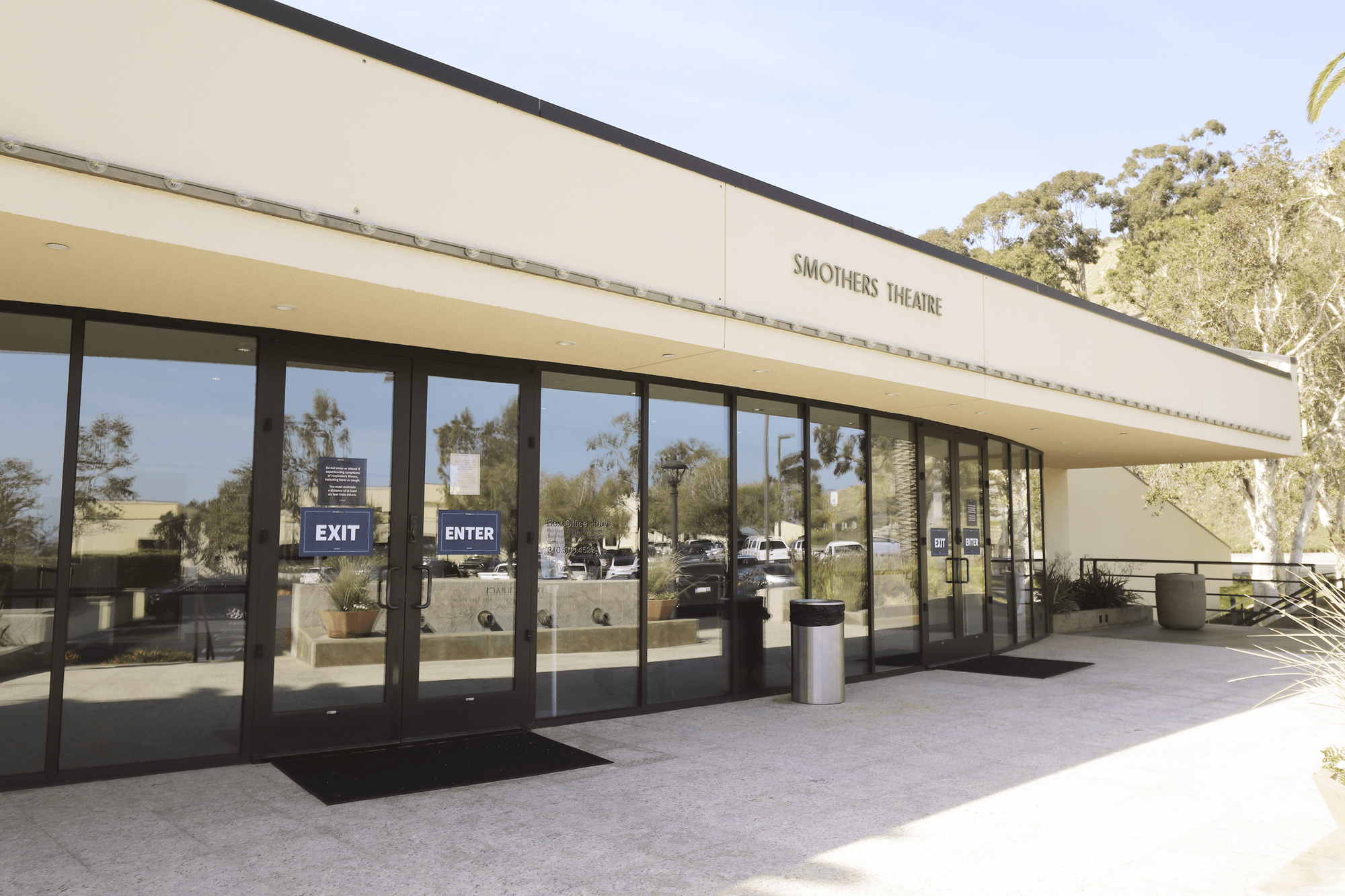
The sun shines on Smothers Theatre in April 2021. The Center for the Arts oversees Smothers, Lindhurst Theatre and Raitt Recital Hall. File photo by Ali Levens (’23)
CFA Managing Director Rebecca Carson, who’s responsible for booking and budgeting all outside performances at CFA, also sits on the Committee. Carson said her role is often to ask questions about what shows will work well with CFA’s audience.
CFA is under the purview of Advancement, an organizational structure that empowered Lauren Cosentino, vice president for Advancement and chief development officer, to censor artwork and shut down an exhibition in the Frederick R. Weisman Museum of Art in October. CFA hasn’t run into any trouble with Advancement over its performing arts programming throughout the 18 years Carson has been in her role, Carson said.
“It does not feel like we seek approval from her [Carson],” Starr said.
Outside performances at CFA acknowledge “standards of conduct” in their contractual agreements with CFA, which includes language disallowing “excessive profanity,” “excessive references to sex” and “language that demeans and exploits women or any racial or minority groups,” according to a portion of a guest performer contract Carson shared with the Graphic.
The Institutional Mission
In contrast, the Theatre Department is not bound to a formal set of guidelines surrounding content they can and cannot include. However, the Committee “deeply” considers Pepperdine’s Mission, Vision, and Affirmation Statement when discerning what shows will work best for Pepperdine’s audience, Theatre Professor Cathy Thomas-Grant said.
“We take seriously the Christian mission and we are not out to just rattle cages,” Thomas-Grant said.
That mission can mean different things to different people. Todd, who directed and choreographed “9 to 5: The Musical” in fall 2024, said Pepperdine’s values of purpose and service are important to her work.
Thomas-Grant, who has taught at Pepperdine since 1995, said one way she carries out the mission is by portraying the experiences of marginalized people on the stage. Her interpretation of the Christian mission also aligns with one of the Theatre Program’s learning outcomes: “Articulate the ways in which theatre serves as an agent of social change.”
Social change has figured prominently in the Program’s shows over the years. For example, this semester’s “no one is coming to save us” dealt with climate anxiety, spring 2023’s “Americana: A Murder Ballad” addressed gun violence in American schools and spring 2017’s “The Interference” commentated on the realities of sexual assault.
“It’s important to have shows now and then that do address these things [social change and social justice], not only for humanity and an educational sense, but also to expand our understanding as artists because we are portraying the human condition,” Thomas-Grant said. “And I’m sorry, the human condition at times is not pretty.”
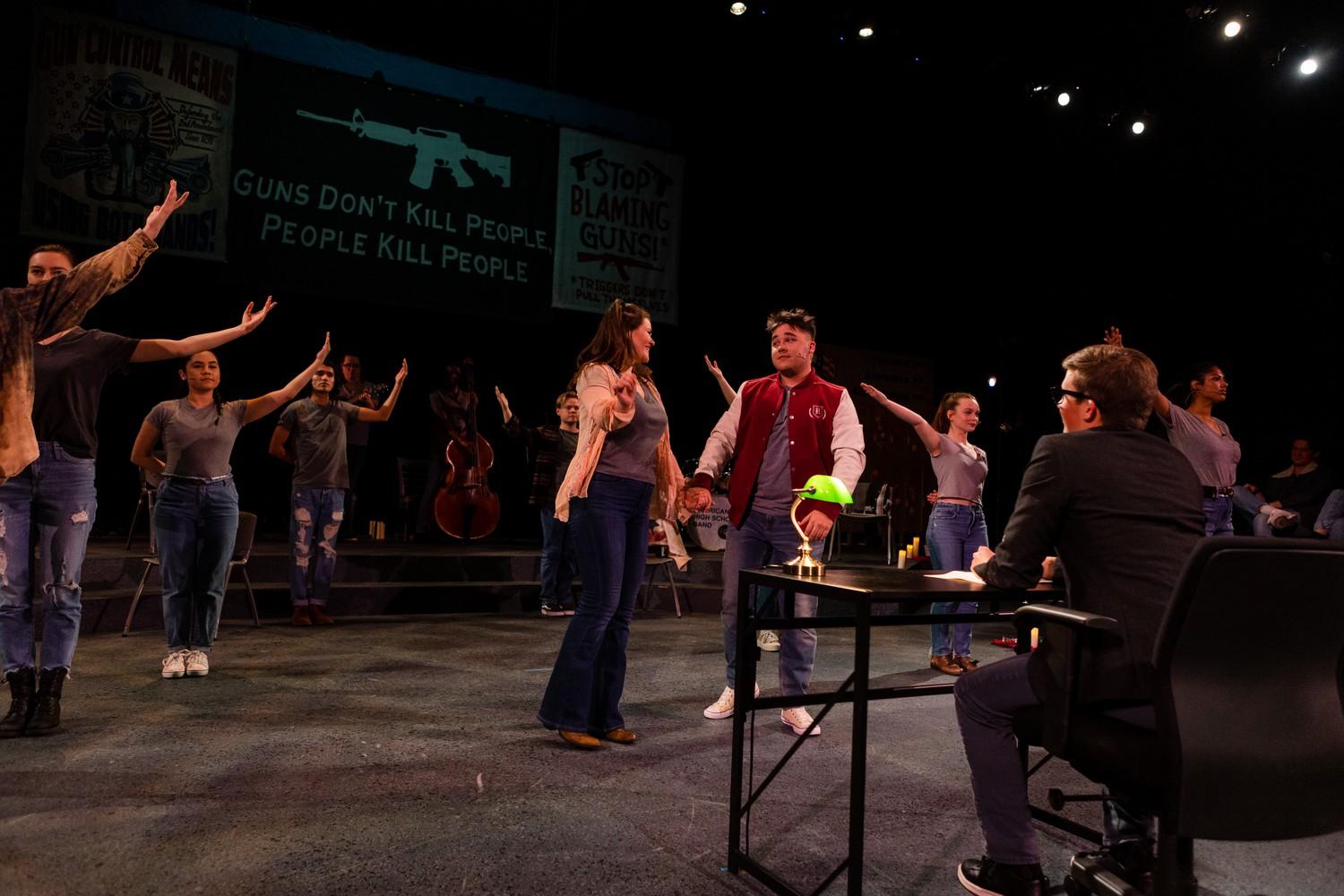
Students perform “Americana: A Murder Ballad” for a dress rehearsal in Smothers Theatre in April 2023. Theatre Professor Cathy Thomas-Grant directed the show, which she said fit into her interpretation of Pepperdine’s Christian mission. File photo by Lucian Himes (’23)
When it comes to prominently-featured LGBTQ+ themes, however, the Program has faced resistance from administrators.
Thomas-Grant said she was the chair of the Fine Arts Division during the season selection process that led up to the spring 2008 performance of “The Laramie Project,” a show about the 1998 murder of gay college student Matthew Shepard. She met with Seaver Dean W. David Baird and Provost Darryl Tippens to get permission to do the play.
Conversation over the play with administrators, which later included then-President Andrew K. Benton, resulted in an agreement: the Program could perform the show so long as there were disclaimers about its content, including profanity, present in advertising for the production, Thomas-Grant said.
“What I relayed to them is, ‘We can’t change the language because we have signed a contract,’” Thomas-Grant said. “And if we are going to stick by our academic integrity statements at Pepperdine, we have to honor those contracts.”
During his time as Fine Arts Divisional Dean, Theatre Professor Bradley Griffin would meet with Seaver Dean Michael Feltner, and later Seaver Dean Lee Kats, to share the list of plays the Program planned to present for the next academic year’s season before they were announced, Griffin wrote in a March 16 email to the Graphic.
During the season selection process that determined the fall 2023 musical, which Todd directed, the 1975 show “A Chorus Line” was initially considered by the Committee, Griffin wrote. The Dean’s Office asked the Program to reconsider the show, pointing out concerns about the show’s language and a gay character’s coming out monologue, which the Dean was concerned would not sit well with the audience. The Program produced “The Music Man” instead that year.
A similar instance occurred with the show “Stop Kiss,” where the Dean objected to the portrayal of a same-sex kiss on stage, Griffin wrote. The show would’ve been performed during the 2023-2024 season.
A University spokesperson referred the Graphic to the Seaver Dean’s Office for comment. The Dean’s Office did not respond.
__________________
Follow the Graphic on X: @PeppGraphic
Contact Henry Adams via X: (@henrygadams) or by email: henry.adams@pepperdine.edu