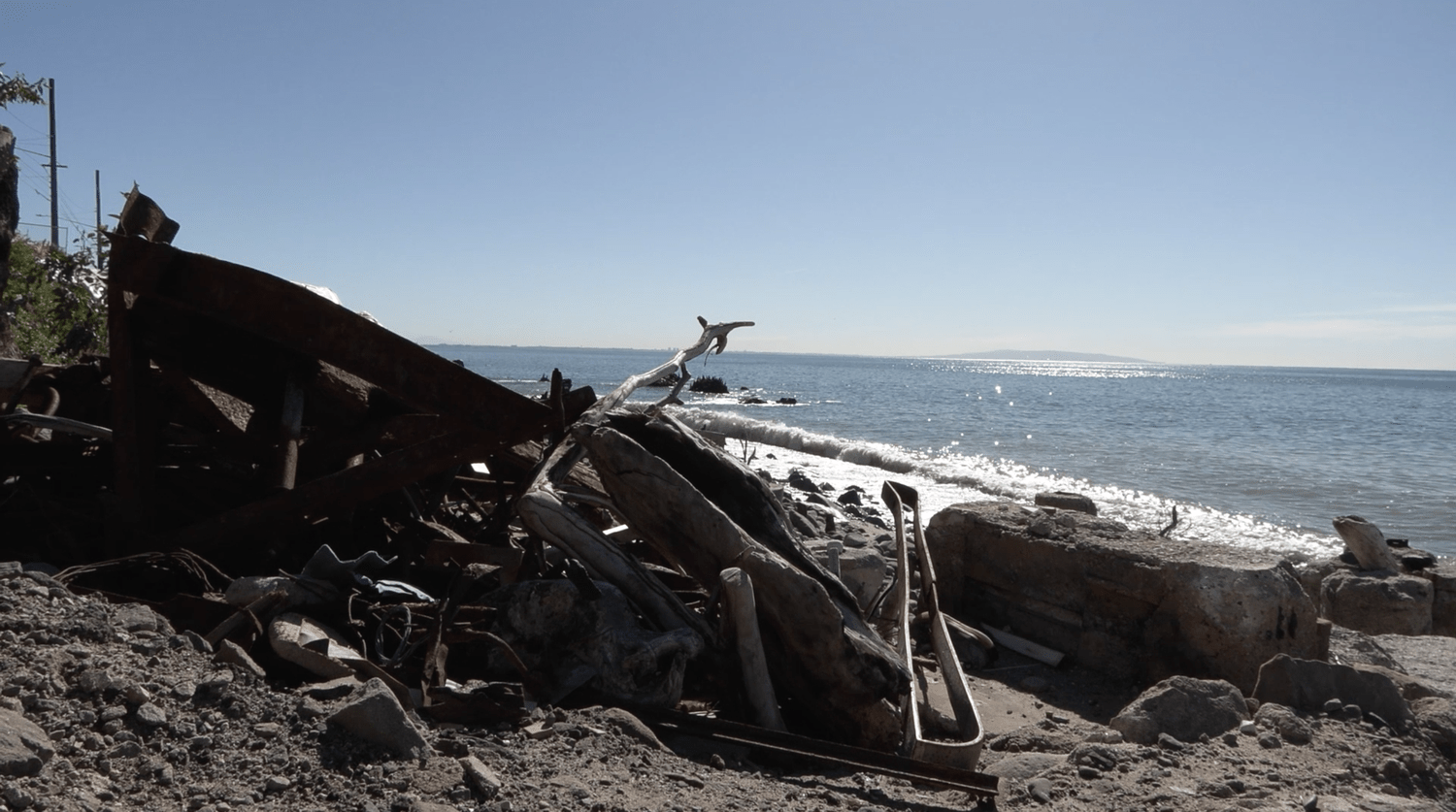
A pile of debris collected by Malibu resident Darren Graves lies at Big Rock Beach, where his family home was lost in the Palisades Fire. He said he has been clearing the shoreline since March 2025, but more than a year later, debris continues to resurface. Photo by Nicolle Castro
The water looks calm again after the rain: smooth and almost clean — but is it really? For some, that uncertainty is enough to keep them out of the water and prompt action.
After the fires, Malibu residents said they are navigating a new reality shaped by fear, uncertainty and a growing sense of responsibility. Questions about water quality resurface with every rainfall, as debris washes ashore and pollutants move unseen beneath the surface. With no clear end in sight, these lasting risks are reshaping how people live and how they return to the ocean.
“Your eyes can only see so much,” junior Jackson Cottrell said. “So in my brain, I’m fine, right? But how much fire debris and construction and everything can you not see?”
For some Malibu residents, the real concern begins after the skies clear, raising new questions about when it is safe to return and what might still be lingering beneath the surface.
After Heavy Rains
Cottrell said waiting three days before going into the ocean after heavy rain seems to be an unspoken rule among Malibu residents. Since the fires, that hesitation has only grown, making the return to the ocean more complicated.
Cottrell, a devoted surfer, said he typically goes to the beach three to four times a week to catch waves. But after the Franklin and Palisades fires, he has avoided the water altogether. When he returned in the fall, Cottrellsaid he could see pollution with his naked eye.
“Not even detritus, because it wasn’t organic,” Cottrell said. “It was from houses and things.”
Since then, Cottrell said he has avoided eastern Malibu beaches, which were more heavily affected, and now sticks to areas like Broad Beach and Zuma Beach. Still, he worries rain can carry pollution even there.
“It was so small that if I went into the water, there’s a chance I could have swallowed some, or it could have gotten into my skin,” Cottrell said.
Heal the Bay scientists found higher levels of pollutants in the ocean after it rained, said Annelisa Moe, associate director of science and policy at the environmental nonprofit. Researchers refer to this as a “pulse effect,” where pollution spikes after storms.
Although the invisible risks of water pollution remain a major concern for Malibu residents, fire debris continues to wash ashore. Darren Graves, whose family home in Big Rock Beach is currently in the engineering phase of rebuilding, said he has been dealing with the remaining debris firsthand.
Since March 2025, during each visit to the remains of his property, Graves said he has added to a growing pile of twisted metal, burned fragments and debris that the tide carried in. Graves has collected more than 600 pounds of debris, and with every rainfall, more material resurfaces.
“We thought we were done in July, August, when all the debris was cleared,” Graves said. “Then the winter storms came through, and the sand level dropped.”
Shifting sand and low tides expose more buried debris along the shore, Graves said. While the pieces washing ashore are smaller than they were in the months immediately after the fires, Graves worries they still pose risks to both people and marine life.
“If somebody came out here and didn’t know that there were pieces of steel and sharp metal objects in the sand, and they were barefoot, they could cut themselves and get tetanus,” Graves said. “So that’s a problem.”
The Invisible Threat
After the fires, rain — once a relief in Malibu’s dry climate — is now the factor that most concerns some scientists. Runoff carries ash, debris and toxic remnants from burned homes into the ocean, introducing contaminants largely unseen from the surface; as that polluted runoff settles, the contaminants sink and accumulate on the ocean floor, where they can persist long after the water appears clearer, Moe said.
“I am also worried about contamination settled on the ocean floor that could be resuspended,” Biology Professor Florybeth La Valle said.
La Valle, a coral reef ecologist, said these pollutants threaten phytoplankton and kelp — organisms that form the foundation of the marine food web — by reducing the sunlight needed for photosynthesis.
“When chemicals dissolve, there is less photosynthesis,” La Valle said. “Murky water can block the sunlight they need to survive.”
Besides that, pollution coming from debris can reach our plates through the food chain. Unlike bacteria, heavy metals don’t dissipate — they accumulate as they move up the food chain, a process known as bioaccumulation, Moe said.
Over time, that means pollution introduced after a single storm can reach fish and eventually, humans, La Valle said. In more severe cases, the disruption can extend across entire ecosystems.
How Long Will the Damage Last?
There is no clear timeline for when Malibu’s beach ecosystems will fully recover, La Valle said. The process could take a decade or more, noting the environment has not yet recovered from the 2018 Woolsey Fire. With climate change shortening the time between fires, full recovery is even harder to predict.
Still, there are signs of hope. Moe said she believes nature can begin to heal if people avoid leaving trash behind and take greater care of the environment.
“Life is miraculous,” Moe said, “We are already seeing dolphins and sea lions returning to areas they had once avoided.”
That sense of responsibility is shared by residents like Graves, who continues to confront the impact of the fires firsthand. As rebuilding moves forward, he said he believes the health of the environment depends on everyday actions the community takes.
“If you see a piece of trash, pick it up,” Graves said. “If you see a piece of heavy trash, pick it up. If you see a piece of corrosive debris, wear gloves and pick it up.”
___________________
Follow the Graphic on X: @PeppGraphic
Contact Nicolle Castro via email: nicolle.assumpcao@pepperdine.edu