
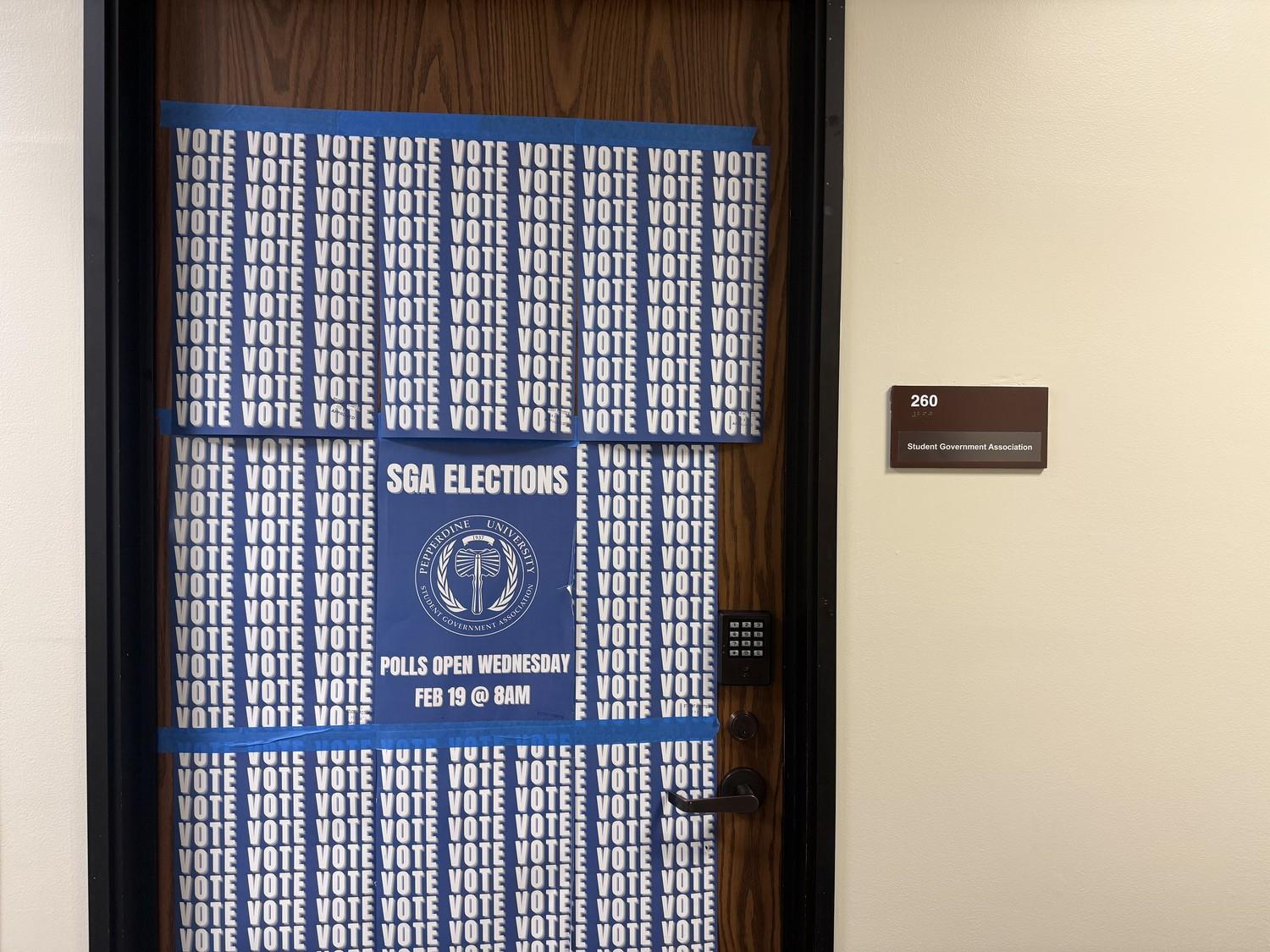
Flyers with the word “vote” repeated cover the door to the Student Government Association’s executive office Feb. 26. The first elections are on March 25. Photo by Sophia Markle
Student Government Association elections will be underway next week. While candidates ask students for their signatures, SGA is working behind the scenes to prepare for the elections.
SGA elections are important for giving the students a voice, said Jacqueline Justiss, SGA executive vice president. It is crucial that students run for SGA this year, as well as vote.
“Making sure students feel involved is huge,” Justiss said. “Reaching new students who aren’t typically involved — that’s something I’d love to see continue.”
When Are Elections?
SGA elections operate on two timelines, Justiss said. First-year campaigning often begins in August and early September, and the Senate is solidified at the SGA retreat at the end of September.
Elections typically occur sometime between February and April for sophomores, juniors and seniors, Justiss said. This year, interest meetings begin in March, with elections scheduled for March 25.
The decision to hold this year’s elections in late March was to ensure SGA held town halls and committees prior to the elections, SGA President H.L. McCullough said.
“That way, if you were interested in running, you could get exposure and know what’s been happening internally with SGA,” McCullough said.
This delay will allow newly elected representatives time to shadow current officials before formally taking their new positions, Justiss said.
Qualifying to Run
Prior to campaigning, candidates must attend two meetings: a mandatory interest meeting and a candidates’ meeting, McCullough said. After that, they have approximately six days to collect their required number of signatures to campaign. Senators need around 30 signatures, and the executive board needs around 180 signatures.
McCullough said the signature process is more than qualification paperwork.
“It’s really that opportunity to go around and meet people,” McCullough said. “Jacqueline [Justiss] and I did it together last year, and honestly, that was some of the most fun I’ve had.”
Justiss said collecting signatures helps candidates build connections with students and hear their concerns.
Different Roles
Interested students can run for a senator position, class president or an executive position. The differences between positions shape both campaign requirements and expectations.
Class senators and class presidents are elected solely by their class, Senior Class President Julian Moghaddasi said. Executive board members are elected by the entire Seaver student body.
“That’s why you saw H.L. [McCullough] and I going to different fraternities, sororities and campus groups,” Justiss said. “You have to get exposure to the whole student body.”
Class presidents and senators serve as the voice of their class in Senate meetings, while executive board members act as a bridge between the administration and students, McCullough said.
“The executive board is employed by the University,” McCullough said. “Senators are expected to work about five hours a week. We [executive board members] hit anywhere from 10 to 28 hours a week.”
Moghaddasi said students should not hesitate to run for the specific position they are seeking because of competition or visibility and not to overthink the process.
“Just run for what you want,” Moghaddasi said.
Safeguards and Oversight
To maintain fairness, the General Judicial Council (GJC) oversees strict regulations over campaigns, McCullough said. The GJC is composed of senators, one executive board member and a director.
Justiss said there were several safeguards: all posters and social media posts must be approved, campaign spending may not exceed a certain amount — approximately $100-$200 — and no campaigning is allowed on voting day.
“We take violations very seriously,” Justiss said.
How Voting Works
SGA elections are now handled digitally through Google Forms, though they have been conducted with written ballots in the past, Justiss said. Polls remain open for 24 hours — typically from 8 a.m., on the official day of voting until 8 a.m., the following day.
Results are communicated to the winners within a few hours of polls closing, Justiss said. After representatives confirm their acceptance, the official results are emailed to the student body.
It is essential students vote, and every vote matters, McCullough said.
“We are a direct pathway to seeing change,” McCullough said. “SGA is the reason we have Starbucks on campus. It’s the reason for MLK Day. It’s the reason for a lot of things.”
SGA is rooted in servant leadership and motivation, and everyone should get involved in the SGA process, whether sitting in on meetings or running, McCullough said.
“Our meetings are open,” McCullough said. “If anyone wants to know what we do, I’ll get coffee with them.”
Looking Ahead
SGA must continue evolving alongside the University, both Justiss and McCullough said.
“Pepperdine has a hard time retaining attention for long periods,” McCullough said. “Future boards need to make sure SGA’s reputation is strong and that students want to be involved.”
With elections around the corner, Justiss and McCullough said they hope transparency, outreach and competitive races will strengthen voter and candidate participation. Their message for students debating whether to run or vote is consistent: engagement matters. The impact a student can make in SGA often lasts far beyond one academic year.
___________________
Follow the Graphic on X: @PeppGraphic
Contact Sophia Markle via email: sophia.markle@pepperdine.edu