
Hanna Chu
Assistant A&E Editor
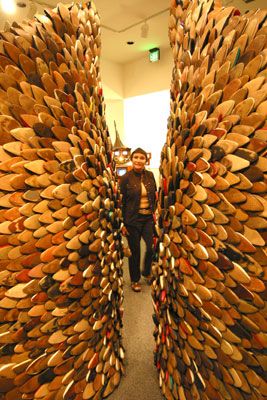 Les Christensen’s sculpture (Photo courtesy Graham Shea/Photo Editor)
The exhibit, “The Eclectic Eye: Selections from the Frederick Weisman Art Foundation,” fills the Frederick Weisman museum with a diverse collection of pop art from the 1960s to present and features various artists including Christo, Keith Haring, Nam June Paik, James Rosenquist and Andy Warhol — all artists who stood apart from the rest during their artistic careers.
Gigantic wings made of women’s shoes, bright cartoon-like orange carrots on the wall and a robot made of old TVs. These are among the many art pieces on display in the new exhibit.
One gallery is devoted to the artwork of Ed Ruscha, an artist who was recently honored at the Venice Biennial, a prestigious international exhibition in Venice, Italy.
Ruscha’s paintings are witty and ironic with his use of words in the pieces, said museum director Michael Zakian.
“We think of writing as something separate and painting as different,” Zakian said. “He kind of bridged the gap and made paintings based on billboards and advertising that he saw.”
One painting on display depicts a sunset. On top of the simple imagery is written “The End.” Another painting depicts a faraway view of a landscape stretched across a wide canvas. On the left side is written “ancient dogs barking” while the right side reads “modern dogs barking.”
Ruscha said he creates paintings with the attitude that art should have the sole purpose of making the artist happy and satisfied.
“Artists make mistakes when they think they have to communicate with people and come across with a message,” Ruscha said. “All they have to do is make pictures.”
Ruscha’s self-described pictures have been on display since July 30 in a nationwide tour with the rest of the collection. The entire exhibit will be on display in the Weisman Museum until Oct. 2.
The range of styles that are presented in the works on display demonstrate Weisman’s eclectic taste in art, Zakian said.
While some collectors collect only one style of art or one particular period, “[Weisman] collected art through the entire twentieth century,” Zakian said. “He liked to be surprised. He liked to see something that he never saw before.”
Museum visitors may also be surprised when they see the oversized dog made of foam break dancing in the center of the museum, or the equally oversized crushed can of Orange Crush mounted on the wall.
“I’m not a fan of art in general, but it’s a very good display,” said Devin Miller, a Malibu resident. “It looks like it was well thought out and well organized.”
Frederick Weisman’s widow Billie Weisman organizes the Weisman Art Foundation. She named this year’s exhibit “The Eclectic Eye,” because she said the phrase described his attitude and approach to art perfectly.
The works of art on display and more from Weisman’s collection also appear in a book titled “The Eclectic Eye,” which was introduced with this exhibit.
Although many other university galleries display smaller shows or less well-known artists, Zakian said “we’ve managed to get exhibitions that are on par with any of the big museums in town. For the students, it’s right here on your doorstep.”
One piece of art that is included in this exhibition is “Marilyn” by Andy Warhol, a piece of art that is so well-known it is immediately recognized by most museum patrons.
“All the pieces are so unique, and they’re like landmark contemporary art pieces,” said Kathy Millar, junior studio art major. “They’re so beautiful and individualistic.”
Zakian said students are encouraged to stop by the museum on their way to class, the Caf or the Sandbar to view the diverse artwork on display in the museum.
While modern society tends to appreciate electronic forms of artwork like film and television more than traditional artwork, Zakian said “there is still something to be gained from that different way of looking because it’s slower and more contemplative.”
Millar also urges everyone to visit the museum.
“You get a new perspective on things,” she said. “You can get a refreshing view of the individuality of each artist so it’s really cool.”
The Weisman Museum is open Tuesday through Sunday from 11 a.m. to 5 p.m. Admission is free.
08-29-2005