
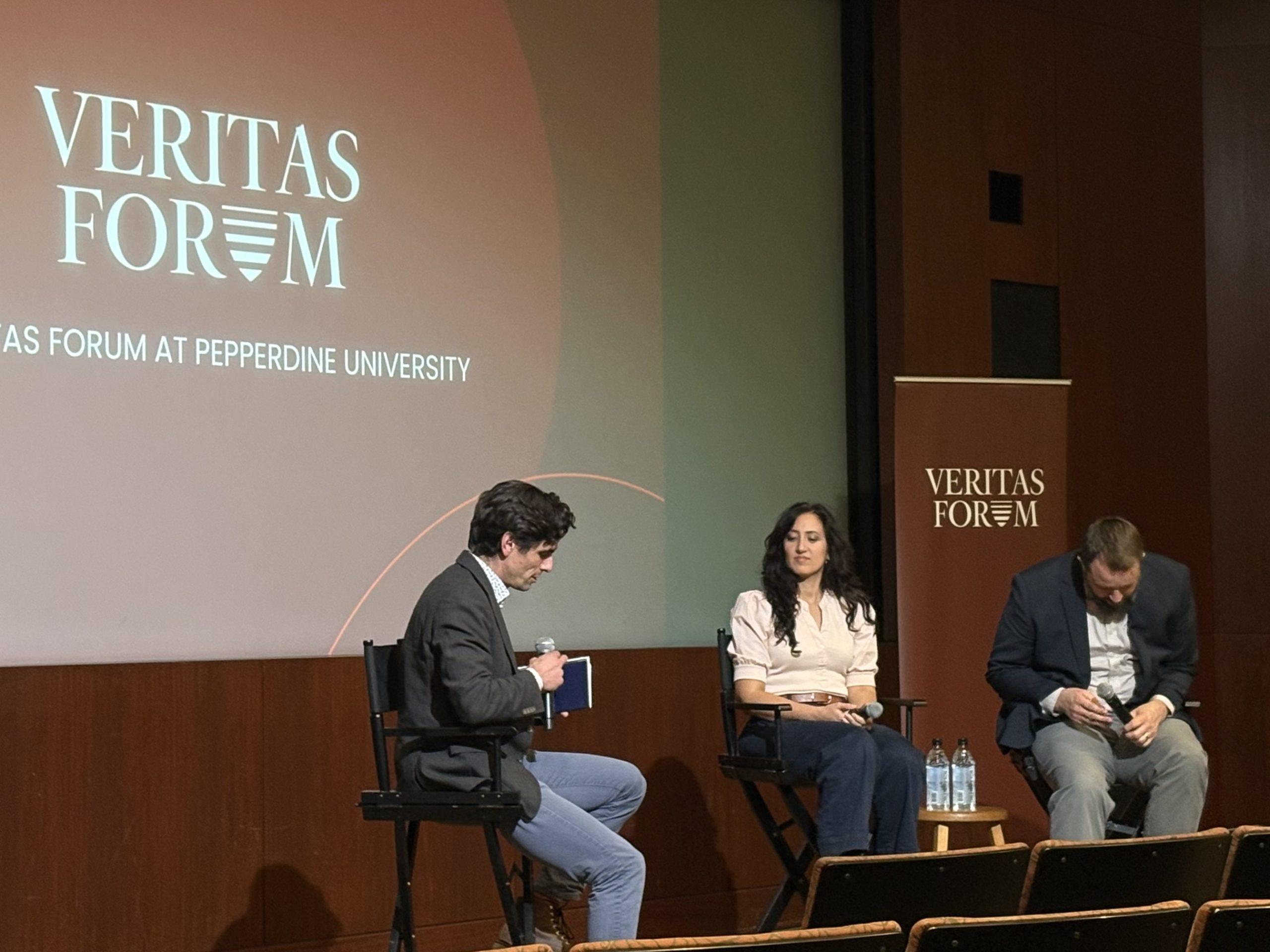
The 2026 Veritas panelists, Matthew Kaemingk (right) and Amanda Rizkallah (middle), sit with moderator Jonathan Koch (left) in front of a crowd of about 100 audience members in Elkins Auditorium on Feb. 17. Panel members shared personal stories and answered audience questions. Photo by Cristal Soto
At a time of deep division in today’s world, Pepperdine’s Veritas Club challenged attendees to reconsider what loving their neighbors truly means at the Veritas Forum on Feb. 17.
The annual Veritas Forum is a campus event hosted by Pepperdine’s Veritas Club that invites Christian scholars and thought leaders to engage life’s big questions through open dialogue. This year’s event featured Matthew Kaemingk, author and professor of Public Theology at Theological University Utrecht, in conversation with International Studies Professor Amanda Rizkallah. The two discussed how Christians may engage disagreement without abandoning conviction.
“When we encounter a difference, our shoulders come up, our teeth tighten, we make little fists, our hands get sweaty,” Kaemingk said. “And in those kinds of situations, we are rarely proud of how we respond.”
English Professor Jonathan Koch, who moderated the two-hour event, pushed the panelists to draw from personal experiences on how they navigated moments of conflict or disagreements.
Kaemingk spoke about navigating conversations about the ongoing conflict between Israel and Gaza between his Jewish and Muslim friends. Both friends urged him to publicly align with their positions on the matter. However, hospitality does not mean full agreement in order to create peace, Kaemingk said.
“I deeply love them,” Kaemingk said. “I hear their cries, and I have strong feelings about the issue myself. But this sense of, ‘I want to agree with their side,’ I can’t fully go with it.”
Similarly, Rizkallah shared her own personal account on how the conflict is affecting her, as the fighting has largely destroyed her family’s Christian village near the Lebanese border with Israel. In contrast, Rizkallah said her home in Los Angeles is largely Jewish, and conversations with her neighbors can be emotionally charged.
“It’s hard to have an authentic and honest conversation when it’s quite painful sometimes,” Rizkallah said. “And feel you don’t feel seen, don’t feel understood, you just feel like you’re banging your head against the wall.”
However, both panelists said they did not believe the answer to this turmoil means agreeing on everything.
“The goal is not unity,” Kaemingk said. “The goal is not consensus. We actually want those differences. It’s a question of how you navigate those differences.”
Kaemingk said today’s politics are deeply tribal.
“Politics today has much more to do with conflicting ways of life and conflicting tribes, and a belief that if the other side wins, my side of my way of life is in danger,” Kaemingk said. “There’s sort of this existential threat of ‘I need to vote on behalf of my tribe, my people.’”
Because of this, Kaemingk said he challenges Christians to rethink how they approach civic participation.
“We vote on behalf of our neighbor, not on behalf of ourselves,” Kaemingk said. “We put our neighbor first when we’re wrestling with different political issues or different candidates. We think about what would be best for our neighbors as opposed to what would be best for ourselves.”
There is a key difference between fighting with wooden swords and steel swords, as one is a way to contend with your opponent and the latter is to destroy them, Kaemingk said.
In the last portion of the event, Koch encouraged audience members to go to the front and ask the panelists questions. Several questions revolved around how to actually engage in these difficult conversations. Several students asked how those principles translate into real-life boundaries and decision-making.
The panelists further explained a Christian’s love and hospitality should be unconditional, just like Jesus’. However, that does not mean one should not have personal limits.
“Hospitality requires some kind of boundary, some kind of wall, some kind of law or limit,” Kaemingk said.
Rizkallah agreed, and said creating such boundaries in conversations takes time and practice.
“You’re overcoming a fight-or-flight response,” Rizkallah said. “That takes training, right? It’s not going to be your natural human inclination.”
Students in attendance said the conversation felt timely. Julisette Acosta, junior Political Science and International Studies major, said the forum highlighted the importance of humility in a polarized climate.
“Everything’s so polarized, and everyone feels like they need to stand for their side,” Acosta said. “You need to understand how other people think, even if you don’t agree with it.”
_________________________________
Follow the Graphic on X: @PeppGraphic
Contact Cristal Soto via email: cristal.soto@pepperdine.edu