Battle between landowners and the public over beach access goes on unresolved
By Michael Travis
News Editor
The Supreme Court recently refused to hear cases involving two California landowners, who had sections of their property taken to provide the public with beach access.
Many have said that the cases, Daniels v. County of Santa Barbara and Cole v. County of Santa Barbara, could have had a huge impact on the debate that has raged between private coastal landowners and the public for decades about the right to access beach property.
Private landowners say that they have a right to privately control coastline that they often pay millions of dollars to own. Public officials say that the beach is public property and that everyone has a right to enjoy it, regardless of who owns the land.
The problem occurs when governmental bodies such as the California Coastal Commission use their authority to confiscate sections of private land and convert them into easements that allow the public to access the beach.
The main point at issue between the two groups is a clause in the Fifth Amendment of the Constitution, which states private property cannot be taken for public use without just compensation.
“It’s not fair to the landowners,” senior Alana Strong said. “They pay so much for that land that they should get some kind of compensation.”
The first case, Daniel v. County of Santa Barbara, involved landowners who were pressured by the Coastal Commission to honor an easement pledge made by previous owners of the property almost 15 years earlier.
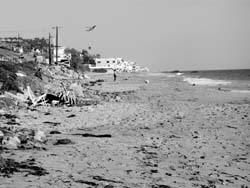 Lower courts, including the United States Court of Appeals for the 9th Circuit, held that the current owners had to honor the pledge to create 5-foot-wide path through their property.
The second case, Cole v. County of Santa Barbara, involved a similar situation where Commission declared imminent domain on a section of land that would be used to allow the public to access the beach.
The California Coastal Commission supported the recent refusal of the Supreme Court.
“This action is a victory for public access,” said Sara Wan, chairperson of the Coastal Commission, in a press release. “The decision affirms the law that a property owner cannot accept the benefits of a permit and then go back years later to try to undo the public access easement.”
One of the attorneys for the landowners, Carter Phillips, said that the commission was using an unusual two-step process to bypass the 1987 ruling. He claimed that landowners were pressured into making a future agreement about allowing public access to the land, and after the property was sold, the terms of the former agreement were applied to the new owners.
Carter expressed frustration at the Supreme Court’s denial of the case, and wrote in the filings that “(The court) should not blink … now when the effect will be precisely the same, uncompensated takings of property….”
The Supreme Court has repeatedly sided with landowners in past cases. The 1987 Nollan v. California Coastal Commission case has long been used as a guideline in determining the legality of such actions.
In the Nollan v. California Coastal Commission, the justices found that a state agency could not confiscate property without the landowner’s consent without first proving that public interest would be served by the action. They also cannot rely on landowners alone to pay for the public’s access to the beach.
A key point given in the opinion states that the Coastal Commission “is simply an expression of the belief that the public interest will be served by a continuous strip of publicly accessible beach. Although the state is free to advance its comprehensive program by exercising its eminent domain power and paying for access easements, it cannot compel coastal residents alone to contribute to the realization of that goal.”
Recently, however, the commission has been asserting its authority over coastal residents in an effort to meet its goals of preserving natural environments and allowing public access to beaches, as with its creation and certification of a Local Coastal Plan for Malibu.
There are other cases involving the use of coastal lands pending in the court system. The city of Malibu is filing several actions concerning the way it will be permitted to use its land, and record mogul David Geffen is suing over a proposed easement on coastal property he owns.
October 31, 2002