
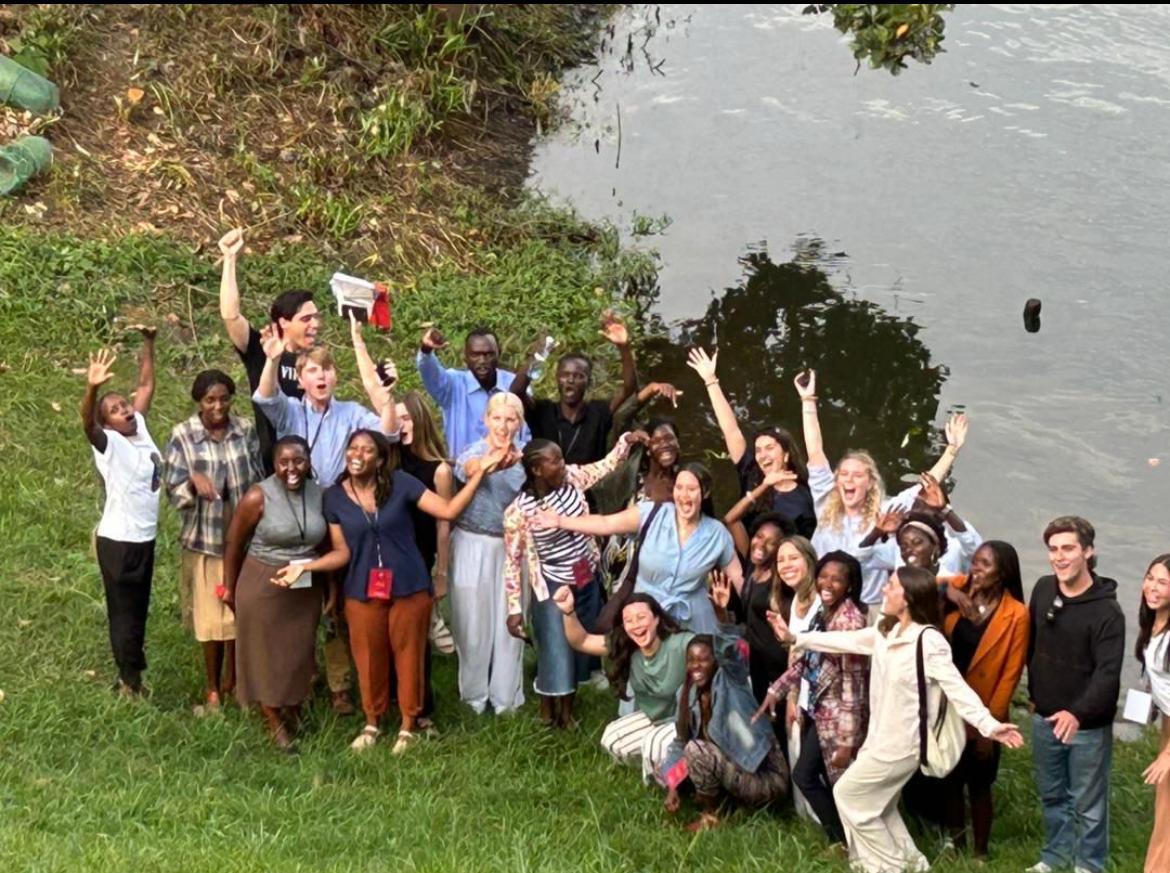
Pepperdine Sudreau Uganda-Rwanda Justice Program students, local Uganda Amazima students and faculty happily celebrate the baptism of Kat Johnston in the Nile River on June 17. Johnston said she was shell shocked by the offer and got baptized the same afternoon. Photo courtesy of Kat Johnston
Being immersed in a foreign culture while being guided by Pepperdine faculty allows students to learn the intersection of foreign culture and Christianity in Japan, give presentations in the Wrens Museum in England and get baptized in the Nile River.
Unlike typical abroad programs, faculty-led programs are created by Pepperdine faculty members who design specialized courses to teach their students in new cultural contexts.
Students who have the opportunity to study their major in another country through a specialized faculty-led international program have a uniquely transformative experience that usually deepens their trust in their chosen path, senior History major Kat Johnston said.
“I knew I would love doing research, but I don’t think I realized how much spiritually I would be transformed by those experiences,” Johnston said.
Johnston said she felt the connection between culture and academics during her 2025 summer abroad with the Sudreau Uganda-Rwanda Justice Program (SURJ).
“I didn’t expect to love that as much as I did,” Johnston said. “It was so reaffirming to me: this is what I’m supposed to be doing. I’m at the right place at the right time. This is where God wants me to be.”
Faculty-led programs typically offer one-month long opportunities for a smaller selection of students compared to academic year abroad programs. This allows students to study in a variety of locations where Pepperdine does not own residential property, said Charlie Engelmann, senior director of operations of International Programs.
The selected group of students has the chance to experience a niche in their chosen field while being surrounded by new cultural contexts that offer unimaginable opportunities of growth and career development, Johnston said.
Faculty members who lead the programs go through rounds of editing and pitching to the International Programs office, which can result in successful faculty-led programs that find the intersection of passion, academics and student needs, said Nicole Gilhuis, assistant professor of History.
Faculty-Led Programs Transform Students’ Outlook
On average, IP hosts eight to ten faculty-led and specialized programs each summer according to Pepperdine’s website. The geography of the programs are just as diverse as the course offerings, which range from pre-med, sport admin, social justice and theatre.
When deciding which faculty-led programs move forward, the IP office takes certain Pre-Medicine and Theatre major sequences into consideration, Engelmann said.
“Sometimes we want academic offerings that are for certain majors that might have a harder time keeping the sequence to go for a full academic year in their sophomore year, or majors that are even more limited,” Engelmann said.
Though Pepperdine’s academic-year programs remain a valuable experience, if the goal is to increase cultural awareness and understanding, short-term programs may be an effective and practical option, according to the International Education Journal.
Johnston said she came home from Uganda, Rwanda and London in the same summer with a new sense of cultural awareness and aspirations.
“The word I would use for both of them would be transformative,” Johnston said. “I feel like I knew what I was getting into, but I didn’t know how much it would reaffirm my purpose, change my perspective on a lot of things.”
Johnston said the London Archival Research Program (INTAX) in July helped her pursue research in East African health care and get a head start on creating bibliographies and scanning sources for her senior thesis.
Johnston said no two days were the same during the SURJ program in Africa. Some of her significant experiences were working with the law system, meeting a Supreme Court justice from Rwanda and working on the prison project in Uganda related to capital punishment cases.
“We would have a meeting with Supreme Court justices in the morning, maybe a marketplace in the afternoon, a day on the bus that takes us to a coffee tour and then dinner with some law students,” Johnston said. “But every day was different. Some days you would go to a cultural presentation. Some days you’d be working in the prison all day with a prison project.”
Johnston said her time in Uganda was interwoven with faith. A passing conversation about her sister’s baptism led to one her most cherished memories.
“I’ve been waiting a long time to be baptized,” Johnston said. “I was waiting for the right time and place, and there wasn’t going to be a better time and place than in Uganda. So we went down to the Nile River that afternoon and I got baptized. So that has been a really incredible experience for me, the most incredible memory.”
The speed of faculty-led programs creates a sense of rush, but it is in the one-month programs where people are stretched in unique ways, junior Religion major Jack Sulewski said.
The fast pace of the programs contributes to growth in new cultural contexts that invoke challenges, questions and self-reliance, Sulewski said.
“It’s just about you doing it and enjoying it, and that empowers you, that enriches you and who you are, which is really what I got out of the international programs,” Sulewski said.
Gilhuis said during her London archival research program and upon her return she was in awe of her students.
“They probably got tired of my beaming smile every time they would say something, and I was like, ‘You have no idea for the next 10 years that’s going to keep unfolding for you,'” Gilhuis said.
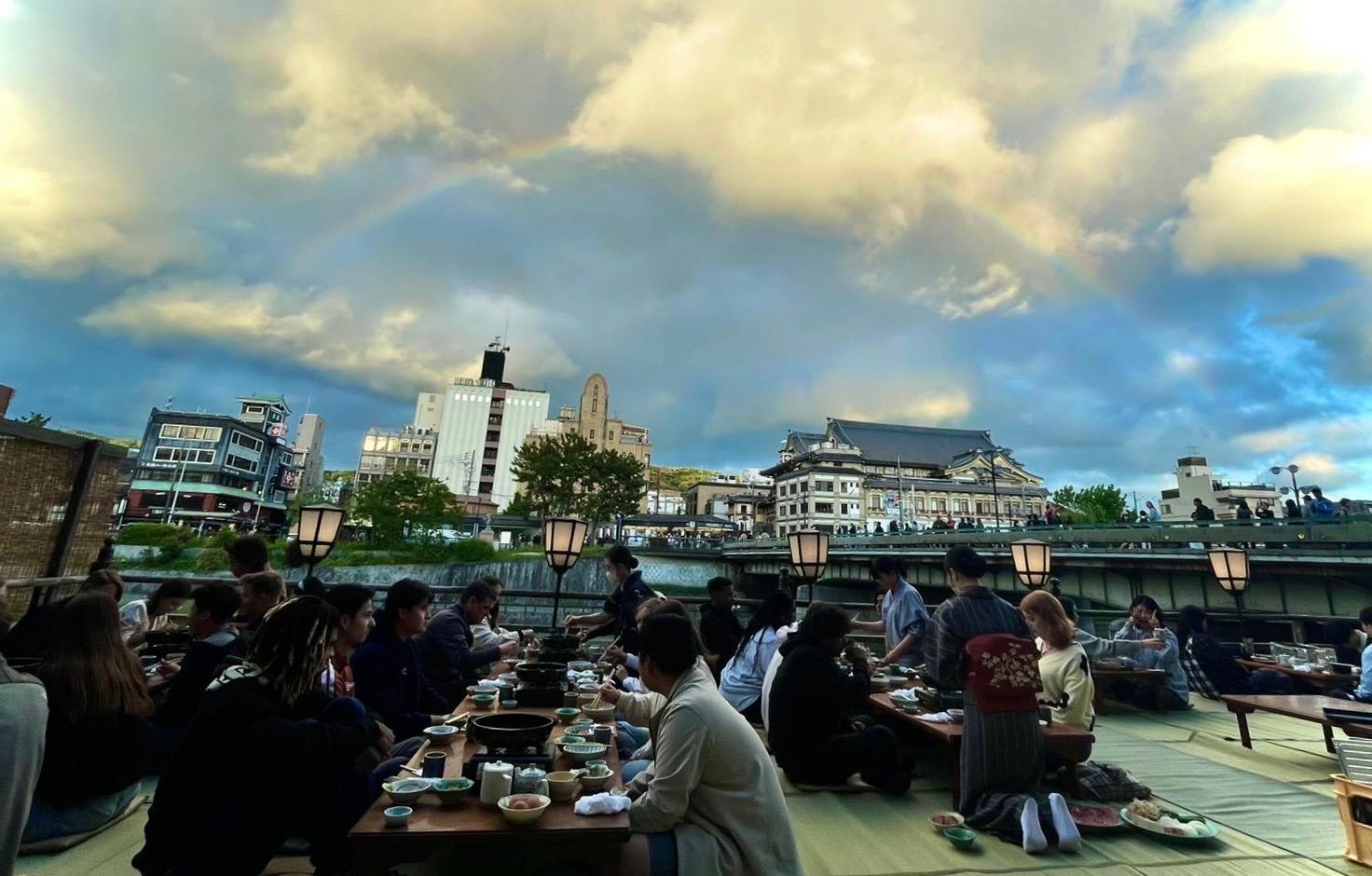
Students from Japan Perspectives Program enjoy a traditional Japanese dinner in Kyoto, Japan under a rainbow May 9, 2024. Kyoto was the first city where the program unpacked and explored. Photo courtesy of Jack Sulewski
Student Career Directions Become Solidified
A survey of 37 Pepperdine students who have participated found the experience of faculty-led programs went far above expectations and left 75.7% of students “extremely confident” in their field of study.
Johnston said she feels incredibly lucky to have had the chance to experience tailored programs in the Uganda and Rwanda justice system in addition to working with archives around London.
“Getting the opportunity to be in Africa and partake in a justice system and work with attorneys and law students was really helpful in deciding, ‘Yes, this is what I want to be doing,'” Johnston said.
Sulewski said his time in the Japan program in 2024 showcased the interplay of Christianity in a new culture while the July INTAX program helped him understand the exact reasons for his passion to become an Old Testament professor.
“Going through that dichotomy gave me more fuel of how to think about it, what that looks like and how that has to do with Christ and other theological things that were powerful for my faith, while also fueling the why behind my career,” Sulewski said.
Hands-on experience through internships and reflection is one of the many ways faculty-led programs contribute to students’ career development and success, according the Journal of Studies in International Education.
Learning how to use databases and archives is usually a lesson reserved for students obtaining a master’s degree, but Gilhuis said undergraduates who participated in her London program gained those instrumental skills early for success in a PhD program, law school and becoming a professor.
Gilhuis said she saw students gain newfound conviction from diving head-first into the basement of archives in London searching for Eastern iconography in ancient architecture and from researching antique objects in relation to religion or health care in East Africa.
“The spark of students — I can say we had 12 students — probably four or five of them, by the end of the program, were expressing now, ‘I know I want to do research in my future,'” Gilhuis said. “It really gave them confidence.”
Faculty’s Involvement and Planning
Faculty members from all divisions have the capability to create unique programs fueled by passion that can be shared and gifted to students, Gilhuis said.
Gilhuis said her INTAX program started as a concept that required workshopping with the dean of IP to find the student needs for the program. The end result was an extremely rewarding experience despite the accessibility challenges, time constraints of a one-month program and five years of planning.
“Once I met with the dean’s office, and they thought, ‘This puts together two high-impact practices for Pepperdine, which is student research and international programs,’ I started getting the green light that people would be interested in seeing a proposal,” Gilhuis said.
The most important consideration for faculty-led programs is to meet the most needs of students in interesting ways. By feasibly broadening the capabilities and scope of what students have the opportunity to do, it creates excitement for faculty-led programs, Engelmann said.
“That’s why we’re excited whenever we can be in Uganda, Kenya or Rwanda, some of these African-based programs help our students,” Engelmann said.
Klive Oh, associate professor of Public Relations, is co-leading the upcoming Korea C3 summer program which offers an opportunity for students in the Communication Division. The program plans to teach students about Korea’s culture, soft power and strong public relation efforts, Oh said.
“So I’ve had the idea for a long time, but work and whatnot got in the way,” Oh said. “But every summer, little by little, I was contacting. I was seeking my old contacts and seeing what can be done in terms of education, all the courses that I have to offer, what would be a good fit.”
Oh said within 10 years of being at Pepperdine he had hoped for an opportunity to teach in East Asia. Currently in his ninth year, he is making his faculty-led program happen.
“So there was, in my mind, the 10-year project, within the first 10 years, I’m gonna try to get something in East Asia,” Oh said. “You know what I mean, East Asia and my home ground.”
Oh said his excitement and passion for the C3 program helped him actively pursue the hovering idea.
“So that passion just clicks, just my upbringing and background, what we have here, and how I know that it would be helpful for students,” Oh said. “I guess those three things just work.”
___________________________
Follow the Graphic on X: @PeppGraphic
Contact Lucy Andrews via email: lucy.andrews@pepperdine.edu