Second Dean’s Lecture installment highlights noted T.S. Eliot scholar, Dr. Jewel Spears-Brooker.
By Kim Oberhamer
Staff Writer
Seaver Dean Dr. David Baird expects students to attend his lecture series merely for educational value. While the series features distinguished scholars from around the country, many students say the lack of Convocation credit may hinder attendance.
Baird is relying on the quality of the speakers and topics to draw in students.
“The idea is to make students aware of the intellectual feast, and that if they know about it they will want to attend,” Baird said. “We want students to attend because they want to engage in intellectual discourse for its own value.
 “I think of it as ‘distinguished’ because of the quality of the lecturers, (for example), their scholarly or professional accomplishments,” Baird said. “Every lecture is designed to raise the level of intellectual discourse on campus.”
But some wonder if Convo played at least some role in filling the seats in years past.
“It would depend on the topic,” senior Alison Stroud said. “If it was something that applied to me I would be more likely to go.
“I understand why they’d (not give Convo credit) because of the noise factor,” Stroud continued, referring to student conversations during presentations. “I think people are rude during Convo.”
Senior Christopher Ragland said he thought Convo credit was beneficial to the program, because students often find it difficult to find the time to make it to lectures they would want to attend.
“It is not a lack of interest,” Ragland said. “I have too many other things to do so I need some other motivation like Convo credit.”
All of the lecturers this year are from off campus with the exception of Paul Westphal, Pepperdine’s head basketball coach. The dean will use a different format than usual too, which includes a debate on sports and Christianity.
While students may not go because of the new no-Convocation credit policy, other students may be compelled to attend. Baird hopes teachers will find it possible to include some, if not all, of the lectures in their syllabus for spring courses.
“If teachers see that a particular lecture would supplement their own classes and wants to require attendance, I would welcome that level of commitment,” Baird said.
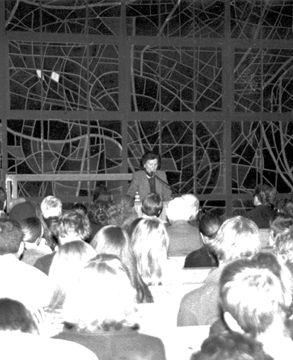
But the lack of Convo credit didn’t hinder attendance at the second lecture in the series, “Violence and Vailing in T.S. Eliot’s ‘Murder in the Cathedral.’ ” In the hour-long lecture, Dr. Jewel Spears-Brooker examined the themes of murder and sacrifice in what she called the author’s “most powerful and political play.”
A performance of selected scenes from the play featuring Pepperdine students Kelly-Jane Rubb, Danielle Allaire, Joseph Obermueller, Marc de la Garza, Ragland, Elena de Mattos and 2002 alumnus Jeremy Lostetter followed the lecture.
Freshman Britnee Stanton, who attended the lecture for her English 102 class, said she was impressed by both the depth of the lecture and the quality of the performance.
“I was under the impression that (the play) was just entertainment, but she really emphasized that it wasn’t just entertainment, but politics,” Stanton said. “And then the acting brought the text to life.”
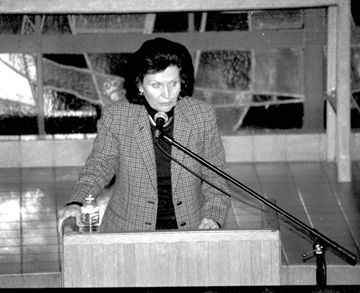 Brooker has been a professor of English literature at Eckerd College since 1981. She has also held teaching appointments at Columbia University, Doshisha University in Japan and Colorado School of Mines. She has also held research appointments at Yale, Cambridge, Harvard and London. She is the author and co-author of six books, including “T.S. Eliot and Our Turning World” (2000), “Reading the Waste Land: Modernism and the Limits of Interpretation” (1990), “T.S. Eliot” (forthcoming), and of 47 essays in books of scholarly journals.
The lecture series kicked off Jan. 13 with David William Bebbington speaking on William Ewart Gladstone’s life as a Christian spokesman.
Bebbington has written several books including “Patterns in History,” “The Nonconformist Conscience: Chapel and Politics,” and “Evangelicalism in Modern Britain” among others. He most recently completed a study of the mind of Gladstone.
— Laurie Babinski contributed to this story
Dean’s Lecture Series Calendar
Dr. Laura Skandera Trombley, president of Pitzer College and Seaver College alumna, will discuss “Why Mark Twain Still Matters: American Icon, Classic Writer and Film Star” Tuesday, Feb. 10 at 7 p.m.
Dr. Robert N. Bellah, emeritus professor of sociology at UC Berkeley, will speak Tuesday, March 6 at
7 p.m. on “Can We Be Citizens of a World Empire?”
On Tuesday, March 18 at 7 p.m., there will be a panel discussion titled, “Resolved that Winning Isn’t the Only Thing: It’s Everything: A Debate on Christianity, Leadership and Sport,” featuring Pepperdine’s men’s basketball Coach Paul Westphal, Olympian John Naber, former men’s tennis Coach Allen Fox and Ryne Naber, former Chicago Cubs player.
The lecture series closes with Dr. Glenn McGee, who will speak on medical ethics March 25. He received his bachelor’s at Baylor University and his masters and doctorate in philosophy at Vanderbilt University. Currently, he is the editor in chief of the American Journal of Bioethics.
NOTE: All lectures in Smothers Theater
January 23, 2003