
Transparency Item: The Perspectives section of the Graphic is comprised of articles based on opinion. This is the opinion and perspective of the writer.
Building a course schedule can be an exhaustive process, especially when you have many professors to choose from for an important class.
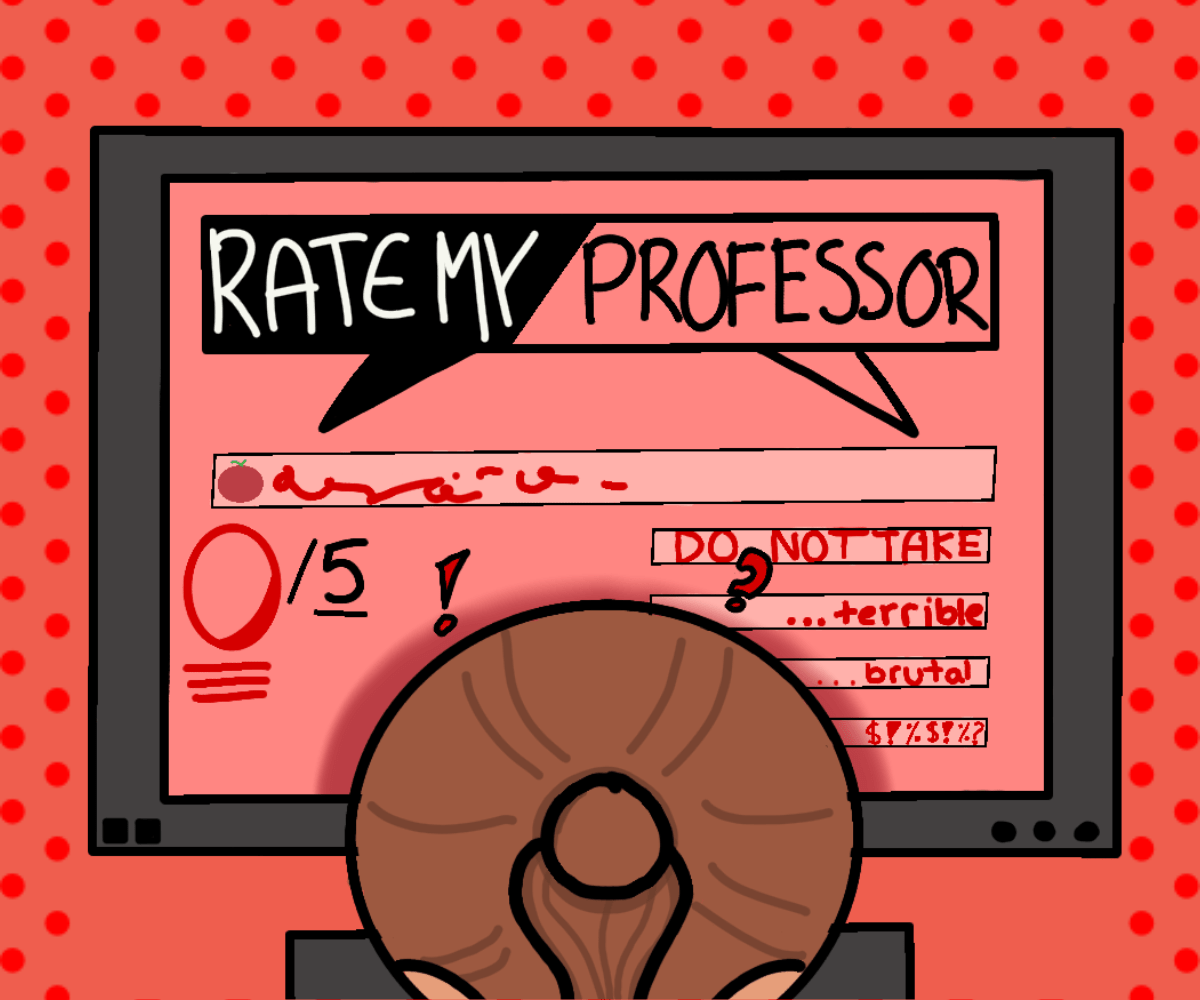
Rate My Professors (RMP) is a popular website to gauge which professors are best for certain courses.
Nevertheless, the popularity does not outweigh the inaccurate and disappointing quality of RMP. The website is incredibly unreliable because its evaluations are negatively skewed, it sets false course expectations and provides little information about many professors.
Unfair Bias
RMP allows students to give unfiltered, anonymous evaluations, which are thought to be reliable because they encourage students to be honest with their reviews.
Nonetheless, RMP allowing anonymous self-reported evaluations decreases students’ accountability to prioritize truth in their statements, according to Texas State University.
Typically, the anonymity of these evaluations evokes stronger negative feelings that compromise the accuracy of the students’ evaluation, according to the Journal of Experimental Social Psychology.
Thus, students’ negative experiences in a course are more likely to be reported on, lowering the reliability of the professors’ ratings.
Also, a course’s difficulty is strongly correlated with lowered quality ratings for the course professor, according to Texas State University.
This implies when students give negative evaluations, it often has less to do with the professor and more to do with the complexity of the course content, further demonstrating how RMP ratings carry an unfair bias that do not reflect the actual quality of college professors.
False Expectations
When RMP quality ratings were compared to official university student-teacher evaluations from University of South Florida (USF), about 50% of professors had at least half a quality rating difference on RMP than in USF evaluations, according to Texas State University.
While most of these differing ratings lean negative, others lean positive.
Positive ratings have shown to create a false expectation for students’ experiences in their class.
Positive RMP evaluations were correlated with students believing they would receive a policy exemption, such as leniency on a syllabus rule, from that professor, according to the National Library of Medicine.
As such, positive RMP ratings give students false impressions professors will go easy on them, and this may cause students to not work as hard in the course. This sets students up to feel more disadvantaged entering the class, impacting their overall success.
Lack of Information
Many professors have little information about them on RMP.
When it comes to many General Education (GE) classes at Pepperdine, it is possible there are a number of new professors teaching these courses.
This could be due to having new, visiting or adjunct status at Pepperdine. These professors may have to adjust to specific teaching styles and course material that their department wants to employ.
Also, the professor’s department could need professors to fill in for increasingly high demand classes which they have never taught before. This shift for professors makes it difficult for students to discern what the actual course will be like.
RMP relies on past students to give their evaluations on the course to help future students become aware of the professor’s quality.
When a professor teaches a new course, there are no past students able to report on the professor’s caliber, making it difficult for students to find reliable information on RMP about these professors.
This can make students feel unprepared since they don’t have any previous knowledge about their professor coming into the course.
RMP evidently tailors the website to allow students to give more emotional statements than factual ones. This form of evaluation disproportionately influences other students when it comes to their opinion of their professors.
In combination with its outdated information, RMP is not accurate enough to be a reliable source. Students should stop engaging with the website if they are looking for dependable knowledge about their courses and professors.
___________________
Follow the Graphic on X: @PeppGraphic
Contact Alyssa Hunnicutt via email: alyssa.hunnicutt@pepperdine.edu