
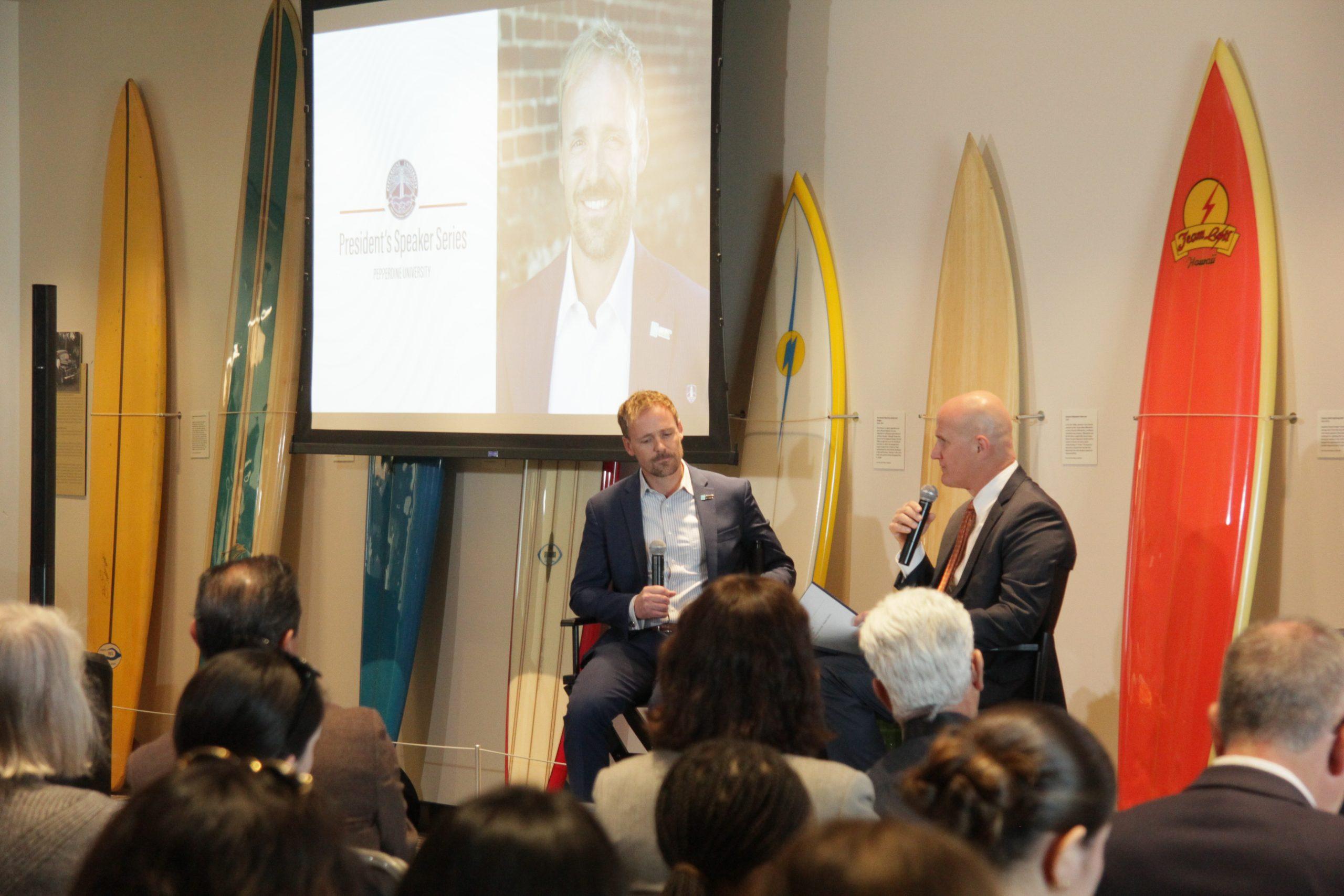
Jeremy Wayne Tate (left) sits beside President Jim Gash in the Surfboard Room on Feb. 26. Gash introduced Tate as an educational entrepreneur preparing the next generation. Photos by Britreyunna Harper
President Jim Gash welcomed Jeremy Wayne Tate, founder of the Classical Learning Test (CLT), for a conversation about academic rigor, Christian education and purpose at the Surfboard Room on Feb 26.
The event was the first Pepperdine President’s Speaker Series of the semester. Students and faculty were invited to consider how classical education shapes both K-12 learning and higher education.
In this conversation, Tate said the way education today is viewed is skewed from the traditional sense.
“Who started to question, ‘What even is education? What are we trying to do?'” Tate said. “The vision for education — that had always been education for centuries, for millennia — has really been displaced in the 20th century with education that is more about job training instead.”
Tate is the latest conservative in a streak of other right-wing speakers the President’s Office has hosted since 2024, which has recently included Andrzej Duda, the former President of Poland, intellectual Jordan Peterson, entrepreneur Palmer Luckey and Liz Truss, former U.K. prime minister.
Tate founded the CLT in 2015 as an alternative to traditional standardized exams such as the SAT and ACT, according to CLT’s website. The test focuses on traditional education, promoting critical and logical thinking. Students receive scores on a 120-point scale. This test has been especially popular with conservatives, according to Education Week.
“What we’re trying to do is, in some ways, build some of the crucial infrastructure [in education],” Tate said.
The CLT program partners with hundreds of Christian schools, private schools and charter schools, Tate said. Other standardized testing companies have historically competed by lowering difficulty rather than raising standards. Over time, competition has resulted in shorter reading passages and the elimination of certain question types, such as analogies.
“We need an alternative that is holding the line instead of racing to the bottom,” Tate said.
At the same time, Tate acknowledged the challenge of building a national testing organization without compromising rigor. CLT leaders must resist the temptation to dilute standards in pursuit of market share, Tate said.
“For us, the nightmare scenario is we hit our 2040 goal, we’re number one, and then we realize we’re just like the College Board,” Tate said. “We want to make sure that we’re true to mission and not compromising on academic rigor.”
In the 11 years of its existence, CLT has shifted from being just a test to preparing students for college as well, Tate said.
“You set off to create a test to influence education,” Gash said. “And now you’ve become a convener and, in fact, in many ways an influencer on the creation of classical schools, Christian schools.”

A student reads a pamphlet detailing Tate’s career path at the President’s Speaker Series on Feb. 26. The event lasted about an hour.
CLT has gained traction among Christian and liberal arts institutions since its founding in 2015. In 2023, Florida became the first state to allow students to submit CLT scores for admission to its public universities alongside the SAT and ACT, according to Education Week.
More than 300 undergraduate programs accept CLT scores, most of them Christian schools, according to CLT’s website. Pepperdine began accepting CLT in its admission in 2025, according to Pepperdine’s website.
The classical education curriculum is being taught in select schools, one of which Gash said he and First Lady Joline Gash recently visited. The principles Tate outlined were evident while visiting the school implementing the CLT curriculum.
“We were like, ‘We can’t send our kids to Oaks [Christian School],’” Gash said. “’There’s no way we could afford it.’ Then we visited, and it was like, there’s no way we can afford not to. There’s things that are more important than the other things we’d be spending our money on.”
Gash, who attended public school growing up, said the contrast in education was very clear.
“I just got tears in my eyes and said, ‘This is what it could have been like? High school could have been like this?’” Gash said.
Tate said all parts of an education must be in equal value in order for a student to develop fully, rather than just test scores.
“You might not ever use French, you might not ever use your Spanish, you might not ever use geometry, right?” Tate said. “But it’s actually going to shape you in a way that you ought to be shaped.”
Gash connected those themes to Pepperdine’s mission as a Christian university. He asked Tate how he understands his own greater purpose and what faithfulness looks like in his professional life.
Leadership often involves enduring difficulty rather than avoiding it, Tate said.
“There’s something powerfully sanctifying that happens when you don’t dodge pain,” Tate said. “Through that, we really experience sanctification.”
Future speakers in the series include Lynsi Snyder on March 31, owner and president of In-N-Out Burger, and Olympic gold medalist Sydney McLaughlin-Levrone on April 8.
_________________________________
Follow the Graphic on X: @PeppGraphic
Contact Cristal Soto via email: cristal.soto@pepperdine.edu