
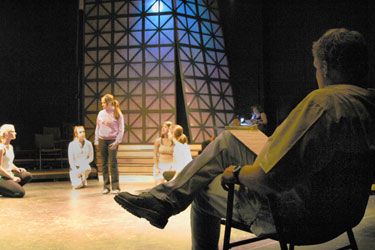
 Director Danny Campbell watches as senior Natalie Lander (standing) acts as Electra in rehersal. Graham Shea / Asst. Photo Editor
Andrea Sanmiguel
Staff Writer
Pepperdine students and guest Director Danny Campbell take on their newest challenge with the Greek tragedy “Electra” beginning Oct. 16 in the Lindhurst Theatre. With antiquated language and audience seats circled completely around the stage, “Electra” provides a unique theatre experience.
“Electra,” a Greek tragedy, is familiar to most of the students at Pepperdine, even if they aren’t aware of it.
The story was referenced in Homer’s “Odyssey” and “Iliad,” which are known to most students through literature classes both in high school and college and also form the basis for the hit movie “Troy.” In ancient Greece, Electra’s plight became so well known that Sophocles, Euripedes and Aeschylus each wrote a play based on the story.
Title character Electra begins to conspire with her brother to avenge their father’s murder. In ancient Greek culture, to achieve this vengeance would have been the most honorable thing they could do.
However the task is not so simple, for the person who murdered their father is their mother, and to kill her would be the most dishonorable thing they could do. The play follows the siblings as they struggle with their decision.
Adjunct professor of drama Danny Campbell is the director of “Electra.” Campbell said growing up, he disliked Greek drama. (He added that he wasn’t fond of Shakespeare either, yet interestingly enough he teaches a Shakespeare class at Pepperdine.) Campbell tried to understand its appeal but had a hard time grasping it, yet he kept trying because, as he asked, “There must be something there. Why are we studying this stuff?”
The day Campbell finally saw a Greek tragedy performed live he said his eyes were opened. After this epiphany he began to really appreciate Greek tragedy. Now Campbell is staging this play because he wants “people to have the same experience I had” and develop an appreciation for Ancient Greek drama.
The Pepperdine version of “Electra” is based on Sophocles’ version of the story. However, it is not a strict translation. The version Campbell chose is a more contemporary adaptation, and said he hopes that will help make the audience better able to relate to it.
Senior Skyler Stuckey, who plays Electra’s brother, Orestes, said this was a good move. Stuckey said the hardest part of doing Greek drama is the emphasis on language. Because of this emphasis, the actors have to “make the words interesting to a modern audience.”
Campbell agrees with Stuckey, saying that he “picked a play which demands actors to be powerful speakers, which is a challenge.” However, he added that his cast is rising up to the challenge and meeting it well.
“Many people say that 90 percent is the cast,” Campbell said. “If you have a good cast and a good play, just get out of the way and let them do their job.”
All of the actors seem to be excited about the project and are working hard to meet all the challenges he sets for them in order to make the play a success, Campbell said.
In a further effort to get the audience excited, Campbell decided to stage his play in the round, which is fairly unusual. When a play is staged this way, the audience is seated in a circle completely surrounding the stage.
The actors have the added challenge of having to play equally to every audience member that around them, but the audience benefits because they are able to get closer to the action.
While explaining this concept Campbell excitedly points to a spot in the audience seating and said “You could be sitting right here and there’s going to be someone right there!”
Campbell and his cast are very proud of the work they have put in so far and feel that Pepperdine students would greatly enjoy the play. Campbell stresses that his goal was to make this play accessible to a modern audience.
“We’re going tell it in a way that’s going to make this, one of the oldest pieces of western drama, come alive,” he said.
Electra opens Tuesday at 7:30 p.m. in Lindhurst Theatre and will run until Saturday. Tickets cost $6 for students and $12 for faculty and staff.
10-07-2004