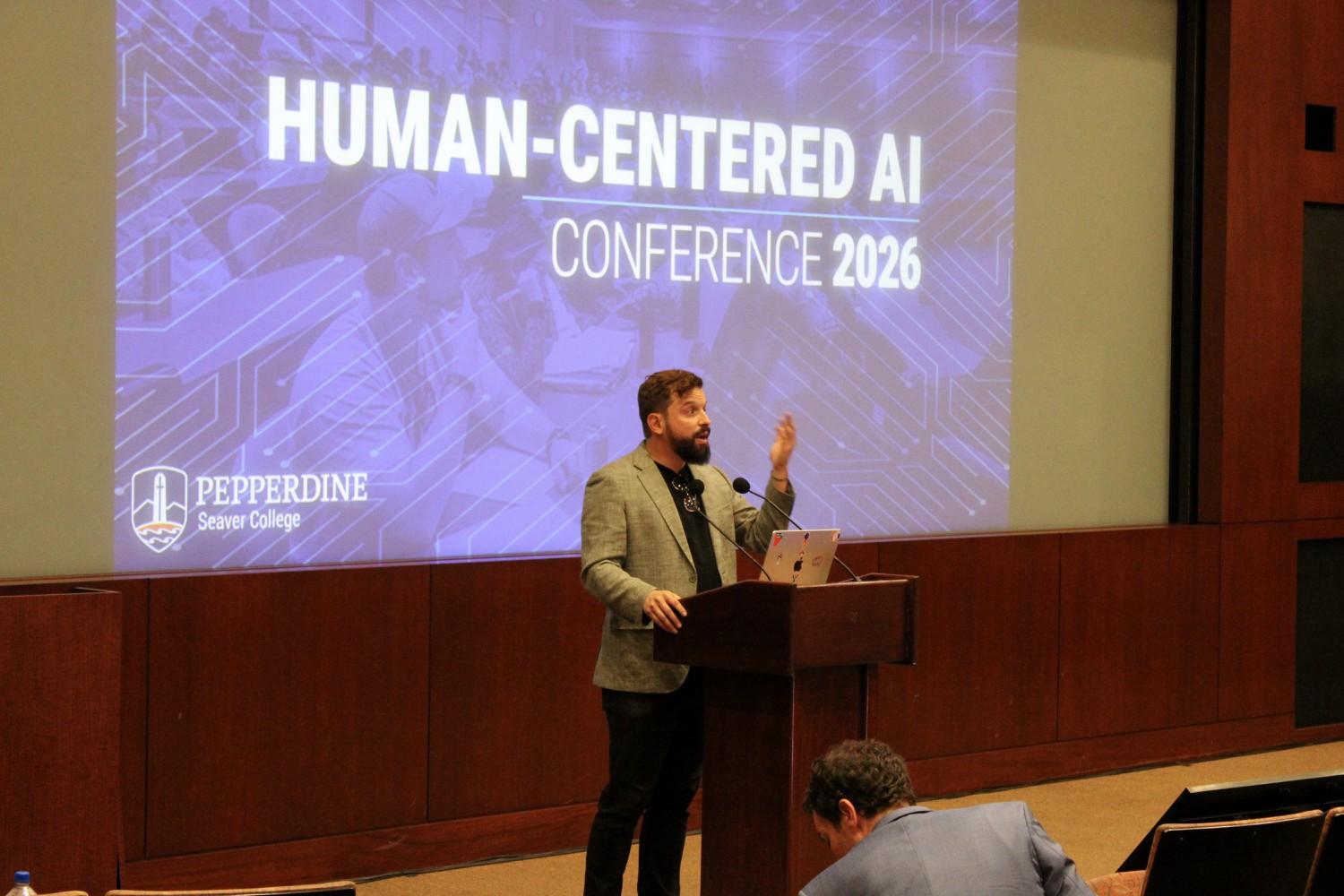
Neuroscientist Leo Christov-Moore addresses attendees on drawing from Buddhist philosophy and the neuroscience of empathy to build human-centered AI. Christov-Moore’s presentation was the seventh of the day Sept. 26. Photo by Guinevere Hesse
Pepperdine University hosted its sixth annual Human-Centered AI Conference Sept. 25–26 in Elkins Auditorium. The two-day event featured keynote addresses, expert panels and structured lectures examining AI through the lenses of robotics, neuroscience, ethics and the world’s religious traditions, according to the University’s event page.
Computer Science Professor Fabien Scalzo, director of the Keck Data Science Institute, and Vice Chancellor Johnnie Moore, managing director of the Middle East Policy Studies Program, served as conference chairs.
Opening day discussions focused heavily on international diplomacy and Middle East relations.
Upon entering, attendees received copies of keynote speaker Judea Pearl’s book, “Coexistence and Other Fighting Words: Selected Writings of Judea Pearl, 2002–2025.” Pearl, a UCLA computer science professor and self-proclaimed Zionist, said that a two-state resolution remains the only viable path to ending the Israel-Palestine conflict.
Pearl added that while many focus on the displacement of “indigenous people,” the Zionist perspective represents the desire for peaceful coexistence between two equally indigenous populations, both Israeli and Palestinian.
Pearl said that this clash of views has formed a primary dividing line globally at the United Nations, even as Palestinian Authority President Mahmoud Abbas has similarly called for two states side-by-side.
During a conversation on potential federal AI regulation, Pearl expressed a deep distrust for government policy.
“Anyone who says they can control AI is talking nonsense,” Pearl said.
Pearl said he also looks at potential AI safeguard systems through a biological lens.
“The only example we have of a supercomputer being enslaved by a less supercomputer is maternal instinct. The mother is enslaved by the baby,” Pearl said. “The baby knows how to control his or her mother and if they want mother’s attention, they start to cry. The mother has no control over it because the mother was programmed that way to help the baby.”
The conference’s second day featured a technical and medical application of artificial intelligence.
Following opening remarks from Provost Jay Brewster, the schedule featured presentations from several researchers.
USC Keck School of Medicine professor Paul Thompson and neurologist David Liebeskind examined neurovascular AI and vision-language models in neuroimaging. Leo Petrossian, CEO of Kandu Inc., detailed how FDA-cleared brain-computer interfaces shed light on AI restoration versus augmentation.
Jie Li, an MIT Tangible Media Group research scientist, explored the art of maintaining humanity in an automated world and Nick Vincent, assistant professor at Simon Fraser University, outlined AI evaluation methods aimed at fostering a more human-centered data ecosystem, according to the conference’s schedule.
__________________
Follow the Graphic on X: @PeppGraphic
Contact Marcos Lizarraga via email: marcos.lizarraga@pepperdine.edu