
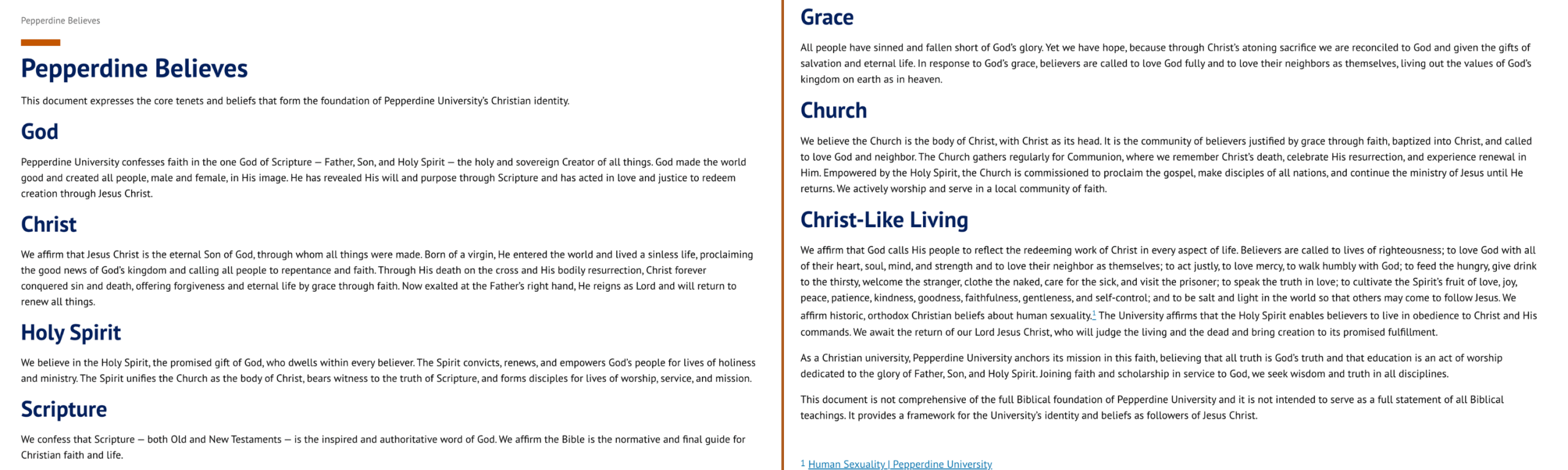
The official “Pepperdine Believes” faith statement first announced in an Oct. 8 email sent by University President Jim Gash to the Pepperdine community. The statement is the first expansion of the University’s foundational beliefs since the Affirmation Statement in 1970.
Pepperdine University published “Pepperdine Believes,” an official University statement outlining seven core tenets and beliefs of Pepperdine’s Christian identity. The document follows a unanimous vote of approval by the Board of Regents and its Faith and Heritage Committee, first announced to the Pepperdine community by President Jim Gash in a campus-wide email on Oct. 8.
In the Oct. 8 email, University administration said that the statement would be added to the official University website 30 days from the date of the announcement. However, as of Nov. 8 — more than 30 days following the initial announcement — the official statement had not yet been posted to the University’s website.
The new document lays out Pepperdine’s official Christian beliefs across seven key areas: God, Jesus Christ, the Holy Spirit, the Bible, grace, the church and Christian living. It marks the school’s first major update to its official faith statement in over 50 years, adding specific stances on scripture, salvation, and human sexuality. In his October email, Gash emphasized that the statement defines the University’s identity as a Christian institution and is not a personal faith requirement for students or faculty.
Members of the Pepperdine community have conveyed mixed reactions to the recent statement. Chris Doran, Seaver Faculty Senate president and professor of Religion and Sustainability, said several faculty members across campus have expressed concerns.
“[The faith statement] has caused a lot of people to kind of rethink about what they thought this place was versus what they think it is presently versus what they think it is going to be in the future,” Doran said.
The statement marks the first expansion of Pepperdine’s faith framework since the “Affirmation Statement” was established in 1970, according to the University‘s website. Although the “Affirmation Statement” and the “Pepperdine Believes” statement share a common theme, the University explains that these are distinct documents. While the Affirmation Statement embodies Pepperdine’s identity and Christian commitments, the “Pepperdine Believes” statement expands many of the institution’s foundational beliefs, according to the statement’s frequently asked questions section.
“I think there’s some concern among the faculty — are we sort of aligning ourselves with Evangelical places in ways that we hadn’t in the past?” Doran said. “Now, the administration says we’re not doing that, but those statements look very similar to the Evangelical statements, rather than something completely distinct, which Churches of Christ theoretically are completely distinct from Evangelical places.”
The document defines the Church as the global body of Christ centered on local worship, disciple-making and regular Communion. In the section detailing Christ-like living, the statement ties spiritual formation to active social service, including feeding the hungry, caring for the sick and visiting prisoners.
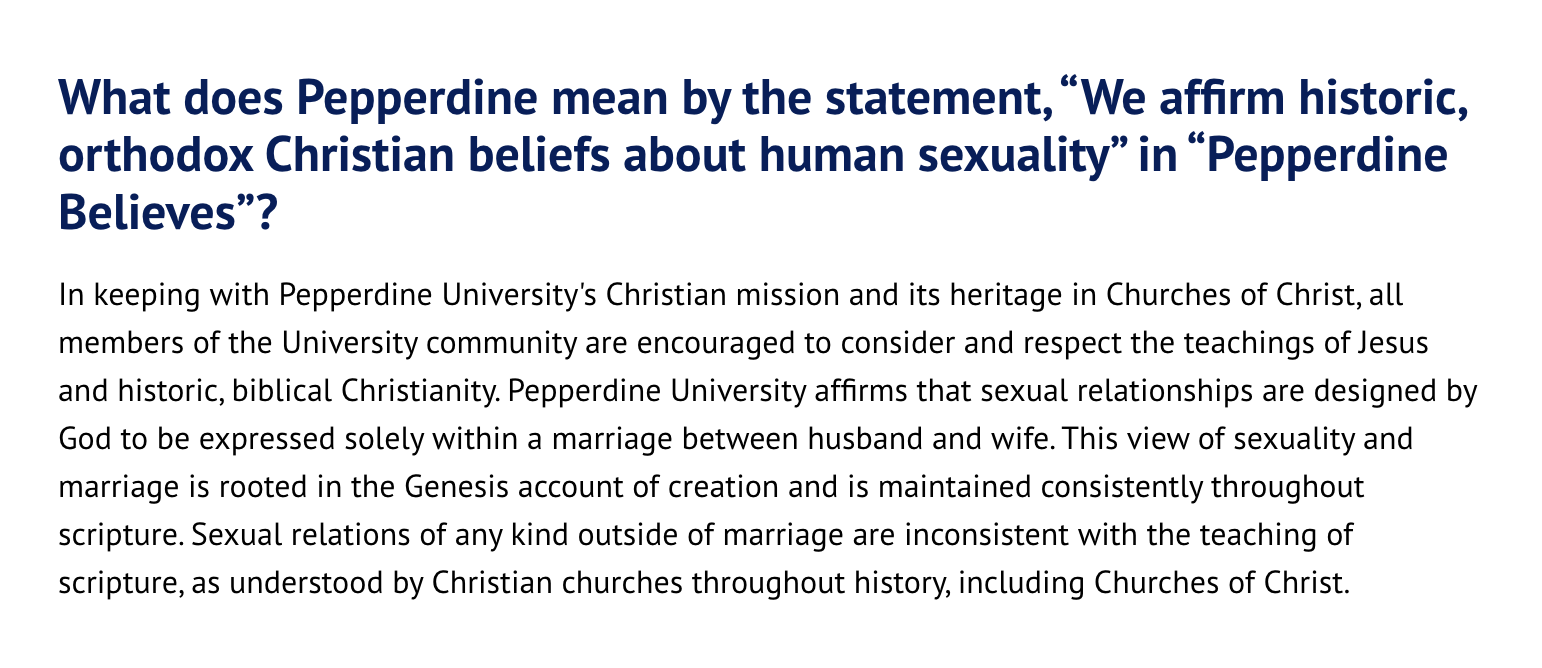
The “Human sexuality” frequently asked questions section of the “Pepperdine Believes” faith statement. The section clarifies the term as reserving sexual relationships solely for marriage between a husband and a wife.
The statement also affirms orthodox Christian beliefs about human sexuality, according to the document. In the “Frequently Asked Questions” section released alongside the statement, the section defines this standard by stating sexual relationships are designed by God to be expressed solely within a marriage between husband and wife, rooted in scripture and maintained across historical Christianity and Churches of Christ heritage, according to the section.
Doran said several faculty members have voiced concern about this section of the statement in regards to faculty, staff and students on campus. In addition, they are unclear about a lot of the language used throughout the statement.
“It became very clear in a number of meetings that administration at this point is not clear on what resident faculty can and cannot say in certain settings to be either in alignment or not in alignment with the statement, and whether that would bring up a situation where that would possibly put our employment at risk,” Doran said.
Much of this ambiguity stems from faculty’s absence in the formation of “Pepperdine Believes,” Doran said. However, he also acknowledged that Pepperdine’s bylaws give the Board of Regents the ability to make high-impact decisions like this.
“I think what is lost and/or what was lost in this particular process is we have a host of really important theological scholars on our faculty that, as far as I know, were not consulted,” Doran said. “Why would you not want to reach out to those who have expertise in this area? It seems like that sets standards of good morale in a community.”
The overall foundation of Pepperdine’s faith dates back to founder George Pepperdine’s original 1937 dedicatory address, which outlined an institution that believed in Christian character while maintaining a policy of voluntary participation for its students, according to the 1937 address.
The statement noted that while endorsement of the affirmation is not required, all community members are expected to acknowledge and respect “Pepperdine Believes” as the institutional position of Pepperdine University.
Several Instagram users commented in support of “Pepperdine Believes” on the Graphic’s post about the faith statement Oct. 8.
“Grateful for Jim Gash’s leadership and the boards approval! It’s remarkable that affirming foundational Christian beliefs could even be controversial at a Christian university,” one user commented.
“A university founded on Christian beliefs should not be afraid to state those beliefs,” another comment read.
In the weeks following the announcement, two Pepperdine faculty submitted letters to the editor to the Graphic expressing opposition to the new faith statement. The letters questioned the direction of the University, asking what kind of Christianity Pepperdine represents and raising concerns over the University’s diversion from its inclusive past.
The Graphic reached out to Seaver College’s divisional deans for comment regarding the adoption of the new faith statement among faculty.
George A. Carlsen, divisional dean of the International Studies and Languages Division, and Brian Newman, divisional dean of the Social Science Division, both declined to comment. Lauren Amaro, divisional dean of the Communication Division, stated she was not willing to speak publicly about the statement. Divisional deans N. Lincoln Hanks of the Fine Arts Division, Regan Schaffer of the Business Administration Division, Lisa Smith of the Humanities and Teacher Education Division and Dyron Daugherity of the Religion and Philosophy Division did not immediately respond to requests for comment.
Over the past month, the Seaver Faculty Senate has provided faculty members with a Google Sheet as a space to vent and voice their thoughts, discussed the issue in an October meeting and started a document where they keep track of faculty uncertainties in the classroom and their day-to-day life. The next step, Doran said, is coordinating a meeting with the provost and president to have a closed-door meeting.
Though a lot of uncertainty remains, Doran said the Senate is trying to be constructive.
“Can we work constructively on working those [uncertainties] out so that we can bring some clarity to the situation where people are not finding a lot of clarity, and thus finding a lot of concern, distress, discouragement,” Doran said.
This story was copy edited by Lila Rendel.
_________________________________
Follow the Graphic on X: @PeppGraphic
Contact Marcos Lizarraga via email: marcos.lizarraga@pepperdine.edu
Contact Amanda Monahan via email: amanda.monahan@pepperdine.edu or via Instagram: @amandamonahanjournalism