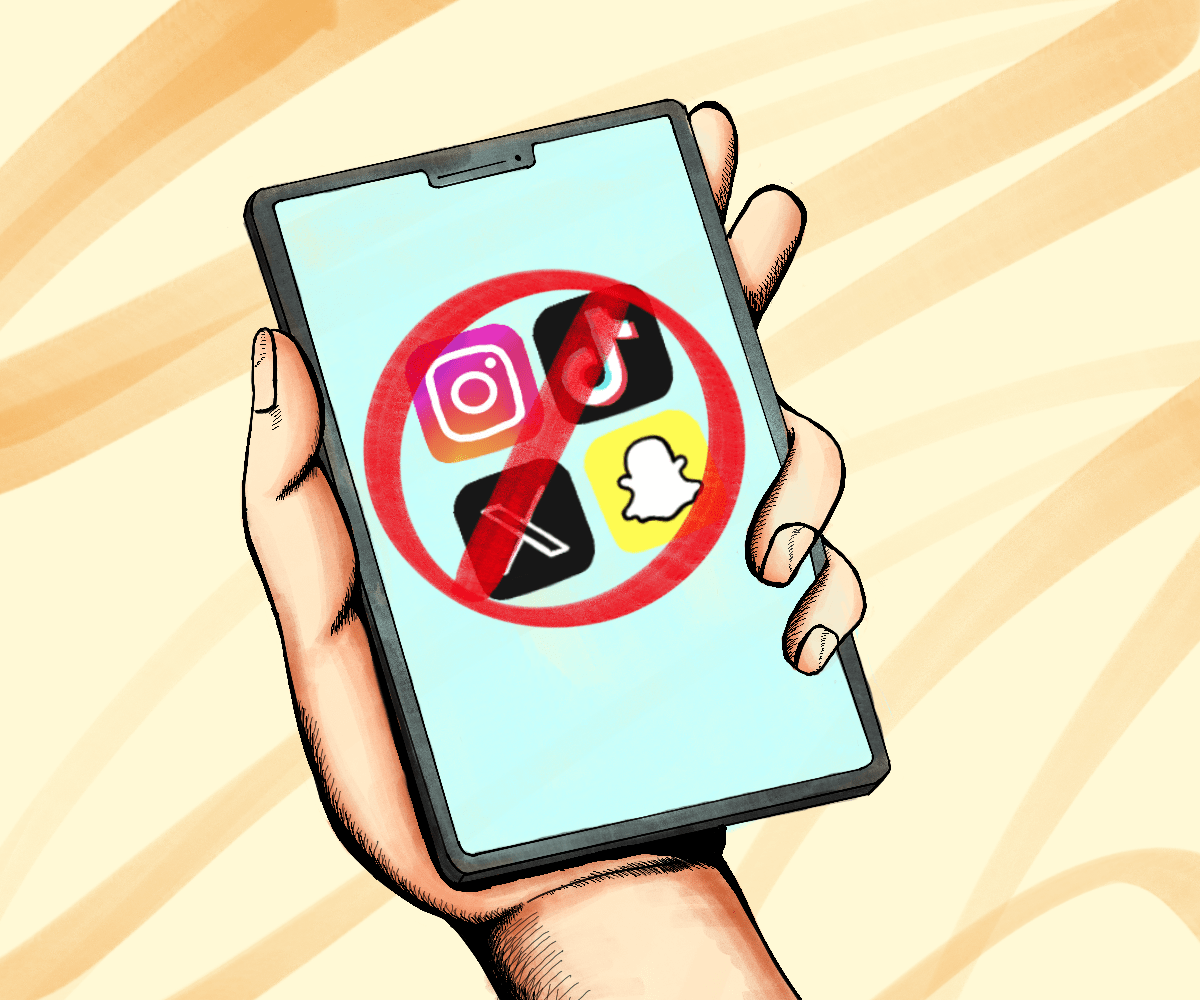
Art by Cara Tang
Transparency Item: The Perspectives section of the Graphic is comprised of articles based on opinion. This is the opinion and perspective of the writer.
Social media is a vital part of many college students’ lives. Platforms such as Instagram and TikTok allow young people to connect with each other through posts, sending short-form content or direct messaging.
Many young adults spend a significant amount of time on social media each week. At least 84.7% of respondents ages about 18 to 23 years old reported using social media at least three hours a day, according to the National Library of Medicine.
Teenagers also use social media quite often, with about one in five teens saying they use YouTube and TikTok almost constantly, according to Pew Research Center.
Recently, Western countries have pushed for increased legal restrictions on the use of social media by minors. Countries like Australia have instituted bans on social media access for those under 16, and Britain and the United States have floated similar — and sometimes more restrictive — laws, according to The New York Times.
These restrictions, while seemingly well-intentioned, are problematic for youth across the board, and alternative solutions to issues caused by social media should be pursued instead.
Social media access for youth provides a number of benefits that might feel rarely acknowledged.
Platforms like Instagram allow teens and young adults to feel more connected with each other both emotionally and in knowing what’s happening in their friends’ lives, according to a 2015 report by Pew Research Center.
Social media helps youth create stronger social networks and form deeper relationships with their peers, which is beneficial for mental health. These relationships can reduce stress and provide emotional support, increasing positive outcomes in education and mental health, according to the National Library of Medicine.
Social media also provides a space for exploration and growth, which is especially important for youth and young adults who are a part of marginalized communities.
LGBTQ+ youth, for example, benefit greatly from the internet and social media. They use it as a space for peer connection, social support, identity exploration and management, according to JMIR Publications.
Other marginalized groups also report feeling the benefits of social media access. Black youth are more likely to say they feel significantly more connected to their peers because of social media, according to Pew Research Center.
LGBTQ+ youth spend, on average, 45 minutes longer on the internet than their non-LGBTQ+ peers, according to Human Rights Campaign. Restricting youth access to social media not only disproportionately impacts marginalized youth in terms of time spent on the platforms, but it also decreases their access to necessary social systems.
This is not to say there aren’t negative consequences of time spent on social media, however.
A 2019 study on the impacts of social media on youth mental health indicated that youth who spend more than three hours a day on social media may be more likely to experience mental health issues, according to JAMA Network.
This is problematic, as mental health issues can lead to self-harm, suicidal ideation and lower academic performance, according to the Suicide Prevention Resource Center. These mental health issues may carry over to adulthood as well.
Pew Research Center also found in 2015 that 53% of teenagers who used social media had seen posts of friends going to events or activities they had not been invited to. While Pew Research Center couldn’t determine that this necessarily caused negative reactions, it seems reasonable that some of these instances would negatively impact a teenager.
Recently, social media companies have been found liable for intentionally making their platforms unsafe and unhealthy for users, according to AP News. In California, YouTube and Meta were found liable for intentionally designing their platforms to be addictive, and in New Mexico, a jury found that Meta intentionally concealed information about child sexual exploitation happening on its platforms, according to NPR and Reuters, respectively.
Issues like these are legitimate, but should not be solved by government restrictions on access to social media. These restrictions are ineffective, as they fail to actually prevent youth from accessing social media and fail to fix issues with social media platforms themselves, according to Knowable Magazine.
It’s clear that companies in charge of social media platforms are responsible for these issues. They are responsible for both continued child sexual exploitation on their platforms and addictiveness through an intentional design that also affects adults, according to Addiction Center.
Addressing the root cause of the problem by intentionally regulating these companies would be much more effective in fixing the issue of social media addiction for both young and old. It would also continue to maintain the safe spaces that youth access through social media, especially in marginalized communities, preventing potential issues of censorship and subsequent isolating experiences for children.
Being intentional about regulations would be much more effective. Ideas such as banning the use of intentional strategies to harness addiction have not been implemented in the United States at large as of yet. The closest the federal government has come to regulating these companies over these issues has been the Children’s Online Privacy Protection Rule, which is supposed to protect users under 13 from having data collected about them.
This is not enough. The federal government should expand this protection to anyone under 18 as one way to prevent harmful advertising practices from impacting teenagers without infringing on users’ access to or use of these platforms.
Acts like the Kids Online Safety Act (KOSA) may appear to approach this subject in a way that might fix these issues, but organizations like the American Civil Liberties Union (ACLU) argue the wording is too vague, according to the ACLU’s website. Acts like KOSA might open the door for state censorship of any subject or media that the government finds inappropriate — a legitimate concern when lawmakers are targeting minority communities like transgender individuals with over 62 anti-transgender bills passed in 2026, according to Trans Legislation Tracker.
These acts might also require age verification, which has taken the form of uploading pictures of government IDs to these social media platforms in Europe, according to YouTube’s Blog. This is a breach of privacy for users and relies on arbitrary indicators that a user might be under the age of 18, such as videos watched or categories of content viewed, according to CBS News.
Age verification like this could restrict the accounts of adult users who allow their children to watch content on their account, or even adult users who watch content that platforms like YouTube might arbitrarily label as “aimed at children,” such as gaming videos. This would force these adults to provide their government ID to have full access to the platform, despite being incorrectly labeled as a minor.
Voters should be aware of the negative effects of social media restrictions when voting on local issues as well as for local and national government officials. Advocate for a safer future for both children and adults by regulating these companies, rather than restricting the lives of youth.
___________________
Follow the Graphic on X: @PeppGraphic
Contact Ashley Burton via email: ashley.burton@pepperdine.edu