
Pepperdine junior Anuj Sahai explains the ins and outs of his lyrical prose.
By Kyle Jorrey
Sports Editor
What is the image of a rapper?
The word itself is loaded with assigned meanings, especially to mainstream society. This probably stems from the fact that hip-hop music was born out of the inner cities from a non-white culture, and is often misunderstood by those who don’t recognize the music as a real form of art.
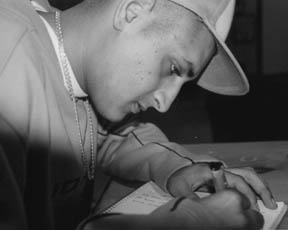 Modern-day rappers of all colors face a plethora of stereotypes that label these wordsmiths as pant-sagging, obscene-speaking, law-breaking loud mouths who have no redeeming value in their music.
Pepperdine junior Anuj Sahai, a native of Long Beach, N.Y., whose parents originally hail from KYLE JORREY/SPORTS EDITOR India, knows all about these stereotypes.
“Growing up was a challenge, ignorin’ the lessons / incorporatin’ your values from a foreign perspective / it’s now I understand, I’m more int-er-ested / I take life as one big meta-phorical question / when I’m praying to God, it’s a rhetorical gesture / on my knees, hands-crossed, arms bent in the center.”
Sahai, in his ability to express feeling and evoke emotion in his lyrics, is essentially no different than a poet. Since he began writing lyrics in the 10th grade, as a means to “battle” his friends over who could put the best on paper, the 20-year-old has been obsessed with the creation of rhyme.
“When I was young, I was always reading poetry books,” Sahai said. “I loved the word play, the ability to create a play on words… rapping is a form of art, it’s just not seen that way. I’m trying to make my lyrics a picture image for anyone listening to them or hearing them.
“Overdosed in the spiritual / a ghost in the physical / my success is my future, I’m a focused individual / flows close to the original, traditional literature / you can shake here with Shakespeare and witness the signature.”
Rappers such as Sahai have the capability to craft thoughts and ideas into intricate rhyme schemes, not the kind of A-B, A-B schemes that people generally think of when they think of rhyming. In this new style of writing lyrics, rappers will often rhyme the same sound four or five times in one beat, all the while including the language tools of alliteration, repetition, and simile/metaphor.
Like an observant author, Sahai said he is always grabbing ideas from what he sees, reads, and learns. After putting a certain thought on paper, he starts the process of trying to maximize the words’ potential into one, crisp sounding line.
“If I I’m reading something and I see a word or phrase I like, then it becomes a challenge to me to flip that into a sick rhyme,” Sahai. “I put the word on paper, I turn it this way, I flip it that way, I step back and look at it from different angles. Like I was an architect trying to figure out a building design or something.”
It is obvious to see why this junior sees what he does as art, an idea that has found little support in many intellectual circles.
“When I’m putting together a rap, it’s like I’m putting together a book chapter by chapter, but this is verse by verse,” he explained. “You have to develop a theme in your hook (chorus) and you have to find smooth transitions, from hook-to-verse, and verse-to-verse.”
“Gentlemen on the surface, a gangsta’ inside / settle on these words, let em’ dance on ya’ mind / a champion comprised / of no family ties / I set my own path, no man could survive.”
But according to Sahai, the music industry’s top rappers are a lot to blame for all of the negative publicity.
“A lot of rappers are uneducated, and because of this people can’t see their skill through all their harsh words and subject matter to their talents,” he said. “This rapper is telling this guy to kill this guy, saying stuff like ‘I dropped out of school, I’m the man. I was selling crack by the time I was nine, I’m the man.’ It’s going to take more educated people to start rapping for the music to get an appreciation as an art.”
Sahai spends his summers back at home in Long Island chasing his dreams of hip-hop stardom and record company paychecks; he has produced three CDs in the last three years, each one gaining the MC more and more fans.
While his lyrics, spreading from person to person by way of CD burning technology, get him respect on the streets of Long Beach, they’ve yet to net him any career plans. But Sahai said he isn’t too worried, he knows he’s young, and in two years should graduate from Pepperdine with a degree in computer science.
Not a bad accomplishment for a rapper.
“The whole rapping thing right now, though I’ve had a lot of positive feedback, it’s still early and I’m young,” Sahai said. “Hopefully I’m only going to get better, but for now, I’m just enjoying taking classes and trying to finish up college.”
So for now, this modern-day urban poet will have to just enjoy his opportunities to impress those who are lucky enough to happen upon him and hear his impeccable lyrical flow. He said anybody who wants to get a CD needs only ask him (no cost), and anyone who wants to battle need only step up. Because while he’d love to find a career in the rap game, in the end, he said, it’s all about rhyming and respect.
“It’s all about respect, it’s all about speaking the truth,” Sahai said. “It’s easy just to spit random things and get them to rhyme, but when those things you rap about have real meaning, that’s when you take rapping to the next level. And I hope that’s where I’m headed.”
“Sometime when I die / when my son is in his prime / I’m a transfer my thoughts through his blood up in his mind.”
October 02, 2003