
Michael Moore’s most recent documentary examines America’s problems with gun killings.
By Elizabeth Craigg
Staff Writer
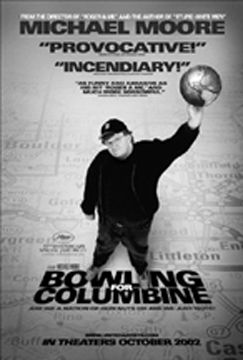 In the parking lot of the Westside Pavilion theater, a group of three people formed — two men and one woman — to discuss the new controversial film “Bowling for Columbine” by Michael Moore.
Moore is renowned for his aggressive filmmaking style that developed in his first film, “Roger & Me.”
Dave Holstead, a 28-year-old computer technician, best describes Moore’s movie style as “creating situations that allows people to act and all he does is sit back and record the outcome.”
Jake Anderson, a 31-year-old comedian, was in awe of how aggressive Moore was in the documentary so that everyone’s perspective on gun violence is presented, including going to the home of Charleton Heston to discuss why guns are so important in America’s culture.
Moore doesn’t focus on the tragedies of gun violence. Instead, he provokes America to think about why we love guns.
In “Bowling for Columbine,” Moore explores two reasons for America’s domestic violence — the continual fear of being attacked by other people and a violent American history.
Moore compares differences in the Canadian and American cultures through interviewing Canadians to examine why America has more violence than Canada. He revealed that Canadians simply do not fear each other and are more diplomatic when dealing with other people. To show this, Moore walks into homes, without knocking on the door, to test the idea that Canadians keep their doors unlocked.
Annie Morrison, a 29-year-old sales associate who was a part of the group outside of the Westside Pavilion theater, agrees that Americans are fearful but is still baffled by the large number of guns that are in Canada. She concludes that Canadians “are probably more afraid of being attacked by bears than by people, whereas we are more afraid of being attacked by people than wildlife.”
This film presents problems that are within the American culture but it presents no solutions. However, no one has ever addressed the problems like Moore did.
Producer and wife Kathleen Glynn promotes the honesty of the movie by calling Moore “a truth seeker, and by asking questions and being ready to hear answers that are not what he necessarily had in mind” in the United Artists press release.
Despite popular demand, “Bowling for Columbine” is playing in only a few local theaters. Producer Charles Bishop said in the press release that the movie was originally going to focus on the Columbine shooting. The fact that this would be addressed during the film disturbed many people.
Sept. 11, however, changed the direction of the film. Moore describes in the press release how he realized the film should be about America’s obsession with guns rather than a sole focus on Columbine.
Anderson, Holstead and Morrison appreciated this decision and praised the movie on its tasteful editing.
“The movie had a great flow that allows the audience to think about the society that we live in,” Halstead said.
Morrison agreed but added that the movie “has you sitting on the edge of your seat, waiting for what will happen next.” Even thought the movie deals with sensitive topics, such as Columbine, Sept. 11 and racial tensions, it has stirred the emotions of everyone who has watched it.
Moore presents this movie with sarcastic undertones, so expect to laugh. It was funny to see hunters making a home video of a dog with a gun around his neck only to get shot in the process. As expected, Moore asks the cops who will be charged with injuring the man, the dog? You will also laugh when a bank in Michigan gives out free guns when you open an account with them. However, you feel sad to see the circumstances of a little boy bringing a gun to school and killing his classmate.
Overall, this movie is a must see for everyone.
November 14, 2003