
Meredith Rodriguez
News Assistant
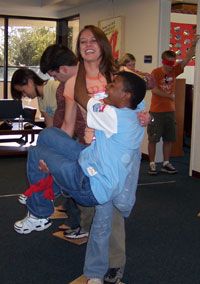 Freshman Kelsey Johnson and Troy
thomas participate in a group
process Saturday, an important
part of the RA application process.
(Photo by Meredith Rodriguez)
One hundred thirty-seven aspiring residential advisors (RA) completed a required segment of the annual RA application process called, “group process” on Saturday. The 29 returning RA candidates were exempt and some observed and helped rate new applicants. That makes a total of 166 candidates for only 68 available spots.
Each position comes with countless challenges and rewards according to Housing and Community Living staff. The most recent challenge includes the elimination of student advisors (SA), a position that has been replaced with an additional RA. As a result, each RA must now room with a resident.
According to junior Ryan Rush, who has served as an RA for two years, SAs were given a stipend but not the RA housing scholarship, though they were often doing the same amount of work as an RA. There was simply too much work involved and not enough compensation.
Having a roommate poses problems for an RA because a resident is not always comfortable discussing a serious issue when an RA’s roommate is present, said RA Molly Oster. “You have to be careful when picking your roommate,” Oster said.
People come to Valoria Richardson, an RA’s roommate, for advice when her roommate is not around.
“I feel like I am an RA sometimes,” Richardson said.
Richardson is also applying to be an RA. She said she hopes being an RA “will help make Pepperdine more of a home instead of just a place I go to class.”
Oster added that having roommates like Richardson makes them more human. No longer segregated in her own room with her own bathroom, Oster said, “Residents notice that I can hang out and have fun too.”
Though RAs such as Oster supervised group process and will sit in on interviews during the next two weeks, residential directors (RD) have more authority in making selections than RAs.
“There is not one cookie-cutter RA,” RD Michelle Pinkham said. “They are as diverse as the residents they will work with.”
HCL staff will use Saturday’s group process as well as interviews and recommendations to choose candidates who are best suited for work in Pepperdine’s ever-changing residential community.
“Group Process is a great way to observe an individual and how they interact with a variety of different people,” Rush said.
Though a vital part of a competitive selection process, Saturday’s group process events were not exactly grueling. Candidates were placed in teams and played familiar games such as Scruples, Cranium and Toxic Swamp. The object of these games was not to win rather it was to demonstrate a candidate’s ability to work with diverse types of people.
“It was difficult at first,” said RA candidate Kyna Pak. “Then I got more comfortable as it went along.”
In spite of the pressure to perform, candidates seemed to enjoy their Saturday event.
“It was a blessing to get to know people,” freshman RA applicant Kelsey Johnson said.
Junior Alicia Burcham agreed.
“It was great working with a whole bunch of personalities,” Burcham said.
Freshman candidate Anthony Alvarado said he believed the exercise would have positive long-term effects.
“It will help us cope and manage next year when facing challenges with new students,” Alvarado said.
Pinkham explained what she and her colleagues generally look for in a candidate.
“Overall we are looking for someone who is self-aware – someone who is aware of both their strengths and their weaknesses and is willing to grow.”
Though no one is eliminated for not being a Christian, a person’s spirituality is a major deciding factor, according to Pinkham and Rush.
“We want someone who is open to having spiritual discussions,” Pinkham said.
However, she added, “we do not want dogmatic Christians.”
Pinkham explained that RA training focuses on how to be a servant leader.
“The center for us is Christ,” she said. “If that is offensive to you then this is not the job for you.”
In an HCL pamphlet entitled, “Risk,” the first RA responsibilities listed are to “Lead with their life and set an example in words, actions and attitude.”
The most obvious compensation for such a daunting task may also be found on this pamphlet.
The RA receives a leadership experience award of $150 for fall training and $1200 per semester. RAs also receive a scholarship equal to the cost of their housing for both semesters. Free room and board is a precious motive for a college student with mounting school-loans.
“However, if that’s you’re motive, then you will be miserable,” Pinkham said. “It is way more work than you think. No one can prepare you for how much work it will be.”
Experienced RA’s seem to agree.
“You are watched by everyone 24-7. It is so hard to be yourself,” RA Jana Wertz said. “You are forced into many situations you wouldn’t normally have to deal with.”
Rihovsky agreed.
“We have to confront awkward situations (such as) documentations and roommate conflicts.”
RAs must also face stigmas, according to Junior RA Karl Kalinkewicz said.
“Often a stigma comes along with being an RA,” Kalinkewicz said.
“People are often wary of what to say around you.”
Many RAs said they struggle to fight against what they call the “cop” stereotype. An RAs duty is much more than simply keeping residents in-line.
“We want RAs to be the resident’s friends and then we train them on how to confront friends,” Pinkham said.
Apart from stigmas and stereotypes there is an incredible time commitment involved.
“Incidents occur at inopportune times like when you’re studying for three finals or you’re in bed,” Rush said.
Freshman dorm RA Steve Serbalik, a Junior at Seaver, likewise expressed how time consuming the RA job is.
“You never know when someone will knock on your door,” Serbalik.
These challenges often give way to immeasurable rewards however.
“To see how people change over the year and to be able to have influence over that is so rewarding,” said Wertz, who said she helped people through eating disorders and alcoholism. “You have to put yourself in their shoes. It’s a challenge. I like that.”
Furthermore, many agree that relationships formed with residents, co-workers and supervisors are very rewarding.
“I have met some of my best friends through HCL,” Rush said.
“As an RA you interact, influence, inspire, motivate, and you learn so much in return – responsibility, patience flexibility, letting go, trusting God with your time and with your residents,” Katie Plummer, a former RA and now an SLA said. “It is the greatest job I have ever had.”
Out of the 68 RA positions needing to be filled, 44 will be put in Dorms, nine in Towers, six in Lovernich, three in George Page and six in Drescher, according to Associate Director of Housing and Community Living, Staci Rothberg.
The RA selection process began at the beginning of December and will end February 22nd.
HCL is a work in progress.
“Every year it gets better and better,” Pinkham said. “More people know what it is about. And less people seem to be doing it for the money.”
Staci Rothberg, associate dean of HCL, who along with the six RD’s will be making the final decisions, said that she has confidence in the group. “While it requires hard work, significant time commitment, prayer and intentionality with each selection decision, the RAs and SLAs chosen for next year will provide the essential leadership needed in the residential community.”
02-03-2005