 ROXANA ASTEMBORSKI/Art & Design Editor
BRITTANY YEAROUT
Assistant News Editor
RICH SCHOOLS INCREASE GRANTS
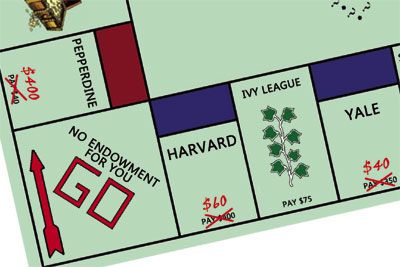
Several high-profile announcements about radical changes in financial aid policies for students at Yale, Harvard and other schools won’t affect Pepperdine students, university officials explained this week.
Harvard recently moved to reduce student loan amounts by replacing loans with outright grants, funded by interest from its massive endowment.
The changes at Harvard and Yale reflect the differences in their endowments versus that of Pepperdine, according to Jeff Pippin, Pepperdine’s senior vice president and chief investment officer. Harvard boasts $35 billion in reserves while Yale has a $22.5 billion endowment. Both schools have accumulated their endowments for more than 300 years, while Pepperdine is only 71 years old with a $734,924,000 endowment.
According to Pippin, an endowment is the permanent investment base of a university, and it represents financial resources above and beyond tuition and fees, allowing the university to build excellence and quality.
“The university’s endowment is very important in terms of providing financial strength and stability, and to lessen an institution’s dependence on tuition and other operating revenues,” Pippin said. “In the long run, better endowed institutions are able to do more things, and all other things being equal, do them with more quality and excellence.”
Relatively speaking, Pepperdine’s endowment is good for its size and age, according to President Andrew K. Benton. He added that every school should do as much as it can do to reduce student loans, but for Pepperdine its financial aid policy needs to reflect reality, and reality is that its endowment is roughly half of what it ought to be in comparison to other premier colleges in the country.
“The challenge is that we find ourselves competing (educationally) with the top 50 to 55 universities in America. We are competing with some of the largest, oldest and most venerable academic institutions and our endowment is ranked lower than theirs,” Benton said.
Pepperdine’s endowment is ranked No. 97 in the nation among both private and public institutions, according to the National Association of College and University Business Officers (NACUBO), the most comprehensive survey of endowments. Also, the one-year investment return (the money that Pepperdine made from investing) as of June 30, 2007, was 18.2 percent, compared to the 17.2 percent average for all institutions reporting to the NACUBO.
“We usually focus more on longer term returns, but feel that the 18.2 percent for 2007 was very good due to our being positioned fairly defensively in what we felt were somewhat pricey markets,” Pippin said. “That defensive positioning should help us in the current market scenario, in which global equity indexes are down 9 to 14 percent as we speak.”
Every year Pepperdine pays out 5 percent from its endowment to scholarships and other operations that are designated by donors and general institutional support. In 2007, the endowment payout was $26 million and $3.8 million went to the scholarship fund.
Benton said that when he became president in 2000 the endowment was $400 million and every year the value goes up through investing, and generous donors making contributions to the endowment.
“Let’s say I woke up tomorrow morning and a donor gave us $100 million,” Benton said. “I would put it into our endowment and then I would use it to reduce loans for students. If we had the wherewithal to eliminate loans we would do it tomorrow.”
Harvard’s “Middle Class Initiative” will affect more than half of its undergraduates and is based on three principles.
First, there is the “Zero to 10 Percent Standard,” which will considerably reduce the cost for families with incomes below $180,000 between one third to one half. Second, Harvard will not anticipate students needing to take out loans. Those loan funds will be replaced by more grants. Lastly, Harvard will eliminate home equity in determining a family’s ability to pay for college, which will reduce the price for affected families by an average of $4,000 per year.
“A great strength of American higher education is the variety of our colleges and universities and the different missions they serve,” said Joshua Poupore, Harvard’s associate communications officer, in an e-mail. “Clearly, one size does not fit all nor would one approach work for every school. We hope, though, that our new initiative will encourage other institutions that have the means to increase financial aid to do so, and to call attention to the issues of access and affordability more broadly.”
Between 2008 and 2009, Harvard expects to increase its annual grant budget by more than 20 percent, from $98 million to nearly $120 million. Yale will boost its budget by $24 million to more than $80 million, according to Yale’s Web site.
Also, families with incomes below $60,000 will not have to pay for their child, those below $120,000 will see their payment cut by 50 percent and those between $120,000 and $200,000 will see a cost reduction by at least 33 percent, according to Yale’s Web site.
Yale student Michael Fan is a sophomore who said he will get to pay less next fall because of the new change.
“My freshmen year it cost my family over $25,000 to come here and it was a financial hassle for my parents,” Fan said. “My mom had to take out money from her retirement fund and that is always difficult. I am in that middle income gap where the college students get hit the hardest with financial aid, and I am very happy with the change in the financial aid policy.”
Benjamin Miller, another Yale sophomore, said his student costs will be reduced by $2,200.
“As a student on financial aid, my reduction in loans will go from $4,500 to $2,300,” Miller said.
Most of Harvard and Yale’s announcements will take effect in the academic year 2008-2009, in the meantime, Pepperdine will continue to invest and receive gifts for their endowment.
STUDENTS IN DEBT FROM SCHOOLING
Kesy Yoon is a senior eagerly awaiting graduation. She will happily receive her degree in public relations but then will face the heavy burden of $67,000 in loans.
“I am not worried about having to pay a large amount at once, but I only get six months after graduation and then I have to start paying back everything,” Yoon said. “It is a very big price you have to pay to get an education.”
Yoon is not alone.
As freshman Chelsea Kadovitz begins her college journey, her excitement is clouded by the vision of future debt.
And junior Nu’uve’a Eshelman has always had to balance homework with work, borrowing $5,000 a year for college tuition while paying for her daily expenses.
The value of education is unquestionable but the high cost is a source of great debate, exemplified by students such as these.
In 2006, U.S. News & World Report said 62 percent of Pepperdine students graduated with debt and of that 62 percent the average debt was $31,718. This puts Pepperdine in the “Most Debt Category,” in comparison to other colleges such as Harvard University, where 42 percent of its students graduate with debt that totals to an average cost of $9,717.
“Everybody is concerned about their debt,” said sophomore Mason Jordan, who is going through the process of applying for financial aid. “It is just one of those overwhelming things that you know is always going to be there no matter what you do and you just take it all in stride.”
Eshelman is from Hawaii and majoring in advertising. She has been awarded the Pepperdine Christian Service Award and the University Alumni Scholarship and said she wouldn’t be at Pepperdine if it wasn’t for every piece of financial aid she has been given.
“I am really grateful for the money Pepperdine has helped me with,” Eshelman said. “I have been really careful about what internship I am applying for. I am only applying for those that have a real possibility of turning into a job, not just for the credit. I need to promise myself that I have a job before I graduate because my family doesn’t have that much money.”
However, Eshelman said that Pepperdine is worth the expensive cost because of its motivational atmosphere, whcih her professors create to help her succeed.
“I am not scared of being poor again, because I have been poor and also I am confident that the skills I have gained here and the connections that I have made will do well for me in the future,” Eshelman said. “I am really excited for the internship I just got (Internet Advertising for ARENA Network). I feel more prepared I think than people who have had to lean on their parents, so I am not scared.”
Yoon is also pleased with her Pepperdine education, but said since she will be graduating this year her parents are putting pressure on her to find a job so that she can start paying back her loans.
“I don’t think it should cost this much to get an education because in a lot of other countries college is free,” she said. “However, going to Pepperdine is worth it — for me it is worth it.”
Besides students paying $34,700 a year for a Pepperdine education, the grand Malibu location doesn’t help with other expenses.
Francesca Smith, a second-year communications graduate student, has a full scholarship and a stipend, and she said that everything is too expensive in Malibu.
“It is hard to find cheap places to eat and even the market is more expensive,” Smith said. “It is really hard to get off campus and find a lot of things to do. Some of the basic stores that you need, such as a Target, Home Depot, or even a video rental place are through the canyon, so you need a car, which also means gas money.”
Many students at Pepperdine are looking into furthering their education post graduation.
However, people with undergraduate debt are less likely to pursue graduate school, according to The Project on Student Debt, an organization that works to increase understanding and public awareness of student debt.
It reported that in 2002 more than 40 percent of college graduates who didn’t pursue graduate school blame student loan debt.
Kadovitz is a freshman who agreed that her loans might play an important role in whether or not she goes to grad school.
“I really want to help my mom out as much as I can because I don’t think it is fair for her to have to pay for all of my loans,” Kadovitz said. “I want to help her out as soon as I graduate, but then that will affect whether or not I go to grad school because I am thinking I need to get a job so that I can help pay off my undergrad loans before I take on grad loans.”
01-31-2008