
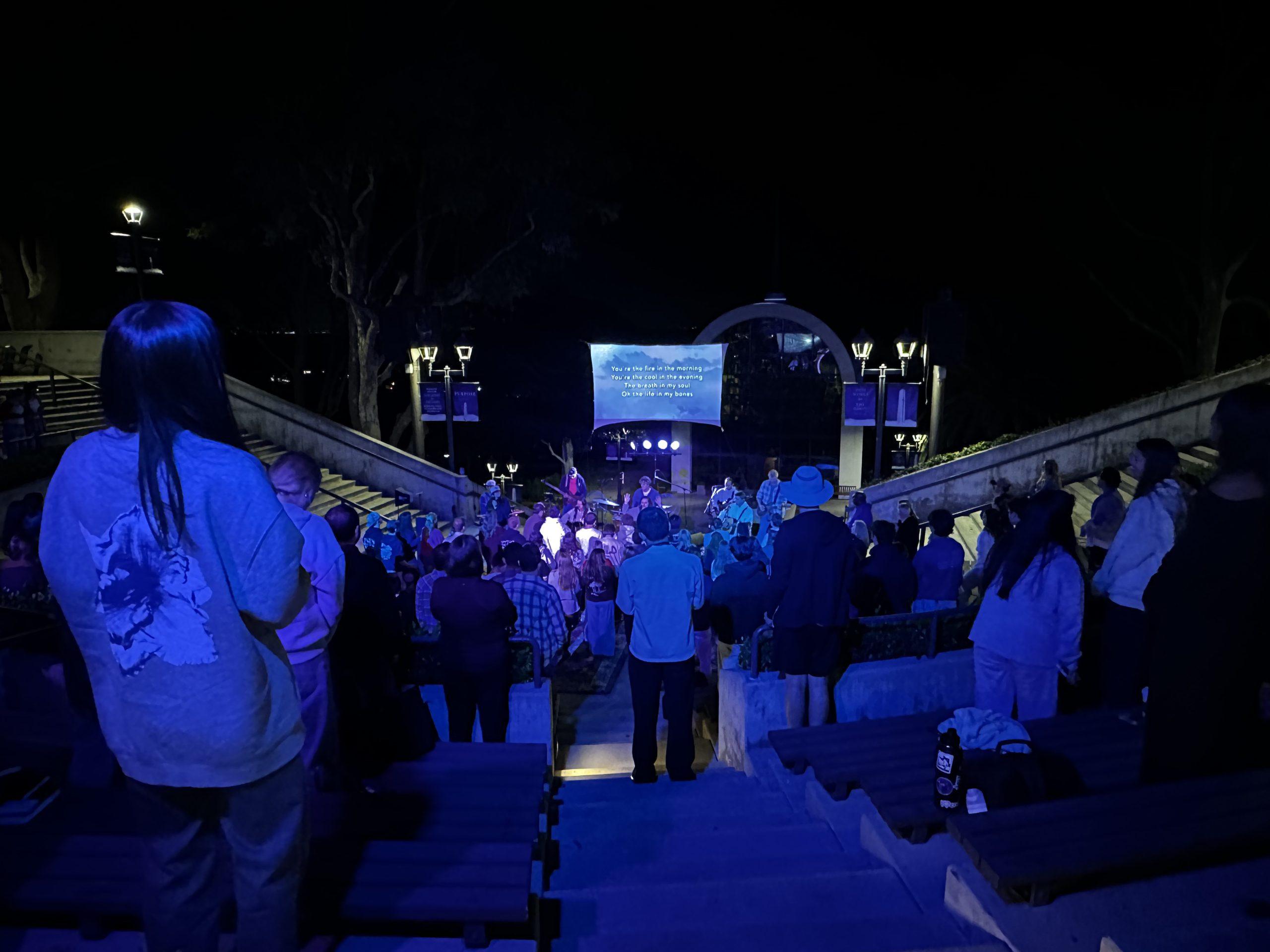
Pepperdine students gather at the Well on Oct. 15 at the Amphitheatre. The Well is one of the weekly University-hosted spiritual gatherings that bring the community together to worship. Photo by Christine Park
As young students at Pepperdine walk a life of faith, they are sometimes faced with navigating hard questions in a secular world. The University offers an educational experience that takes both a Christian faith-framed and religiously diverse approach to explore identity in a changing world, said John D. Barton, former director of the Center of Faith and Learning, in a 2019 lecture.
While attending Pepperdine, undergraduate students have opportunities and requirements to participate in a variety of diverse chapels, Religion courses, interfaith organizations, worship services and other activities to grow in their spiritual journey. A Christian education plays a role into how young students foster values such as love, justice, morality and integrity in a secular society for a well-prepared life, according to the Journal for Freedom of Conscience.
“Faith puts you at a higher standard because you’re not just looking at what you believe because our opinions change all the time,” said junior Olivia Spivey, vice president of external outreach of Seaver Global Justice Institute. “I feel like we’re always growing and we’re always changing, but the Bible stays the same.”
How Faith Takes Shape at Pepperdine
Though a Christian institution, Pepperdine students make up a diverse body of religious affiliations and denominations.
As of fall 2025, within the student body, 60.2% identify as Christians that are not Church of Christ nor Catholic, 21.2% as Catholic, 4.5% as Church of Christ, 5.3% as Jewish and 8.8% as none, according to the Office of Institutional Effectiveness.
The steady decline of Americans identifying as Christians has stabilized due to Generation Z not abandoning the faith at the same rate as previous generations, according to City Journal.
Junior Liza Shevetovska serves as president of Veritas Club, a student-led ministry on campus.
Shevetovska comes from an Orthodox Eastern European family, and said her faith wasn’t shaped with a deep understanding of scripture but rather due to cultural ties. Now, her faith has branched out to different groups of faith systems more spiritually and connected her material life to spiritual life.
“Only in Pepperdine, when I found such a big community of people who stick to the same faith, mostly Protestant, which was very new to me, almost like discovering a new religion at home,” Shevetovska said. “That shaped what I have consciously been practicing, following and reading scripture.”
Junior Noah Shifter, vice president of operations of Veritas, said his faith background comes from a different denomination.
“I probably am closest to a Baptist, but like an old Baptist,” Shifter said. “It’s kind of hard to explain. There’s this thing called the Baptist Confession in 1689 London, and I think a lot of that is what I believe.”
As for Spivey, she said she grew up as a Christian, and chose a faith-centered lifestyle for herself in high school. Since then, her faith has been the center of everything she does.
Spivey said she stays grounded daily in her spiritual life by reading the Bible every morning and listening to worship music, which to her is a singing vessel of prayer to the Lord. She said it helps to stay grounded in the spiritual life at Pepperdine by going to campus Bible studies and the Well, which takes place every Wednesday night at the Amphitheatre.
“Surrounding yourself with that outlet of people who are trying to pour into the same beliefs that you’re pouring into, you’re able to even have the Lord speak through them into certain things in your life,” Spivey said. “So, it’s not just really a journey by yourself, but rather also a journey with other people around you.”
‘All Morality Comes from God’
Derek Estes, Religion and Ethics professor, said he believes in a theological perspective on the concept of morality.
“Everything else that exists besides God is made by God,” Estes said. “That includes obviously the natural world, the Earth, the sky, the seas, stars and animals. But, all the non-physical things too. God creates, also, morals. Ultimately, I think that morality comes from God since everything comes from God.”
Morality is can be used “descriptively to refer to certain codes of conduct endorsed by a society or group, or accepted by an individual for her own behavior,” according to Stanford Encyclopedia of Philosophy.
Usually, most Christians think right and wrong can be determined by reason alone, without any divine revelation, Estes said. For example, why lying is considered universally bad is not because of God, but rather due to the moral intuition in every being.
“Objectivism is just the view that there are objective rights and wrongs that are independent of my view,” Estes said. “Relativism is the view usually that my views determine what is right or wrong. The problem with relativism is that it will probably make lots of things permissible that clearly are not permissible.”
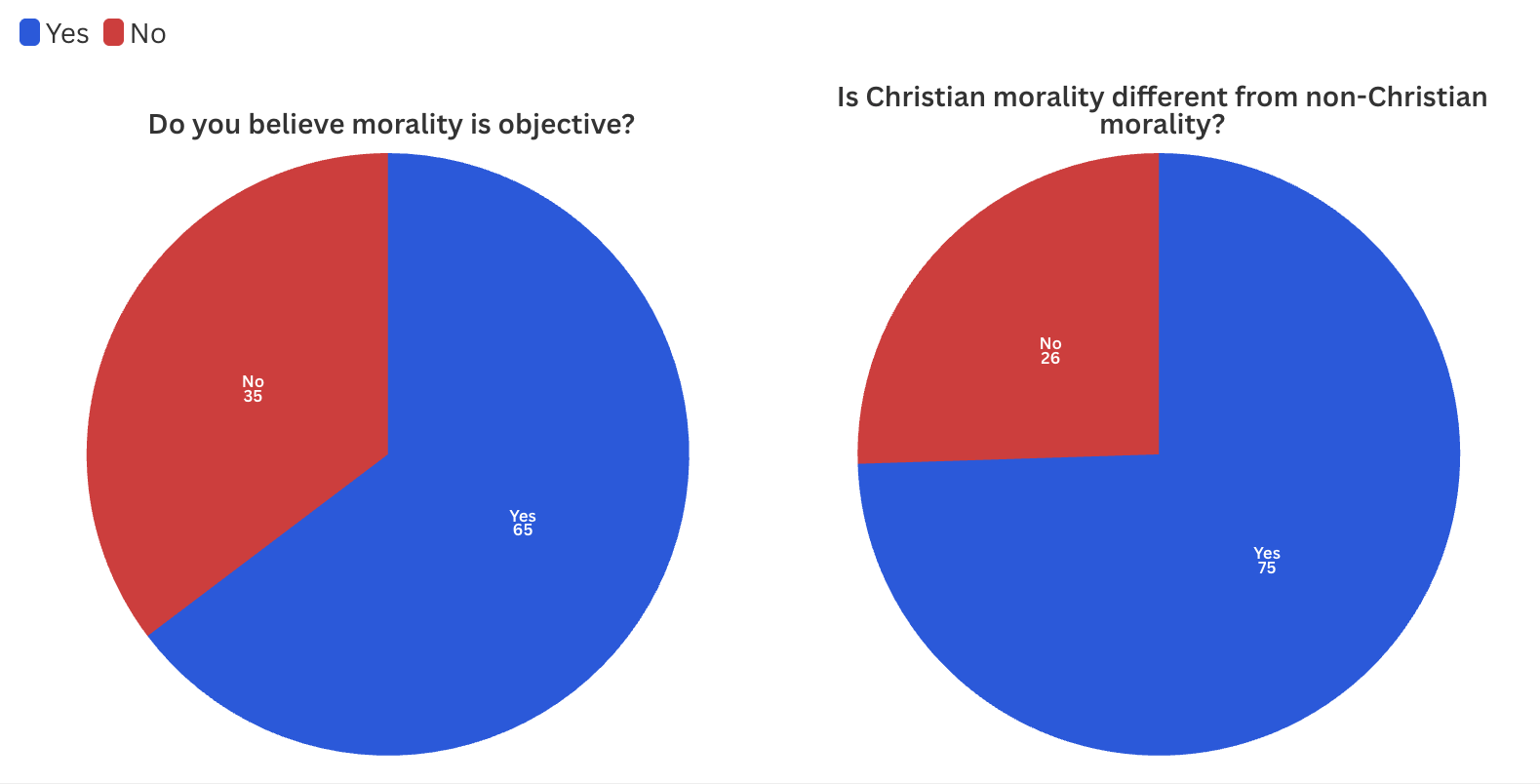
A poll conducted on a sample of 51 Pepperdine students found 64.7% believe morality is objective. In addition, 74.5% of the 51 students responded they believe Christian morality is different from non-Christian morality. Infographics by Christine Park
Estes used the example of slavery, from 6,000 years ago up until 100 to 120 years ago. In the U.S., a culture existed where slavery was thought to be good, and if one was to hold a relativist view, they would answer the question of whether slavery should be allowed as ‘yes’ during this time. However, if one were to be an objectivist, the answer would be ‘no.’
“Patriarchy has been the norm, sexism has been the norm, racism has been the norm, slavery has been the norm, genocide has been the norm in most cultures at most times in the world,” Estes said. “And we have morally improved since then. It seems pretty clear to me. And that is only possible if there are objective norms that we can get from objective morality.”
Yet, disagreements exist even among Christians, where there are different opinions on how morals are applied.
Christians disagree on certain grey areas, such as killing, Estes said. Christian pacifists think killing is wrong in every circumstance: for self-defense, capital punishment, abortion and even to protect one’s family. Other Christians believe killing in self-defense and even in war is permissible.
But Estes said this is not due to disagreeing on what morality is. Rather, the reasoning of explaining morality is where the different opinions come in.
Looking toward what God would have her do in certain situations, or what the Bible says, is where Spivey said she attains the guidance to determine what is right and wrong. It’s looking not at her own understanding, but the Lord’s.
Sometimes, having open dialogue with non-religious people about the morality of controversial topics requires finding areas of overlap, Estes said. This can be done by converting religious reasoning into non-religious logic.
Estes, for example, said he makes an argument against abortion by appealing to the fact that everyone considers drinking alcohol while pregnant to be bad, as it can cause fetal alcohol syndrome. Then, Estes argued, if harming a fetus is bad, wouldn’t it be possibly worse to potentially kill the fetus entirely?
Navigating situations where the Bible is silent requires thoughtfulness and prayer, Estes said. God doesn’t want followers who robotically follow the law, but wants us to be reflective, full people who have a relationship with Him.
“God has a set of values, things he cares about, things that are in his nature,” Estes said. “Love, joy, peace, patience, kindness, goodness, faithfulness, fruit of the spirit. We should reason on the basis of those things and make good choices, and I think there’s some room for God to be understanding when we’re not perfect on those choices.”
Hook-up Culture and Relationships Grounded in Love
Romantic relationships can pose different challenges for young people of faith. Of 12- to 21-year olds who are sexually active, 70% are reported having uncommitted sex within the last year, according to the Institute for Family Studies.
Hookups can be defined as “brief uncommitted sexual encounters between individuals who are not romantic partners or dating each other,” according to the American Psychological Association.
“I realize that we’re all made in God’s image and by viewing everyone like that, it allows me to shape my relationships in the sense that no one is a bad person,” Shevetovska said. “No one probably wants to do bad. Everyone just wants to be loved. That helps me try and understand people rather than turn away from people or judge them.”
Shifter said his faith tells him the purpose of dating is for marriage and a reflection of one’s willingness to self-sacrifice.
“I think of it [hook-up culture] less as something that people are doing wrong,” Shifter said. “It’s more so ignoring a hundred bucks on the ground to go pick up something else. I think the sacred union of marriage, as I was talking about in Ephesians five, is just so beautiful and holy and good that I don’t want anything to come in between me and that.”
Spivey said she was someone who wanted a relationship that was intentional. She is engaged to her high school sweetheart and makes sure the core of their relationship is looking toward what God would want.
“I always had this image of, ‘If I’m gonna date a guy, it’s because I see him as being the type of person I would want to marry,’ because relationships can end one of two ways,” Spivey said. “You either break up or you get married.”
The consequences of hookup culture often leads to “negative emotional outcomes” and “heightened symptoms of depression and anxiety,” according to the Institute for Family Studies.
Estes said leading a life with no commitment to anyone else at more than a hookup, most of the time, leads to a pretty sad life.
Beyond hookup culture, love can mean different things to different people. For example, the LGBTQ+ community encompasses many sexual and gender identities of Pepperdine’s student population.
Sustainability Professor Chris Doran has been a vocal advocate and mentor for LGBTQ+ students at Pepperdine. He provides open conversations on LGBTQ+ topics from a Christian perspective through his work in lectures and conferences for churches, according to the Pepperdine Seaver faculty page.
“The rates of anxiety, depression and suicidality in the LGBT community are far higher than they are in the general population across the board, and I share that with churches not to scare them, but to say, ‘You need to realize that part of why this is, is because a lot of those folks feel like they don’t have a home,’” Doran said. “And so why wouldn’t they be anxious or depressed or suicidal if they don’t feel like they fit into any community?”
LGBTQ+ students can hope to find community within Pepperdine, through things such as the Gender and Sexuality Alliance Crossroads club on campus, finding support and counseling in the Student Counseling Center or with faculty and professors who are there to support their students, Doran said.
“Often, heterosexual, straight folks feel like queer people need to tell us what they want and what they need and that’s not fair on anyone,” Doran said. “We shouldn’t expect people that are in the minority position in society to somehow have to articulate all their needs and wants, when most of the time, they just want to be treated as human beings. I think our queer community on campus, that’s all they want, is just to be treated like a human being.”
Christian Politics in a Pluralistic Democracy
Knowing how Christians should engage in politics is a question students in her Religion 300 class engage with all semester, considering a nation founded with religious liberty and with no national establishment, said Christina Littlefield, Communication and Religion professor. Littlefield also serves as the advisor for Currents Magazine, which is part of Pepperdine Graphic Media.
“You can do that in a secular democracy when you have religious liberty for everyone to bring their faith to bear, everyone to, you know, here’s what my faith says, but leave room at the table for other people of other faiths and other worldviews to do the same,” Littlefield said.
Making a law based on religious belief is implicitly treating those people as of greater value due to giving preference to their religion, Estes said. However, it prioritizes secularism as well.
“The problem is that’s not neutral,” Estes said. “It is impossible for us to be neutral because if we say no religious beliefs are allowed, that inherently privileges non-religious beliefs. If you say you have to convert your religious beliefs into secular language in order for it to be acceptable in public discourse, then you are limiting religious belief.”
Christians can be in the government and with reason try to influence policies and the culture for the better, but do so rather carefully when wielding certain power. A serious temptation follows to strong-arm people into being Christian and doing things a way that non-Christians’ hearts don’t accept and will often cause more harm than good, Estes said.
“When is a Christian advocating in a way that seeks the flourishing of all and is inclusive of all or welcoming, at least, of all voices, recognizes their one voice of many at the table?” Littlefield said. “And when is a Christian or other person of faith trying to dominate or push their own viewpoint on others?”
When religiously motivated legislation is pushed on everyone that not everyone agrees with, that is where tensions start to arise, especially happening even today, Littlefield said. These issues can include abortion access, same-sex marriage and transgender rights.
Many of the tensions that exist today in the political sphere can be labeled as political polarization.
“Political polarization among Americans has grown rapidly in the last 40 years — more than in Canada, the United Kingdom, Australia or Germany — a phenomenon possibly due to increased racial division, the rise of partisan cable news and changes in the composition of the Democratic and Republican parties,” according to Brown University.
A possible factor into the current political polarization are the dynamics that play out when a religious ideology becomes a forefront of a current administration.
Currently, Christian nationalism is in power through the Trump administration, and can be seen in extreme forms from his top influencers, like Secretary of War Pete Hegseth and Russell Vought, director of the Office of Management and Budget, Littlefield said. This movement brought him to power and through the Project 2025 federal policy agenda, its playbook is being instilled.
As a political conservative himself, Shifter said his faith continues to take shape in politics.
“You’ll see Christian nationalism everywhere in the headlines,” Shifter said. “What does that even mean? I think for Christians, we ought to be Christians first. Certainly above political party, but even above country.“
Each individual Christian must recognize how other ideologies might shape how they weigh and view scripture for themselves and decide what is the best path forward, Littlefield said.
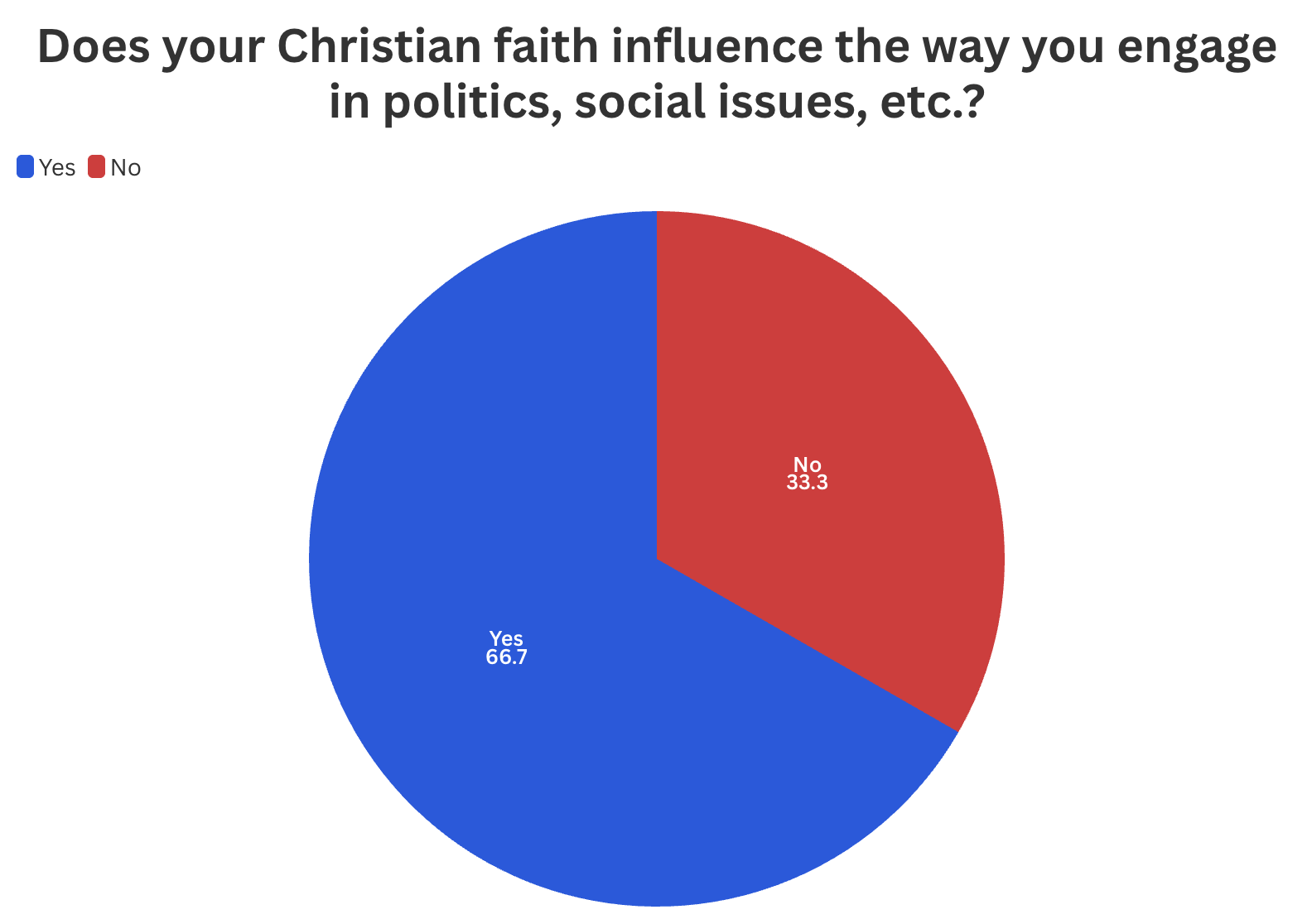
The poll reports about two thirds of students feel their Christian faith influences the way they engage in politics and social justice. The remaining third felt their faith does not influence their engagement.
The political divide in Christianity comes down to the difference in how scripture is interpreted, Littlefield said. Conservative Christians tend to look at scripture through an infallible lens, taking the original manuscripts without fail, while progressive Christians look at it through more of a critical lens.
“Scripture is God-breathed and it’s authoritative for our lives,” Littlefield said. “We have to take it seriously. We have to wrestle with its whole and ‘What does it mean for our lives?’ and strive to interpret it and apply it in the most faithful way possible.”
From a student perspective, navigating the political climate at Pepperdine can offer contrasting views.
“In the Pepperdine community, everyone tries to maintain an image of friendliness [and] peace, which on one hand helped us stay away from the outcomes of big colleges, like Harvard, Columbia,” Shevetovska said. “So, on one hand, we kind of stay clear. On the other hand, I think it creates a sort of bubble of living in a fantasy world and keeping to oneself.”
It’s important as Christians to learn to approach politics from a mature standpoint, Spivey said.
“Whenever you kind of paint everything black and white, you’re missing the whole point,” Shevetovska said. “Yes, we have to be against evil, but we have to remember that evil never appears as evil. Evil will always appear very similar to good.”
At Pepperdine, political polarization seems to be handled a lot better, where many students are able to meet in the middle even on extreme issues, Spivey said.
“The student body, just a few years ago when they [previous students] did the study, was diverse,” Littlefield said. “But slightly more democratic, slightly more left of center. Today, I think that is shifting. I think we are shifting toward more moderate to more right of center.”
A possibility as to the growing shift, specifically at Pepperdine, could be that the current generation’s ‘coming of age’ years were influenced so sharply by Trump, Littlefield said, hinting at his start of presidency back in 2016.
Regardless of political affiliation, being at Pepperdine gives students the advantage of being in a space of intellectual diversity, Littlefield said.
“I would use this time to practice having those [hard] conversations because you never know what the atmosphere is going to be like, whatever career or whatever you go into,” Littlefield said. “And this is really the safest place, the most diverse place to engage ideas that are different than your own and practice articulating what you believe and why.”
God’s Intended Purpose for Us
Doran said the Bible gives perspective on how intentional Christians are to be about their purpose given their time here on Earth.
“The Bible is meant to talk about who is God, why is God talking to us, why are we put on this place [world] to do something?” Doran said. “And, if we are, what are we put here to do?”
We still continue to ask the same questions, but our answers are going to be different, Doran said. We’re wearing glasses from the 21st century, while biblical literalists were wearing glasses from two to three thousand years ago. They didn’t live in an environment where electricity, women’s rights and homosexuality were perceived to exist.
“It’s really educating yourself and learning about what’s going on in our country and our world, because I do believe, obviously, God cares about our world and so it’s important for us to be able to be educated in that as well,” Spivey said.
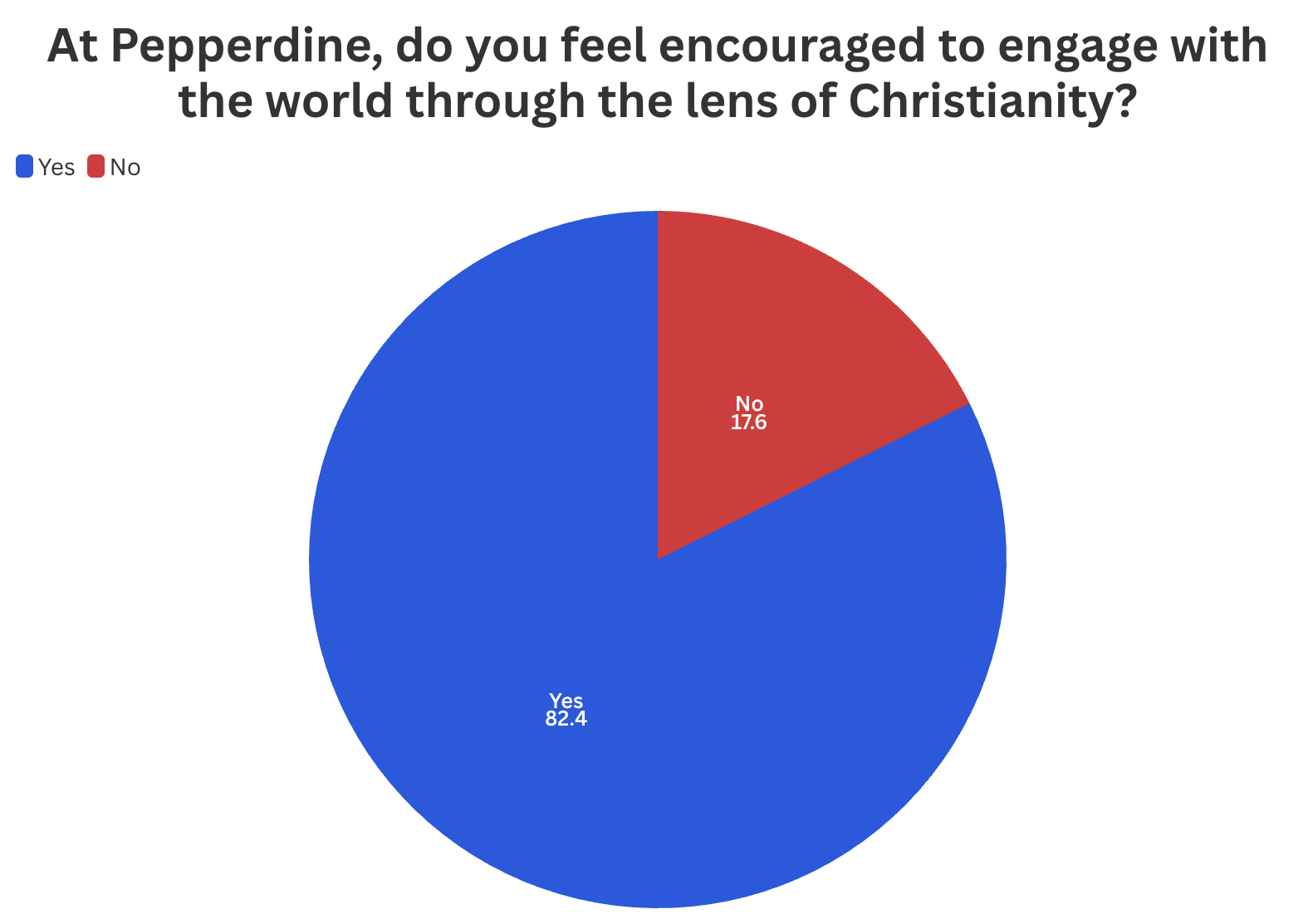
The poll reports that 82.4% of students feel Pepperdine encourages them to engage the world with the lens of Christianity. 17.6% felt otherwise.
In scripture, it talks about protecting the foreigner, the widow, the orphan, the weak and the marginalized, Littlefield said.
Throughout American history, social movements, such as civil rights in the ’60s and ’70s for equal rights for Black, other people of color and Indigenous people came from Christians, Estes said. Martin Luther King, Jr, civil rights activist and pastor, is a clear example of how Christians have influenced the law and culture for the better.
Inspired by the civil rights movement, the Environmental Justice (EJ) movement became widespread in the 1980s, intersecting environmentalism and social justice. EJ encompasses the just treatment of all people to ensure protection and equitable access to a healthy, sustainable and resilient environment, according to the University of Michigan.
Doran said our collective inability to see our role in creation and act within sustainable boundaries causes pollution, biodiversity extinction and inability for people to breathe clean air, which can be considered an ecological sin in God’s eyes.
“Christians should be involved in the political aspect of this because no environmental problem can exist just as a local issue,” Doran said. “And so just because the way our democracy works, you have to work that out through legal and political and legislative challenges.”
Sometimes being involved in sustainability politics requires a system of trade-offs, Doran said. It can feel like compromising some of your own values, but knowing how to navigate it is necessary work in a democracy.
“In general, people hear there’s climate change and there’s global warming, but I think it’s one of those things they think their effect is so small, it’s not going to be a big deal,” Spivey said. “If they throw a piece of trash or they don’t recycle, well, what difference am I making?”
However, looking at how biblical texts illustrate humans and non-human creatures interacting means it should be respectful of how we interact with the rest of the planet God has given us, Doran said.
It is the same as how our physical bodies are considered the Lord’s temple and therefore in our best interest to take care of and make strong and healthy within our short lives, Spivey said. Similarly, the Earth is a temporary home that God gave us, so why wouldn’t we try our best to take care of it and make it beautiful?
One way Pepperdine students can combat the climate crisis is by being mindful of our everyday diet, being more carbon friendly and eating more plant-based foods and less meat and cheese, Doran said. Another way is taking a step back and being more practical in material consumption.
“What am I doing to honor God in this particular field?” Spivey said. “I think that should be more talked about and people realizing that their personal choices actually can make a huge difference.”
As faith and society continue to evolve, young Christian students will continue to wrestle with questions on how to define their morality. Yet, it’s reflecting on God’s Word in the forefront of their principles that guide living out a life of faith, Estes said.
_________________________________
Follow the Graphic on X: @PeppGraphic
Contact Christine Park via email: christine.park@pepperdine.edu