
‘Kill Bill’ combines graphic violence and brilliant storytelling. Is anyone surprised?
By Peter Celauro
A&E Editor
When Quentin Tarantino released “Jackie Brown” in 1997 and began his six-year break from moviemaking, many film aficionados mourned the loss of a genius in an industry where true ingenuity is always lacking.
Many others thanked the good Lord that the long string of violent, vulgar and non-chronological movies had finally come to an end.
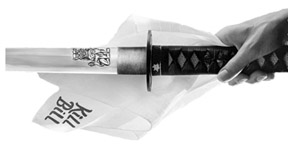 No matter how they felt, however, almost all moviegoers must have felt their interest piqued when they first saw the previews for “Kill Bill” — Tarantino’s two-part epic that will undoubtedly knock everyone who sees it on their rumps.
PHOTO COURTESY KILLBILL.COM
“Kill Bill” tells the story of a bride (Uma Thurman) who finds her wedding party slaughtered by the “Deadly Viper Assassination Squad” — the crew of which she was once a part. The gang is composed of five lethal killers (whose mugs you’ll quickly recognize) and headed by Bill (David Carradine), a man so ruthless, he takes the liberty of executing “the Bride” himself.
Or so he thinks.
In the tradition of countless films before it (most of which Tarantino probably watched and used as references for this one), the bride awakes from her coma four years later with severe muscle atrophy and a bad hunger for revenge. What makes matters worse is that the massacre took the life of her unborn child, so she’s really ticked off.
You don’t have to love kung-fu movies to appreciate what happens next. But you must have at least some predilection for it to sit through the whole thing. The audience spends most of the movie watching “the Bride” take on the gang (and their hired help) one member at a time, with much samurai sword-swinging and gushing of blood. I don’t want to spoil it for you, but I will reveal there’s a great deal of limb-loss and even a spanking.
What makes “Kill Bill” so unique, however, is that it’s beautiful. Tarantino is a master storyteller, piecing the movie together in non-chronological chapters that give the audience the plot bit by bit and leave viewers longing to know more. At the end of the film, moviegoers have seen enough to feel that they’ve watched a great movie but haven’t yet seen the whole story — volume one ends in the cliffhanger to end all cliffhangers.
Tarantino is also a master cinematographer. “Kill Bill” is chock-full of vivid colors and interesting lighting schemes. The style of film is ever-changing, with some scenes in black and white and even an anime sequence telling the background of one of the characters. The set is varied and always visually appealing. The martial-arts choreography (orchestrated by Yuen Wo-Ping, who also worked on all three “Matrix” films) is first-rate and does justice to the countless kung-fu classics that inspired it.
The soundtrack is good, too. It boasts a wide range of musical styles and composers. Everyone from Wu-Tang Clan’s the RZA to Quincy Jones made contributions, all of whom do a good job of creating the mood and keeping the film rolling.
So there it is. If you want an exciting, moving, well-written and beautifully filmed movie, see “Kill Bill.” If you want a bloodbath, see “Kill Bill.” If you want Uma Thurman, take a number. (And then see “Kill Bill.”) But beware — it truly is one of the most violent, bloody films in the history of American cinema. And yet, somehow it’s also truly a joy to watch.
October 23, 2003