
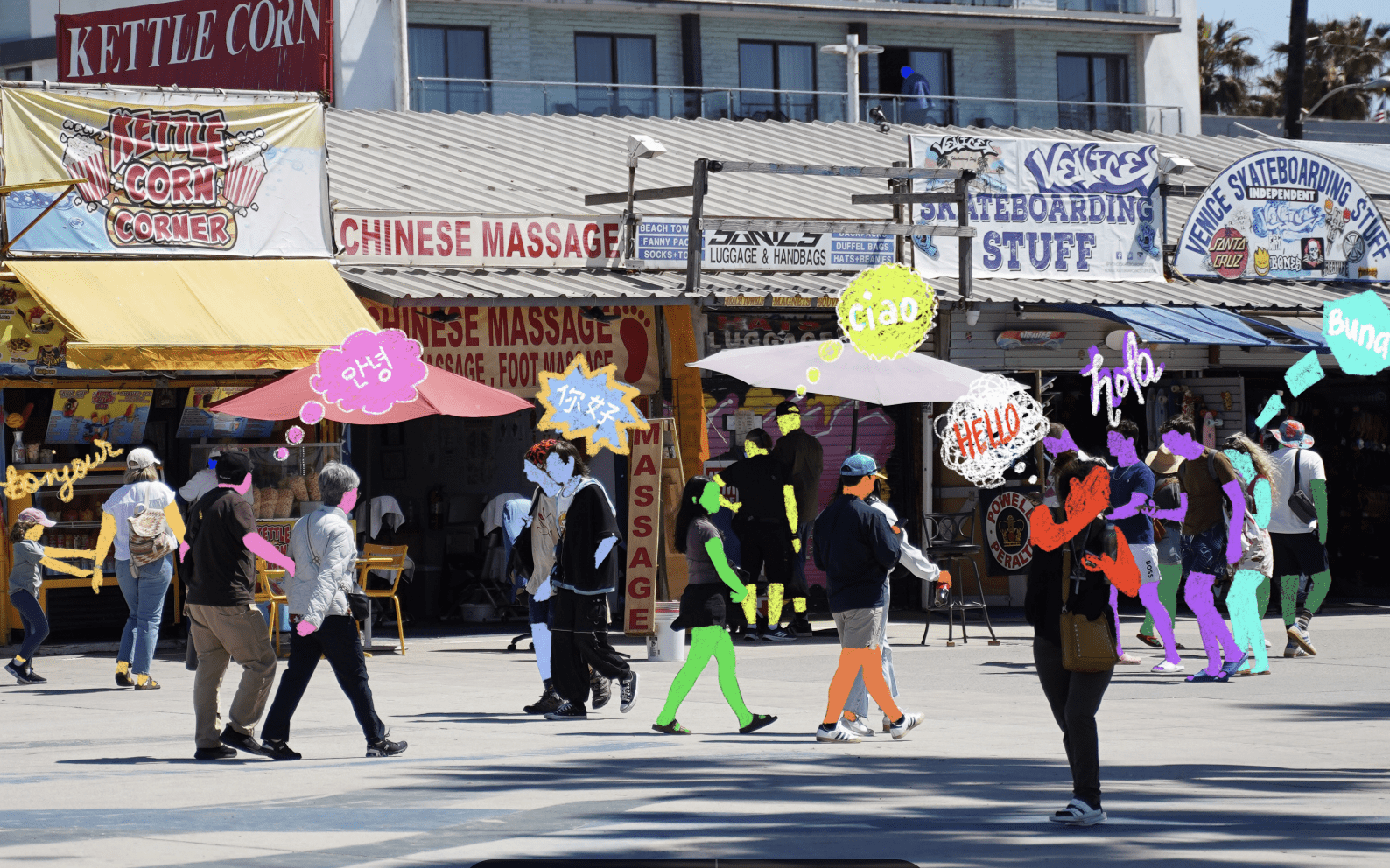
People walk on the Venice Beach Boardwalk on March 31. Venice Beach is filled with both tourists and locals, where a mix of languages can be heard all around. Design by Christine Park
In a country where hundreds of cultures are constantly interacting and meshing, some students find themselves connecting through a shared foreign language.
Over 80 countries are represented through Pepperdine’s international student body, making up 10% of the University’s student population, according to Pepperdine University. Additionally, the University is filled with second-generation Americans who share parts of their family’s culture with others on campus, including language.
“Culture is a big umbrella, and language is just a way to be able to express culture,” said Sharon Wakio, assistant director of Intercultural Affairs for International Student Engagement.
Natalia Geller, a native Spanish-speaking senior at Pepperdine, found connections in a new country through her native language. Seniors Elen Arustumyan and Annie Markarian said they formed a friendship where they bonded over language and their shared culture.
An Armenian Bond
Arustumyan was born and raised in Armenia and moved to Massachusetts at the age of 10. Arustumyan said the Armenian population in Massachusetts sometimes doesn’t speak Armenian, but being a student at Pepperdine gave her a new opportunity to speak her first language again.
“Coming to California was basically like the best decision I’ve made because I got the opportunity to meet people who speak the same language that I do — who speak the language that I grew up speaking,” Arustumyan said.
Aside from the language differences, Arustumyan’s move to the West Coast brought her to a state that has a significant Armenian population. California has over 200,000 Armenians, while Massachusetts has an estimated 27,000, according to World Population Review. Los Angeles County has the largest Armenian population outside of Armenia, according to LA County.
Arustumyan and Markarian said they initially met each other in their first year at Pepperdine. They recognized their shared Armenian identity, but never had a conversation with each other — they shared smiles and waves but not words.
Toward the end of their sophomore year, Arustumyan said she was looking for a roommate. She reached out to Markarian, beginning a new friendship.
Besides bonding over their shared heritage, the two also bonded over language.
“At times, when I didn’t know how else to explain myself, I would just switch into Armenian and just talk to Annie in Armenian, and Annie would just respond in the same language,” Arustumyan said.
Wakio said when people have a shared language, there is an assumption of a basic understanding of the culture that is represented through those words.
“Both of us speaking the same dialect was definitely a plus,” Markarian said. “Jokes were easier to understand, even just describing something or how our feelings were, how the day went, it made it funnier and more authentic or genuine.”
Markarian went on to say, “Saying something in your native language was just more freeing in some sense, because we were better able to understand each other.”
Markarian said she felt more at home at Pepperdine because of the Armenian community here. Both Markarian and Arustumyan are part of the Armenian Students Association (ASA) and said being around their fellow Armenian students feels like home.
Arustumyan discovered her connection wasn’t just limited to bonding over the Armenian language. She said she even formed a connection with another Armenian student through speaking Russian.
Rather than making a conscious effort to speak the Armenian language with others, Arustumyan said she naturally finds herself speaking it whenever those around her can understand. Both she and Markarian said it was important to preserve their language in a country where it’s not the dominant language.
“Perserving your language — the Armenian language — is super important,” Arustumyan said. “The language is what carries our traditions, our values, our humor and idioms.”
Navigating a New Country
Geller came to Pepperdine four years ago, embarking on a new chapter of life in a new country far away from her home in Lima, Peru.
Before coming to Malibu, Geller didn’t go to an international school. In her first year at Pepperdine, she said she didn’t meet anyone that spoke Spanish, forcing her to learn a foreign language by jumping in with both feet.
She tried to advance her English by watching movies without subtitles. Geller said she also spoke a lot with her grandmother, who was from the United States.
In the following years, Geller formed multiple friendships at Pepperdine from hearing a familiar accent in class.
“It’s kind of like a really nice conversation starter,” Geller said. “People will always find ways to talk to each other and kind of find out [where they’re from].”
Wakio said there should be a good balance of expressing oneself through one’s native language — people can still practice their native language while also putting themselves in situations where they can learn and practice a new language.
Geller now finds a balance between her two languages. When she speaks in Spanish, she said she thinks in Spanish, but when she speaks in English, she thinks in English.
“It feels like you’re changing personalities when you’re speaking a different language,” Geller said. “I feel like English is more classy and then Spanish is more energetic.”
Geller’s biggest obstacle in learning English is the large amount of slang casually used in the language. She said if she’s in a one-on-one situation, she’ll inquire to understand the slang, but in a group setting, she doesn’t ask.
Geller said she came to Pepperdine undecided on a major, and eventually picked Integrated Marketing Communications (IMC). A Business Ethics class ignited her interest in Philosophy, and she took on the topic as a minor.
She then learned how to express herself better and argue logically, as well as becoming a better writer and speaker.
While English isn’t Geller’s first language, she now feels that she is completely fluent. Some of her best friends are English-speakers, and she said she’s able to jump that bridge and connect deeply, making profound connections.
Language, in the larger context of culture, can serve as an entryway for connecting with others, whether they’re international students, first-generation Americans or second-generation Americans.
__________________
Follow the Graphic on X: @PeppGraphic
Email Nick Charkhedian: nareg.charkhedian@pepperdine.edu or via Instagram: @nickcharkhedianjournalism