
Amy Larson
Staff Writer
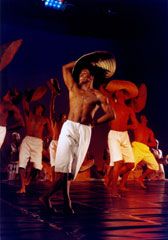 Photo courtesy
Columbia Records
Bale Folclorico da Bahia, an award-winning performance team, will be appearing in the Smothers Theatre at 8 p.m. tonight
This is the second time Pepperdine has hosted this performance troupe. Marnie Mitze, managing director for the Pepperdine University Center for the Arts, said she is excited to have the company return to campus.
“This is a unique culture that a lot of people are not aware of,” she said.
Pepperdine wants to do as much as it can to give the students a knowledge and appreciation of diverse cultures, Mitzi said.
Junior Danielle Sotelo, who went to Brazil last year while studying abroad in Buenos Aires, said the Brazilian culture is worth discovering.
“After visiting and exploring Brazil on my own I have found the culture exciting and bright and the people welcoming and happy in themselves,” she said.
“I encourage people to learn the culture, and for the people who can’t visit the country to at least watch the ‘bale’ to get a small taste of the country.”
Mitzi agreed that learning about new cultures is part of the reason this dance troupe is coming to Smothers.
“We want to introduce as much cultural diversity as we can,” Mitzi said. “We’ve also hosted the National Dance Company of the Philippines, and the National Dance Company of Spain.”
Mitze said some of her favorite aspects of the Bale Folclorico are their extraordinary costuming and vibrant energy.
Walson Botelho, the co-creator and director of Bale Folclorico da Bahia, said he prides the performance team on being.
“We have a different way to entertain people,” he said. “It combines modern dance and older Afro-Brazilian dance. The ability to dance older folkloric dances as well as other, more contemporary types is one of the biggest differences between Bale and other types of dance companies.”
Additionally, Botelho said, Bale Folclorico is exceptional because it is able to put its own individual spin on older, more traditional dance routines.
“We are able to do a contemporary revision of the traditional dances of Bahia, he said. “We try to keep close to the folkloric dance, but we have a modern way to show it.”
One of the key pieces of a successful Bale Folclorico performance is the audience. Audiences are so necessary, Botelho said, because they have a definite connection with the performers.
“We are able to show the people,” he said. “They can feel exactly what we want to say.”
This troupe, which The New York Times has called “exuberant and virtuosic,” combines 38 dancers, singers and musicians. Viewing a Bale Folclorico performance is a cultural education, as they perform “Bahian” folkloric dances of African origin.
Examples of these unique dances include samba, capoeira (a style of martial arts), slave dances and dances to specifically celebrate Carnival.
Created by Botelho and Ninho Reis, Bale Folclorico is the only professional folk dance company in Brazil. Though they have received many honors, Bale Folclorico is a relatively new group, founded only 16 years ago.
In the short time of its existence, the group has been quite celebrated, gaining critical acclaim throughout the country.
The debut for this company was no small performance. In July 1988, Bale Folclorico first performed for more than 20,000 people at the Joinville Dance Festival in Brazil.
Since then, the Bale Folclorico’s performance schedule has steadily increased. Throughout the existence of the company, they’ve won such prestigious awards as the “Performance of the Year” award (given to them at the Bahia International Dance Festival) in 1988, and the “Fiat Prize” (an honor given to recognize what is considered the best dance company in Brazil) in 1990.
The group has also had the privilege to perform in some of the world’s most impressive theaters, including the Sydney Opera House.
Bale Folclorico undertook its first United States tour in 1995. With their immense success (nearly all the performances sold out), the company was willing and eager to tour the country again with other honors in 1997, 1998 and 2000.
The “Puxada de Rede,” or “fisherman’s dance,” is a remarkable dance that is still performed by fishermen today in Bahia. This dance shows the performers appealing to Iemanja, the powerful goddess of the sea, asking for their fishing nets to be full.
One of the most popular dances done by the performers is the Boi-Bumba. This distinctive dance tells the story of fairy-tale creatures inhabiting a forest.
These magical creatures are the complete opposite of the wild monsters of the forest, and the interaction between these two groups is displayed.
These dances, as well as others performed by the company, draw from a background of folklore that belonged to the aboriginal natives of Brazil.
In addition to these traditional dances, Bale Folclorico integrates new and diverse dances on each of their tours. The troupe will have a new show this time around, keeping even the most experienced Bale audience members on their toes.
09-30-2004