
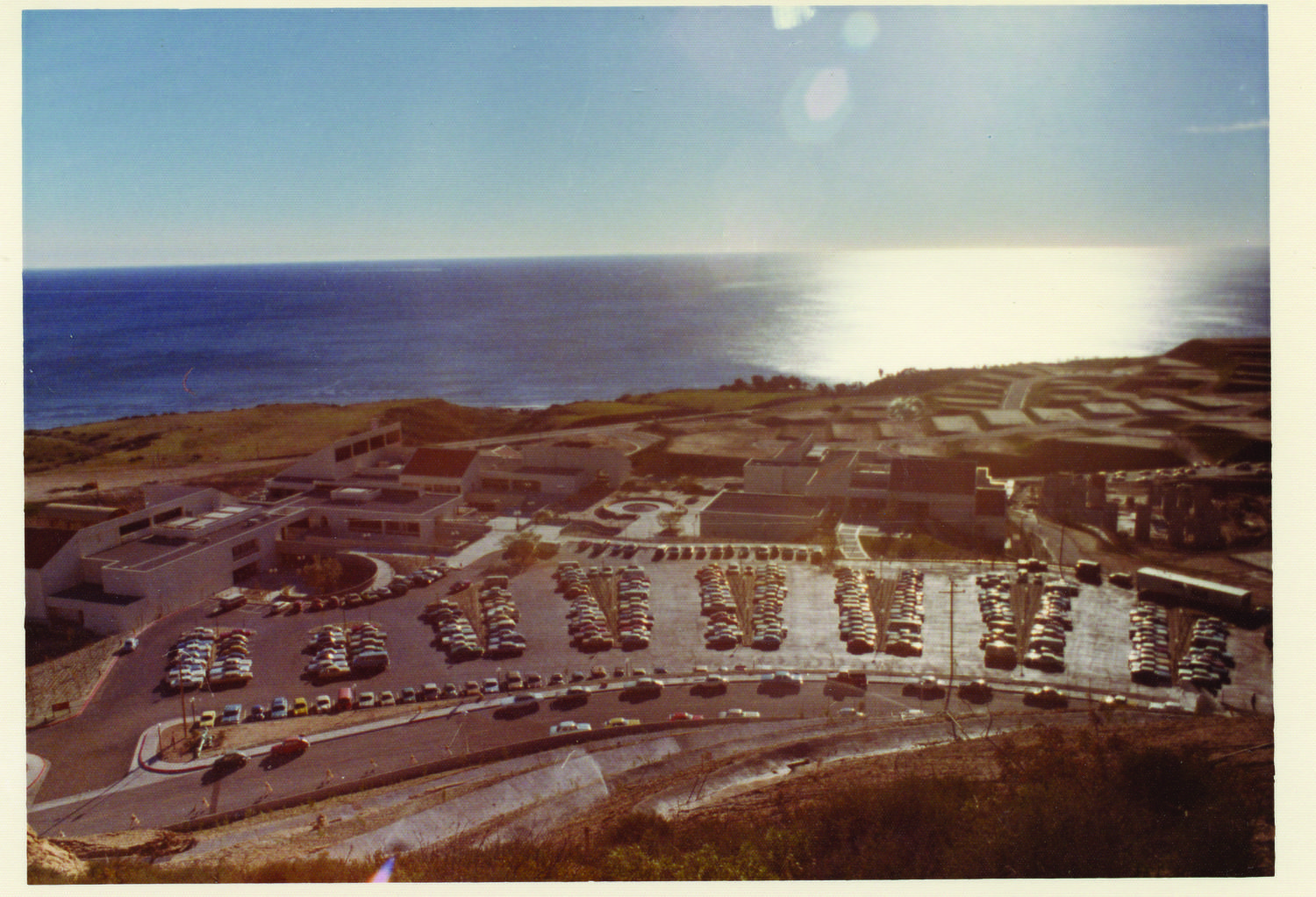
Photo courtesy of Pepperdine Libraries Digital Collections
“Pepperdean.”
That was the name East Coasters would sometimes use to misidentify the small Bible college in South Central Los Angeles known as George Pepperdine College, said John Watson, founder of the Sport Administration Program and a 1972 alumnus.
Before the move to Malibu, George Pepperdine College was a Church of Christ affiliate far from its Southern-based denomination. The college was facing financial shortfalls and was strapped for space. Additionally, the college was struggling for survival as growing racial tensions during the turbulent 1960s made it hard to recruit students to the campus. After surviving the 1965 Watts Riots, a campus security guard killed a young Black man, Larry Donnell Kimmons, in 1969.
Administrators praised the move to Malibu in Fall 1972 as a miracle that paved the path to today’s Pepperdine University — an R2 university with five professional schools and 26 national athletic championships.
“I don’t think Pepperdine would have been able to survive another 50 years. I don’t think they could have increased the curriculum. I don’t think they could have been competitive athletically,” Watson said. “I don’t think they could have drawn people for Theatre majors or Science majors. There just wasn’t space to do what you needed to do, and that’s why I think it would have struggled and perhaps not financially be able to succeed.”
The Early Days
In September 1937, George Pepperdine College opened its doors off the corner of 79th Street and Vermont Avenue in Los Angeles to 167 students. The 34-acre campus was home to the University for the remainder of Founder George Pepperdine’s life.
Within less than a decade of Pepperdine opening its doors, the University saw major growth in its student population. The G.I. Bill — which increased university opportunities for veterans — was passed in 1944, and in the years that followed, Pepperdine’s student population grew rapidly from the high hundreds to slightly under 2,000 students, according to Pepperdine’s website.
The University was then faced with a dilemma. While their population size grew, there was no more room to expand. On top of that, Pepperdine was in a tough financial situation.
“Around 1951, George Pepperdine’s personal fortune evaporated in what he called ‘unfortunate investments,’” said Pepperdine historian Sam Perrin, also known as the Ghost of George Pepperdine. “So he lost all of his money, and he was no longer able to be the sole donor to Pepperdine that could single-handedly support the college’s operations.”
The University’s Board of Trustees appointed a committee to evaluate the next steps for Pepperdine. The committee concluded that buying property adjacent to its South Central location would actually be more expensive than building another campus somewhere in the nearby suburbs, according to W. David Baird’s book “Quest For Distinction: Pepperdine University in the 20th Century.”
Racial Tensions
The Watts Riots, also known as the Watts Uprising or the Watts Rebellion, broke out in 1965 and lasted six days, involving 34,000 people and 34 deaths, according to the History Channel.
Pepperdine’s LA campus wasn’t just close to the riots, but a part of the action. The National Guard camped out on campus as one of their staging grounds for trying to stop the rioting, said retired Journalism Professor Ken Waters, a 1972 alumnus.
“The Watts Riots erupted on the school’s doorsteps. Campus was evacuated, and more than 400 National Guardsmen bivouacked in the Pepperdine dorms. The whole country watched on television,” former Pepperdine President William Banowsky wrote in his book “The Malibu Miracle: A Memoir.”
Just four years later, one of the darkest moments in Pepperdine history occurred: the death of Larry Kimmons.
Kimmons, who was 15 years old, and a group of friends went to Pepperdine’s campus to play basketball, but their plans were cut short by a campus security officer who shot Kimmons in the chest with a shotgun.
Perrin pointed out that Pepperdine’s president at the time, Norvel Young, had been looking for another campus before the Watts Riots — far before the Kimmons shooting — but the events that took place on campus and in the surrounding community brought a sense of urgency to the situation.
“I think it is fair to say that both of those events probably accelerated Pepperdine’s move to Malibu, and the reason for that, to be totally clear, is that Pepperdine was having a really hard time attracting residential students who wanted to come live and study on the Los Angeles campus,” Perrin said. “At the time, a lot of Pepperdine students were members of the Churches of Christ, and [they] tended to come from small towns, from rural areas.”
Despite this outside perception that the area was unsafe, people on campus didn’t feel this way.
“I never felt unsafe,” Watson said. “My wife lived in the housing right there at 79th Street, and she lived by herself, and she never felt unsafe.”
A New Opportunity
The options for a new campus had included more than 40 potential properties, but the University had narrowed it down to just three options: one in Calabasas, one in Westlake Village and one in Palos Verdes.
Then, the Adamson-Rindge family donated 138 acres to Pepperdine for a new campus, creating an opportunity for the University to move to the heart of Malibu.
In Banowsky’s memoir, he recalls receiving a phone call from President Young, excitedly telling him that Pepperdine received an offer for land in Malibu. However, the offer was not as simple as it might have initially seemed.
“There’s one huge negative,” Young told Banowsky. “It’s rough and mountainous without any of the basic utilities whatsoever. Some trustees already say site development costs are prohibitive.”
The two then visited the 138-acre site, as Young told Banowsky about the property that had no roads, water, gas, electricity or a public sewer system.
“I think [Banowsky and Young] visualized a beacon on the hill, from a spiritual perspective,” Watson said. “A place that they could really articulate their Christian faith and educate young people in an environment that could just shine and ultimately shine worldwide.”
While the donation appeared to be ideal for Pepperdine, the rugged terrain would come with financial complications, since Pepperdine needed to build its facilities.
As a result, the University looked to donors within the Churches of Christ, which proved to be unsuccessful. Pepperdine then turned to conservative businessmen in the community, appealing to them by selling themselves as aligning with their values, Perrin said.
“The emphasis of the University was going to, and did, change to some extent, still staying a Christian institution but also focusing on donors that would help us who are more interested in a conservative, free-enterprise focus of the institution,” Watson said. “That’s what I think a lot of the major donors to help build this campus valued in the Pepperdine curriculum and the philosophy that was being articulated by the leadership.”
At the time, conservatives and corporations were pushing back against previous expansions of the social safety network and new regulations to promote clean air and water that increased taxes and the costs of doing business, as historian Darren Dochuk documented in his book “From Bible Belt to Sunbelt: Plain-Folk Religion, Grassroots Politics, and the Rise of Evangelical Conservatism.” The U.S. was also in the midst of the Cold War, and conservatives sought to promote the freedoms of a capitalist democracy over a communist control of the economy and limitations on individual rights.
While Pepperdine aligned itself with capitalism, Watson pointed out that it didn’t mean Pepperdine students wouldn’t study socialism or communism but rather that Pepperdine brought in speakers who emphasized the positives of a capitalist society.
Blanche Seaver, widow of oil executive Frank Seaver, was the main contributing benefactor who helped Pepperdine’s Malibu campus become a reality. Seaver donated an estimated $300 million to help develop the Malibu land, according to Pepperdine.
“In terms of the fundraising operation, it was so successful that it has few rivals in the history of American higher education,” Perrin said. “To go from a school as small and unknown as Pepperdine was to what it has become, even just in those first 10 years in Malibu, I think was a tremendous accomplishment.”
Ronald Reagan was an early friend of the University while governor of California and then as president of the United States, helping connect administrators with numerous conservative donors. At the major fundraising dinner in 1970 called ‘The Birth of a College Dinner,’ Ronald Reagan delivered a speech.
“He called himself the ‘bait’ that night,” Perrin said. “Because he knew that if he was giving a speech, he could get all of the wealthy and powerful people in Los Angeles to come here, and they all ended up donating to Pepperdine.”
What Remains
The current image of Pepperdine is far removed from the older days of being a small, unrecognizable West Coast college.
While Pepperdine was building the Malibu campus, the understanding was that the University would preserve the Los Angeles campus and have a secondary location in Malibu. This dual-campus experiment went on for some time, but ultimately, administrators shut down and sold the Los Angeles campus. At that point, some community members questioned Pepperdine’s values in moving from the inner city to the beachside campus.
“On the one hand, you have the community members who probably did feel like Pepperdine had given up on them. And maybe that’s true,” Perrin said. “On the other hand, you had a lot of people, a lot of Pepperdiners, both faculty and students, staff, who felt that Pepperdine was betraying its own principles, that the reason they came to work at Pepperdine in the first place or came to study [at] Pepperdine is because they wanted to come serve in this underprivileged neighborhood and that they felt that by moving off to live with the movie stars in Malibu, by moving to Malibu, they had sort of shortchanged this goal that Pepperdine had always had.”
Waters was a part of the Pepperdine community during the events of the Kimmons shooting as an undergraduate and stayed with the University as an assistant director to the public relations director and a student during the University’s Malibu beginnings.
“The student body was either apathetic or opposed to the move, and the reason for the opposition primarily was, ‘Wait, you say Pepperdine that you’re Christian, that you care about the poor, you care about the community that at that time was all African American,’” Waters said. “‘You care about all of these things, and yet you’re running away from the inner city.’”
Although it looked like Pepperdine’s move abandoned the community that it had served for years, that didn’t paint the whole picture.
“There was a lot of resentment from the LA community that we were abandoning them because we’ve been part of that community,” Watson said. “We’ve been serving that community, and we continue to serve them. We continue to serve them even today — our School of Education is down there a lot and working in that community, but it’s not known.”
Whether focusing on the pain of the journey or the hope that it provided for the University, the momentous move to Malibu significantly changed the course of Pepperdine’s future. In a 2010 interview about his memoir, Banowsky described the change that Pepperdine went through with this move.
“It was from being a little college to a university, from being 30 acres to 830 acres, from no endowment to Mrs. Seaver’s 300 million dollars,” Banowsky said. “From South Central Los Angeles to Malibu. They call it a miracle.”
_________________________________
Follow Currents Magazine on X: @PeppCurrents and Instagram: @currentsmagazine
Contact Nick Charkhedian via email: nareg.charkhedian@pepperdine.edu