
The Atlantic Treaty Association hosted an international gathering in Edinburgh to discuss post-Iraq war relations.
By Sarah Carrillo
Assistant News Editor
Four Pepperdine students were given the rare opportunity last week to travel to Scotland, dine with U.S. ambassadors and listen to top officials at NATO speak on their careers in international affairs.
Junior Josh Dover, sophomore Sean O’Neil and seniors Patience Heath and Derek Olson attended a conference in Edinburgh, Scotland, of the Atlantic Treaty Association, a think tank associated with NATO.
 The theme of the conference was Trans-Atlantic relations after the war in Iraq.
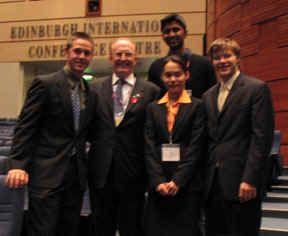
Of the 13 American student delegates, Pepperdine sent the most students from one school. Two students from the University of California San Diego attended and students from Georgetown, Marquette and the U.S. Naval Academy also Clockwise from left, Pepperdine student Sean
represented the United O’Neil, former U.S. Ambassador Rober Hunter,
States. UCSD student Saket Vemprala, Georgia Tech
student Peter Riddett and Georgetown student
Student delegates from Ean-Ha Kim attended the NATO conference.
all over the world,
including countries such as Turkey and Greece, also attended.
Some say that attending a small university limits the opportunities available, but for Dover, being at Pepperdine actually helped him attend the conference. He learned about the conference and received the application from Dr. Dan Caldwell.
After he was accepted, Caldwell acted as an intermediary with the Social Science Division, the Dean’s office and the President’s office in order to receive help in funding the trip. All of these departments quickly donated funds to the four students, which enabled them to go.
“The only reason we were able to go was because of their generosity,” Dover said.
Dr. Chris Soper, chair of the Social Science Division, said his department and others will provide scholarship support and help supplement costs for students attending conferences such as this one.
“I thought this was a good opportunity to expose some of our top students to good ideas and experiences that they wouldn’t have otherwise had,” Soper said.
One of the biggest events at the conference was a speech made by Lord Robertson, the head of NATO, about his career at NATO and issues the organization is facing.
“It was amazing to hear a man who’s done so much for the world reflect on his time when he only has six weeks left in office,” Dover said.
The delegates also spent an afternoon at the American embassy in Scotland and learned about career opportunities in foreign service from Principle Officer of the Consulate General, Cecile Shea.
“I made some great contacts with ambassadors and other delegates while I was there and it was great to learn more about potential new careers,” Dover said.
Pepperdine students at the conference also ate breakfast with Nicholas Burns, the U.S. ambassador to NATO.
“He (Burns) is an amazing speaker,” Dover said. “He represented the American view very well and he handled questions that tried to tag him as an arrogant American very well.”
The NATO delegates, and the Americans in particular, received some criticism from protesters and in some cases the speakers at the conference.
“Some protesters (outside the conference) were calling us murderers and saying we (the student delegates) are too young to be murderers,” O’Neil said. “There was one protester holding a sign with NATO on it but had it say ‘Nuclear Attack Terrorist Organization’ instead. The Scottish people overall, though, were very friendly.”
Dover said one of the frustrations some of the American delegates had was delegates from other countries stereotyping Americans and not having an open mind about the American perspective. O’Neil said even some of the speakers did not seem to have an open mind.
“Some speakers had negative things to say about America, like the weapons of mass destruction argument,” O’Neil said. “And (the French Ambassador’s) lack of wanting to address American questions showed he wasn’t going to have an American review his statements.”
However, Pepperdine delegates were able to learn from the anti-American sentiments they experienced.
“(The conference) shaped my idea of what the international arena is,” O’Neil said. “I learned how things are outside of the U.S.”
Dover said the conflicts that sometimes occur within NATO can actually be positive.
“There are many different perspectives and even though I don’t agree with all of them, hearing them makes you question and reform your own beliefs,” Dover said. “It’s really interesting that you may come from different parts of the world but admiration for NATO and its beliefs crosses borders. One idea that I learned is NATO is a democracy and we do argue and it’s good that we argue because that’s what makes us a democracy.”
The host of the conference, the Atlantic Treaty Association, is made up of national voluntary and non-governmental organizations that support the activities of NATO.
The association works to inform the public about the missions and responsibilities of NATO, to research the purposes and activities of NATO, to promote democracy and to develop cooperation between its members.
November 13, 2003