
Supermarket employees picket Vons, Pavilions, Albertsons and Ralphs stores across Southern California.
By Rudabeh Shahbazi
Assistant Perspectives Editor
More than 70,000 employees and nearly 900 stores throughout Southern California have been affected by the first grocery workers’ strike in 25 years.
The strike began Oct. 11 after nine hours of negotiations between the United Food and Commercial Worker’s Union and Safeway Inc. ended in a stalemate. Union workers at Vons and Pavilions, which are both owned by Safeway, went on strike.
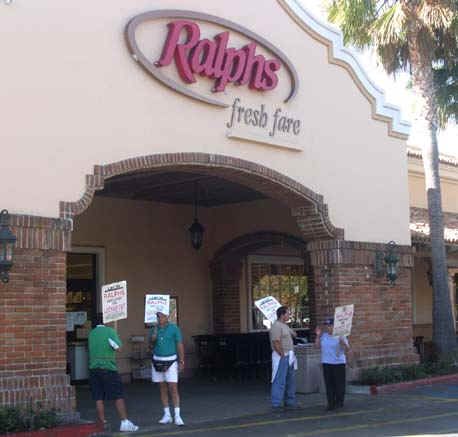 With Vons on strike, Albertsons and Ralphs locked out their own employees to present a united front against labor unions. Picketing began Oct. 12, and it may take weeks before the situation is resolved.
The labor controversy involving Ralphs, Vons and Albertsons began last year at a meeting between union representatives of the grocery workers and the nation’s top-four DANIEL JOHNSON/PHOTO EDITOR markets, led by Safeway Inc. Chief Executive Steven A. Burd. Burd wanted labor leaders around the country to make concessions in future contracts, saying non-union competitors such as Wal-Mart Stores Inc., threaten store profits and benefits for workers.
Instead of drawing up the new contract the corporations demanded, union leaders organized a national strike. The dispute erupted Oct. 19, when thousands of grocery workers began to picket at Safeway, Vons and Pavillions’ stores and Kroger Co.’s Ralphs and Albertsons Inc. stores 24 hours a day in an effort to dissuade shoppers.
Workers complain about companies’ insistence to cut health and pension benefits, freeze wages and lower pay for new workers.
Food Union Representative Fred Ramirez, whose contract expired Oct. 5, said he was thinking of how to pay his monthly expenses after being locked out of Ralphs in Malibu. “We’re not asking for anything but to keep what we have. I am a single parent with one child and don’t want healthcare to rise. Rent is so high,” said Ramirez, who commutes from Canoga Park.
The supermarkets maintain that they face a real competitive threat from discounters like Wal-Mart, which has plans to open bulk grocery outlets next year, and Costco Wholesale Corp., as well as smaller retailers such as Trader Joe’s. Wal-Mart does not have a union and pays its workers less than $9 an hour (almost half of what union grocery store clerks now earn) resulting in lower prices and stronger competition.
The supermarkets contend that the cost of operating stores and paying full coverage for their employees, as mandated by the union, has become increasingly expensive in the face of a bad economy, which has caused sales to drop.
Particularly, Safeway Inc. is in trouble because of its recent local supermarket purchases in other parts of the country, such as Dominick’s Supermarkets Inc, Genuradi’s Family Markets Inc. and Randall’s Food Markets Inc.
After acquiring these chains, Safeway laid off workers and replaced popular regional items with its own private goods. Currently, Safeway has lowered prices and is trying to sell Dominick’s in an effort to regain lost profits.
Union representatives and employers have yet to agree on health care and pension cuts, as well as frozen wages for employees. The union is seeking to keep the benefits it has and is also requesting a 50-cent hourly wage increase the first year, and 45-cent increase for the next two years.
Christopher Rowe has worked in the produce department of Albertsons in Calabasas for three years.
“We just want to keep what he have right now,” Rowe said. “They keep trying to take away what we’ve been fighting for for 40 years. It’s just corporate greed.”
Malibu Ralphs stock clerk Ganzalo Macias said that people who have worked 30 years in the company are dependent on it, and now suffering from the cutbacks. He was told he was locked out at midnight after working all evening. His manager already had replacement employees ready.
“I wasn’t expecting it, it was a real shock,” said Macias.
Like thousands of other employees, Macias thought of his job as a career. He started as a bagger in 1987 and worked his way up.
“Now temps are coming in from the streets and getting more than $18 an hour,” Macias said. “It took me years to make that much.”
Many union employees say the plan to hire temporary replacement workers has only resulted in chaos. In Malibu, employees say the scabs have overcharged customers, and some people have even walked out because of the lack of training and expertise of the people now running the store. Ramirez says the companies are not paying enough attention to who they are hiring. Rowe agrees.
“They’re bringing people off the streets who don’t know what they’re doing,” he said.
Union employees are concerned that new employees who are hired with lower wages will replace them, living from paycheck to paycheck below the poverty line and without proper health insurance.
Signs outside the stores announce that they are hiring. Holiday and overtime wages are printed in bold and posted behind the glass windows on the inside of the stores. In Malibu, the wages on the sign at Ralphs have been crossed out on the outside of the glass by employees who say the stores are trying to mislead customers into believing these are regular wages. The sign outside Vons announced that food clerks and drivers would be paid $17.90 an hour, and meat cutters would get $19.80 an hour.
Tim Pietrolungo, who works at Albertsons in Calabasas, said he could not understand why the company is flying employees in from out of state and hiring security guards to patrol the peaceful picketing when it won’t even pay its employees.
Despite a few negative responses, workers remain steadfastly hopeful. Sabrina Price, who walks to work at Albertson’s in Calabasas, stands outside 12 hours a day and 3 hours a night. “People drive by and tell us to go to school and get a real job. I can’t afford to go to school. I am trying to save up for it right now by working.”
Price said the picketers are misunderstood.
“A lot of people don’t understand that we can’t go in period,” she said. “We want to come back to work. People think we are on strike, but we’re forced out there,” she said.
Macias of Ralphs in Malibu said a store truck driver tried to run him over.
One thing is certain. Employees find strength in support from the community and each other.
“Thanks for standing by us,” said Rowe.
At Albertsons in Calabasas, picketers said their management is showing a lot of support. Price said her manager brought them ice cream and told her he would be there too if he were in the same situation. As Malibu Ralphs picketers answer questions at midnight, a non-union employee emerges from inside the store to bring them coffee.
“I was never here,” he said, smiling at his friends who are standing outside. “We were surprised— people are really backing us up. They’ve been very nice,” said Macias.
Picketers have been successful in turning many regular customers away and dropping sales, and all over California they are getting honks of support from passing cars.
The picketers have been supporting each other as well, many of whom spend more time outside in the hot sun and through the night than they would have spent working. They speak of unity with coworkers they have never spoken to before.
Tim Pietrolungo of Albertson’s in Calabasas says he sees both sides of the story. His brother, who is a manager at a Ralphs in Los Angeles, has been working 20-hour days.
“I don’t like to tell customers not to shop there,” Pietrolungo said. “I wouldn’t mind paying something, but not half. I don’t know how much longer I can wait before I start looking for another job.”
Rowe has been working on roofs 15 hours a day and picketing at night, mostly to support his fellow workers with families to feed and bills to pay, is also looking for other employment options.
“We’re doing what we have to do,” he said.
Pietrolungo agreed.
“I just try to take it a day at a time,” he said.
Management at Ralphs, Vons and Albertsons refused to comment.
October 23, 2003