
Controversy sparked after state reveals plan to take back popular recreation area.
By Michael Travis
Editor in Chief
Although the city of Malibu is 27 miles long, it has no public parks of its own.
The majority of them are covered with sand, water and waves, making them state property. The only non-beach park in town also belongs to the state of California, and now it wants it back.
In less than a year, the state plans to reclaim Malibu Bluffs Park across the street from Pepperdine.
The park is a popular spot for youth baseball and soccer games. These youth leagues would no longer be allowed to use the fields at the park if the state reclaims the land.
According to Paul Adams, director of Parks and Recreation for the city of Malibu, there is a major problem with the state’s request for the city to vacate.
There are no places for the ball fields and players to go. He said that there aren’t many places where new parks can be built — primarily because the city doesn’t own much land. Most of it is held by the state and private owners.
“Until we have something hard on the table, we can’t give a definite date of when the park can be moved,” Adams said.
In 1983, the state Department of Parks also signed an agreement with Malibu Little League that designated the area as a place for them to operate. This adds a legal dimension to the Malibu Bluffs problem.
The league has said it will not rule out legal action to prevent the state from moving the fields it currently uses.
The controversy that has cropped up around Malibu Bluffs Park has become a microcosm of the larger public facility problem that the city faces.
As a result, the Malibu City Council is currently discussing placing a bond measure on the ballot in June to get the money needed to solve the problem.
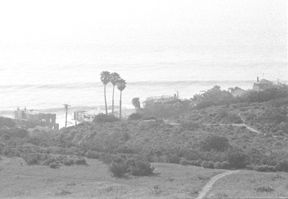 It all began when the acting director of the California State Department of Parks, Ruth Coleman, issued a letter asking the city to relocate the ball fields in Bluffs Park within a year. The CSDP wanted to use the area for other purposes, something which had been insinuated in previous operating permits.
In the past, county and later city officials managed Bluffs Park under five-year operating permits issued by the California State Department of Parks.
The new permit, issued last May, gave the city a renewed operating license for a year under the condition that the city would provide a timetable with specific dates showing when the park would be vacated.
In 2000, the Malibu City Council created a commission to determine the future needs of its citizens concerning public parks and facilities.
The end result of the project, completed with the help of community organizations and a paid consultant, was a Parks and Recreation Master Plan for the city.
The two-year study determined it would cost about $15 million to provide the public facilities Malibu needed over the next 10 to 20 years, including the ball fields in question and a community center.
However, the study didn’t include the cost of acquiring the necessary land to build these facilities on, which could add more than $15 to $20 million to the overall cost.
The city doesn’t have that kind of money — there is roughly $12 million in its general fund.
“It’s the job of city government to provide these things,” Adams said. “And it can only work within the budget provided by the taxpayers, and the state and federal governments.”
So far the city has received about $6 million in state and federal grant funding for city improvement projects. Most of this money is already spent on Malibu’s long list of development plans, like the new sidewalk that was recently built in front of Malibu High and Juan Cabrillo Elementary.
Adams said the most effective way for the city to raise money for projects like this is through bond measures.
Bond measures are basically the way governments borrow money, whether they are federal, state or local. When a bond is issued, the issuer promises to repay a given amount, the principal, along with any interest, usually over a 20-year period. Investors basically become creditors to the issuer of the bonds.
In order to repay bonds, the government levies taxes on its citizens.
In Malibu’s case, each property owner would be assessed for taxes to pay the bill.
When a government wants to issue a bond, it must seek approval from its voters in the form of a bond measure. The catch is that a bond measure needs a two-thirds majority of voters to approve it.
About a year and a half ago Malibu placed a parks bond measure on the ballot, Proposition O, and it received 62 percent of the vote, which wasn’t quite enough.
The city of Malibu’s Bond Measure Advisory Committee is currently discussing whether to put another measure on the June ballot.
It is scheduled to make a recommendation to the city council by Feb. 10. The committee will meet again Jan. 30 at 7 p.m. in the large conference room of Malibu City Hall.
“The issue is for the people to decide,” Adams said. “They are the ones who will benefit, but they are the ones who are going to have to pay taxes.”
January 30, 2003