
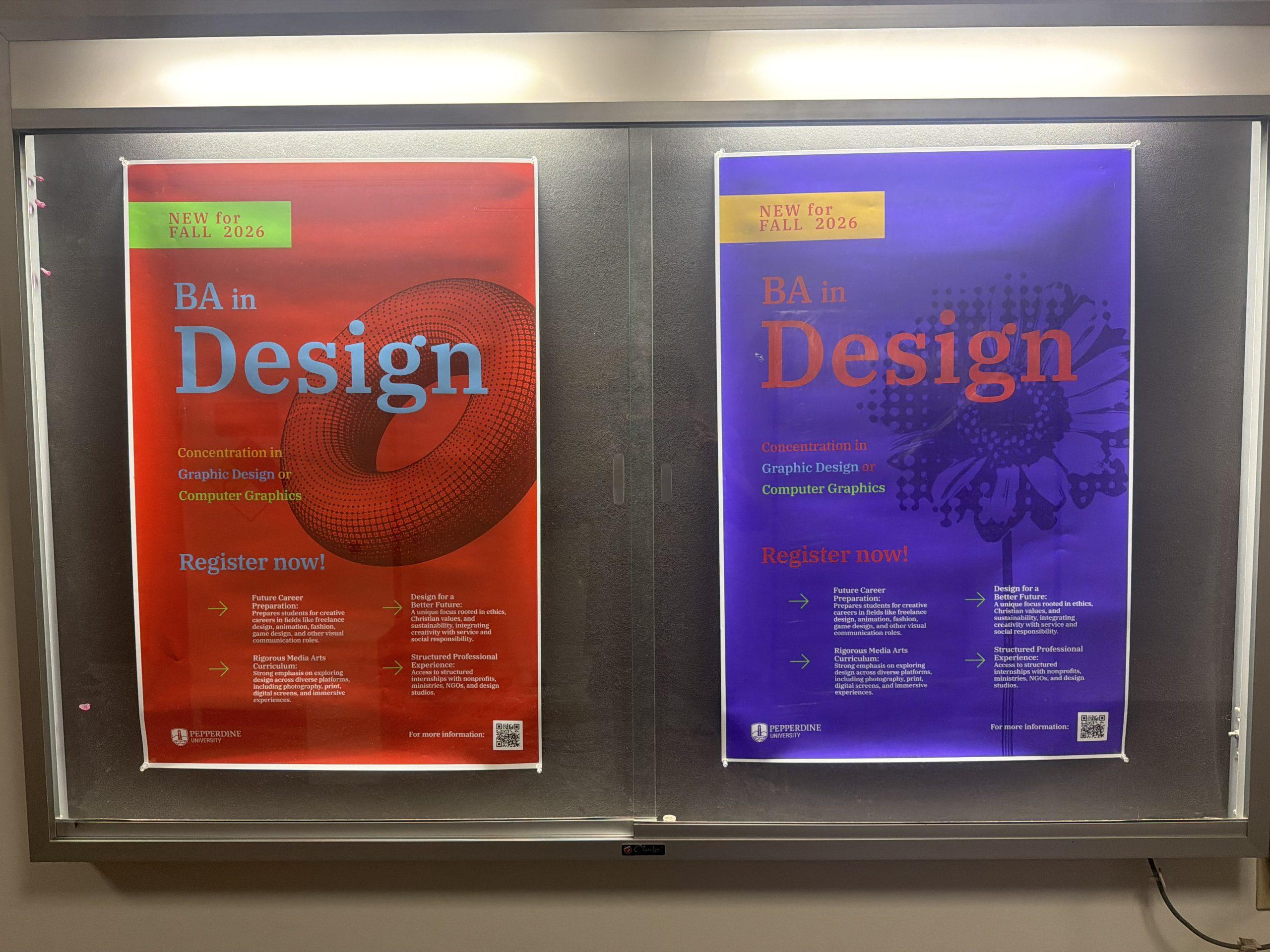
Posters for the new design major inside the display case on the first floor of the Cultural Arts Center. Kate Parsons, as associate professor of digital art, said she was most excited about the computer graphics concentration option. Photo by Oliver Evans
The Fine Arts Division launched its new design major at the beginning of the Fall 2026 Semester.
Kate Parsons, an associate professor of Digital Art, said there had been conversations about a design major before she arrived at Pepperdine in 2018. It wasn’t actively pursued until two years ago, and it wasn’t approved until last year.
“It’s necessary to let students know more about what kind of skills you could get from this kind of major,” Senior Liangyu Sun, an Art major who also goes by Jinx, said. “It could just be your chance to become Doctor Strange.”
Parsons said the approval process for the major involved a lot of curriculum development and whether students were pursuing graphic design or creative technology.
“We’re hoping to cover both of those things in detail enough so that they get the skill sets that they that they need,” Parsons said.
The degree in Design has two emphases: Graphic Design, which bridges traditional fine arts with modern digital media, and Computer Graphics, which merges technical programming with high-end digital artistry to prepare students for the “frontier” of interactive media, according to Seaver College.
Desired Learning Outcomes
Parsons said one desired outcome for design students is to give them foundational skills to better decide whether they want to pursue technical design or creative design.
Parsons said a Studio Art degree can mean anything from photography, sculpture and painting to more design-like work. The design major aims to provide graduates with skills like 3D modeling.
“One thing we’re also looking at doing is working with the entrepreneurship and business folks,” Parsons said. “Because again, this is essentially art in business.”
What Does a Class Look Like?
Adjunct Professor Eli Joteva said Houdini is a powerful procedural 3D modeling tool. Joteva, who also runs her own studio practice, said procedural 3D modeling allows artists to create a system for generating multiple versions of an art piece.
“It’s also powerful for visual effects software,” Joteva said. “It’s the industry standard tool for visual special effects.”
Joteva said students may also be familiar with tools like ZBrush functioning similarly to sculpting clay allowing one to make a single chair, for example. With procedural 3D modeling you can make a system that produces an infinite number of chairs of varying heights and depths.
Joteva said students start off by learning how to model static geometry with Houdini. Then the course will move into making animations, looking at various types of simulations like Vellum, which is used for cloth animations.
“By the end students will have the ability to render,” Joteva said. “They’ll be making an actual feature short animation that they completely produce.”
Joteva said the course will also teach students how to procedurally generate environments. Depending on whether someone wants a desert or a forest — it will create digital trees to populate that environment.
“We’re also running simulations over the terrain,” Joteva said. “It actually runs a simulation of what the environment would look like if it eroded over time.”
Joteva said another project students complete is a poster about a non-human subject, which is then turned into a target for an augmented reality experience. Students learn how to inform and communicate about the subject in an immersive way that surrounds the viewer.
What Design Students Might Do
Sun said that this new major is what she wants to learn. From what she has heard from Parsons, it is not just about creating a poster.
“I think that would be more fun to let the student know this is not just making a picture in Photoshop,” Sun said. “It gives you an opportunity to work with your computer or with a screen or with a code machine.”
Sun said TouchDesigner is a program that lets people communicate with the computer through the camera. She learned the basics with Parsons, but learned the rest on her own. Sun said Parsons may teach some TouchDesigner in the new major.
Senior and Art major Jinx Sun’s final project for an animation class during the Spring 2026 semester, created using TouchDesigner. Credit to Jinx Sun.
______________
Follow the Graphic on X: @PeppGraphic
Contact Oliver Evans via email: oliver.evans@pepperdine.edu