
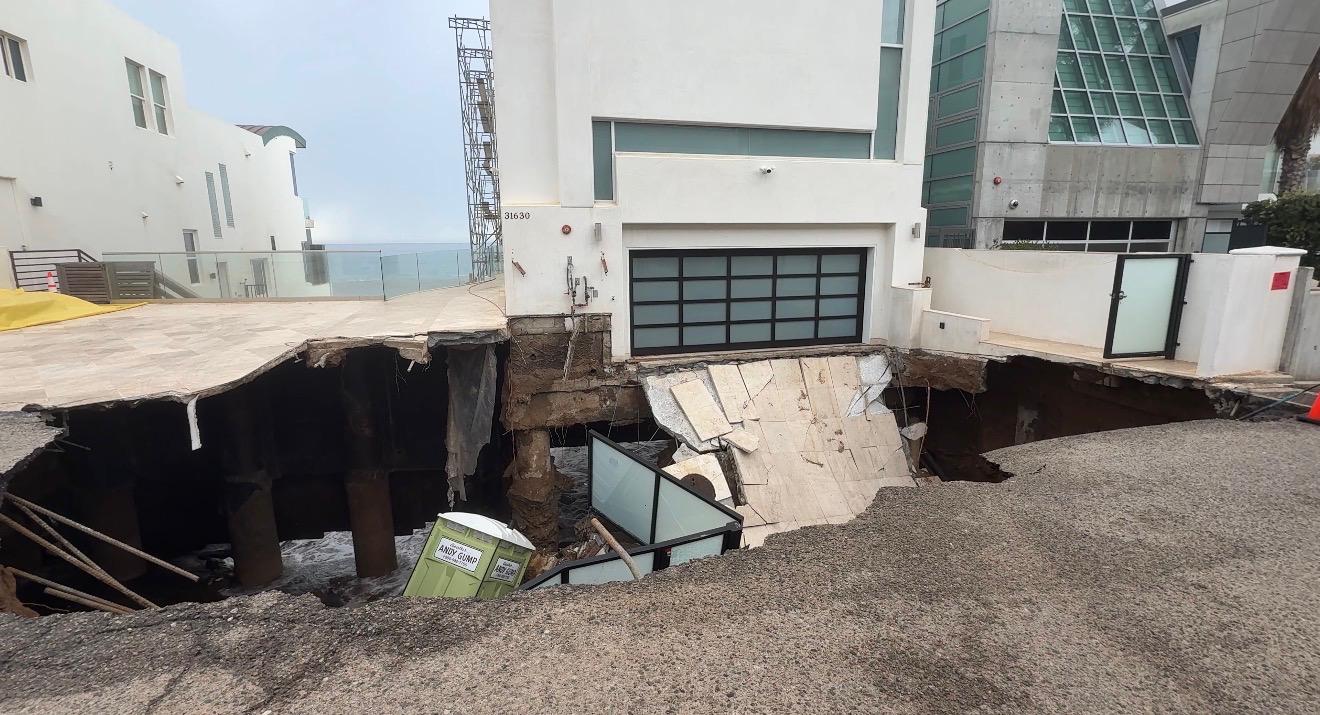
A sinkhole opens under a driveway on Broad Beach Road in Malibu on the morning of Sept. 8. The last recorded sinkhole in Malibu was in 1998. Photo by Alexa McGlathery
On July 27, high tides crept over the shoreline of Pacific Coast Highway (PCH) and onto the burn scars left from the 2025 Palisades Fire. With waves crashing into these empty burn lots, the foundations eroded, carving so much of some properties away that the asphalt began to collapse.
This marked only the beginning of a series of weather, tide, swell and El Niño-related events across Malibu over the course of two months.
“The whole coast of Southern California has a larger regional climate impact story,” said Matt Myerhoff, Public Information Officer for the City of Malibu.
The late July erosion of Palisades burn lots quickly became a safety issue for residents and the 40,000 people who use PCH daily, Myerhoff said.
“That was definitely a very serious public safety issue because cars and people could go off the edge,” Myerhoff said. “And because it’s potential damage to a major public highway.”
The City of Malibu quickly began working on repairs with Caltrans, the state’s government agency for managing California’s highway and transportation systems, but just days later, another issue arose — one of Malibu’s favorite beaches began to face its own erosion.
“And at the same time, the same high waves and high tides that did that damage severely eroded the beach at Point Dume State Beach,” Myerhoff said.
As the high waves and tides wore the sand away, all the way up to the edge of the road that leads into the parking lot, the cliffs “just eroded and just fell and collapsed into the sand,” Myerhoff said.
As Hurricane Marie was passing up the Pacific coast, though it didn’t come too close to the coast of California, it came “close enough,” resulting in a storm surge and rising sea levels in Malibu, Myerhoff said. It was during this period that Malibu saw a catastrophe that hadn’t happened in 28 years.
Around 7 a.m. on the morning of Sept. 8, a private home driveway collapsed, leaving a giant sinkhole at a property on Broad Beach Road. The sinkhole extended beneath the property toward the ocean, allowing bystanders to see the tide beneath where cars once drove and parked.
“Underneath the house, the waves had come all the way up over there and eroded that whole thing. So the driveway just collapsed and was gone,” Myerhoff said. “Septic system, septic tank gone, you know, into the ocean, and about three quarters of the small two-lane roadway there just gone, collapsed into the hole.”
Myerhoff said nobody was inside the home when the driveway collapsed, but the incident resulted in 31 homes being red tagged, meaning everyone, including homeowners, were prohibited from entering the homes. Mandatory evacuations began in the neighborhood that morning.
While only five out of the 31 tagged homes were actually damaged, Myerhoff said the sinkhole created an inaccessible roadway for residents and emergency personnel.
As Malibu continues to see an influx of weather and El Niño-related events, residents began to vocalize their worries.
“Residents are concerned, understandably so, and there is a lot to be concerned about,” Myerhoff said.
Preparing for Winter Weather
While Malibu has already suffered large amounts of damage caused by weather and waves, Myerhoff said this winter is forecasted to have stronger than usual storms and stronger and more intense rains.
“We think it’s anticipated there will be a lot of rain, and that also means erosion down the hillsides, into the ocean and also away from the ocean, just regular erosion,” Myerhoff said. “You know we have a very large recent burn scar from the Palisades Fire, so there’s always the danger of mudslides and debris flows because the vegetation is all burned away.”
Myerhoff said the city does not have the resources to individually inspect the over-100 beachfront homes in Malibu, however he encourages residents to prepare their homes for these severe weather conditions as early as possible.
A good way for residents to prepare for these conditions is to visit LA County sandbag distribution stations, which can be located on the LA County Public Works website, Myerhoff said.
“Anybody that lives in a beachfront home needs to be thinking about and taking action to prepare their property,” Myerhoff said.
Myerhoff said the city has a meteorologist on contract who provides them with specialized weather forecasts that are more accurate and detailed than the National Weather Service. Myerhoff emphasized that with Malibu’s unique geography, this type of forecasting makes a huge difference.
Further than its unique terrain, Myerhoff said the weather conditions also impact driving in Malibu — something which is already dangerous, but with more amplified conditions in events like this.
“It’s pretty dangerous when the traffic signals are out in Malibu, especially along PCH, you know, because people then just drive straight through the dark traffic signals,” Myerhoff said.
Myerhoff said residents in the burn scar areas of the Eaton and Palisades fires can get up to 25 filled sandbags for their properties at one of two locations in Altadena and Malibu. There are also always sandbags available at the entrance of Zuma Beach.
This story was copy edited by Lila Rendel.
_________________________________
Follow the Graphic on X: @PeppGraphic
Contact Amanda Monahan via email: amanda.monahan@pepperdine.edu or via Instagram: @amandamonahanjournalism