

The exterior of Smothers Theatre on the Malibu campus. The performing arts theater has held various productions since 1980. Photo courtesy of Pepperdine University
On the morning of July 30, the Lisa Smith Wengler Center for the Arts had the 1975 production “A Chorus Line” on its website. By the end of the day, the website was quietly updated to reflect a new change — the 1943 musical “Oklahoma!” was replacing “A Chorus Line.”
The decision, which came from the Seaver Dean’s Office, was one that left Kelly Todd, assistant instructor of Teaching of Theatre and former director of “A Chorus Line,” baffled.
“It was really disappointing to me. I was really looking forward to directing ‘A Chorus Line,'” Todd said. “The messages and themes are at least about dedicating yourself to a purpose, and that’s what we talk about a lot here at Pepperdine anyway. So it felt like it would fit in so well here, for me.”
In an email sent to Lee Kats, dean of Seaver College, regarding the decision to remove “A Chorus Line” from the upcoming theater season, Kats referred the Graphic to the Fine Arts Division, writing that he had “nothing to add beyond what they conveyed.” Paul Begin, senior associate dean of Seaver College, did not respond to the Graphic’s request for comment on the story.
“A Chorus Line”
“A Chorus Line” is an award-winning musical that premiered on Broadway in 1975. Based on real-life broadway performers, the production follows 17 dancers auditioning for the final eight spots in an upcoming Broadway musical. Throughout the play, the director asks each dancer to share personal stories about their lives, revealing their deepest vulnerabilities but also their greatest ambitions.
As one of the longest running Broadway shows of all time, “A Chorus Line” received nine Tony Awards, including one for Best Musical and a Pulitzer Prize for Drama.
Directed by Michael Bennett with music by Marvin Hamlisch and Edward Kleban, the show is considered revolutionary by those in the theater community. Unlike many shows at the time, “A Chorus Line” had no large scenery, intermission or leading role according to Signature Theatre, a Tony Award-winning regional theater.
“A Chorus Line” was also one of the first major Broadway musicals to address homosexuality through its characters. Paul, one of the roles, delivers a monologue about coming to terms with his identity as a gay man through performing in the arts.
His monologue ends with him bursting into tears, retelling the heartbreak regarding the condemnation he received from his parents for being gay, according to the Golden Globes website.
A Timeline of Events
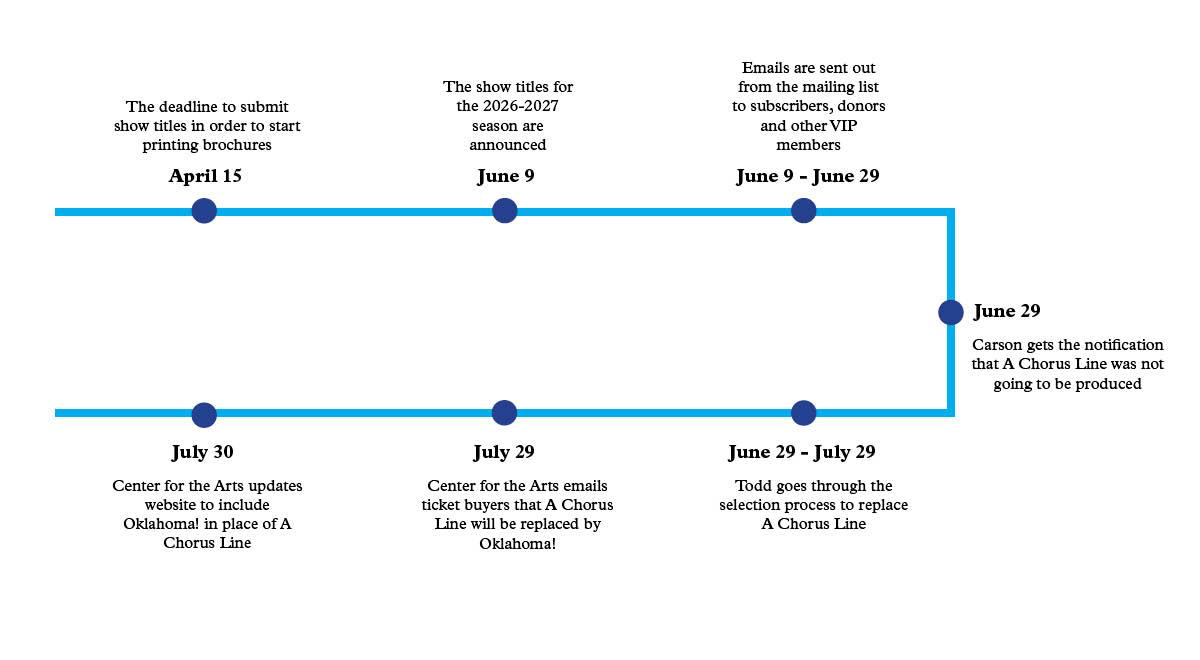
Infographic by Christine Park
The deadline to submit shows to the Center for the Arts was set for Wednesday, April 15. When choosing titles, Prof. Lincoln Hanks, Fine Arts divisional dean, said several different factors went into the selection process.
“There’s considerations of not only the education value of a show, but also is it the right show for the season,” Hanks said. “In terms of balancing themes and of course in terms of our campus and community, all those kinds of things are part of that conversation.”
Hanks said he got involved in those faculty conversations late, but eventually signed off on their season selection. From there, Hanks sent the production titles over to the Dean’s Office. After receiving no response, the Fine Arts Division moved forward under the assumption of approval from the Dean’s Office. It’s unclear why the Dean’s Office did not respond to the season selection or whether they normally do.
The process then moved to the Center for the Arts and Integrated Marketing Communications, the University’s central team for creative marketing, communication and design. Carson confirmed that the Theatre program met all the appropriate deadlines.
The Center for the Arts took around one month to design and produce 30,000 brochures for the upcoming theater season. It cost the Center for the Arts $20,000 to print the brochures, plus an additional $10,000 for postage.
On Tuesday, June 9, the Center for the Arts sent out emails through its mailing list — which contains subscribers, donors and other VIP members — confirming the show titles for the upcoming 2026-27 theater season.
However, Hanks said the Dean’s Office brought up concerns regarding the themes of “A Chorus Line” shortly after the announcement. As a result, Hanks brought in Bradley Griffin, professor of Theatre and Theatre Program Coordinator, into meetings with administration. Todd was set to be involved in those conversations but was out of the country at the time. Hanks said he and Griffin advocated to keep “A Chorus Line” as a part of the season during these meetings.
“We went over and advocated for ‘A Chorus Line’ to the Dean’s Office, just to talk it through and see if we can get an understanding of what we could do to keep it on the season,” Hanks said. “And it came down to one, maybe two whole songs in the show that were of concern, thematically.”
The main song of concern that Hanks referenced is “Dance Ten, Looks Three” by Hamlisch and Kleban. The song follows a female dancer named Val who repeatedly loses out on Broadway roles due to her physical appearance, despite having all the technical ability, and she only begins to get hired for roles once she gets plastic surgery done on her body. Throughout the song, Val repeatedly sings the words “tits” and “ass,” with the last line talking about how getting new “tits” and “ass” changed her life, according to Genius.
Yet, even with the bold language, Griffin said this is still a story worth telling.
“She uses profanity, but she’s also talking, telling a sort of a truth there,” Griffin said. “She’s owning the fact that if this is the way that she has to play the game, then she’s going to play the game, and she’s going to get the role.”
On Wednesday, June 29, while Carson was on vacation, she received an email notification from the Fine Arts Division that “A Chorus Line” would no longer be in production. Carson said the Center for the Arts had to work quickly in deciding how to best communicate this news with ticket buyers.
“We quickly worked to determine what musical we were going to replace it with because we felt like it was best to let our patrons know what we were going to do instead,” Carson said.
Then, on Wednesday, July 29, the Center for the Arts sent an email to patrons and ticket buyers for “A Chorus Line,” notifying them that the show was being replaced by “Oklahoma!”
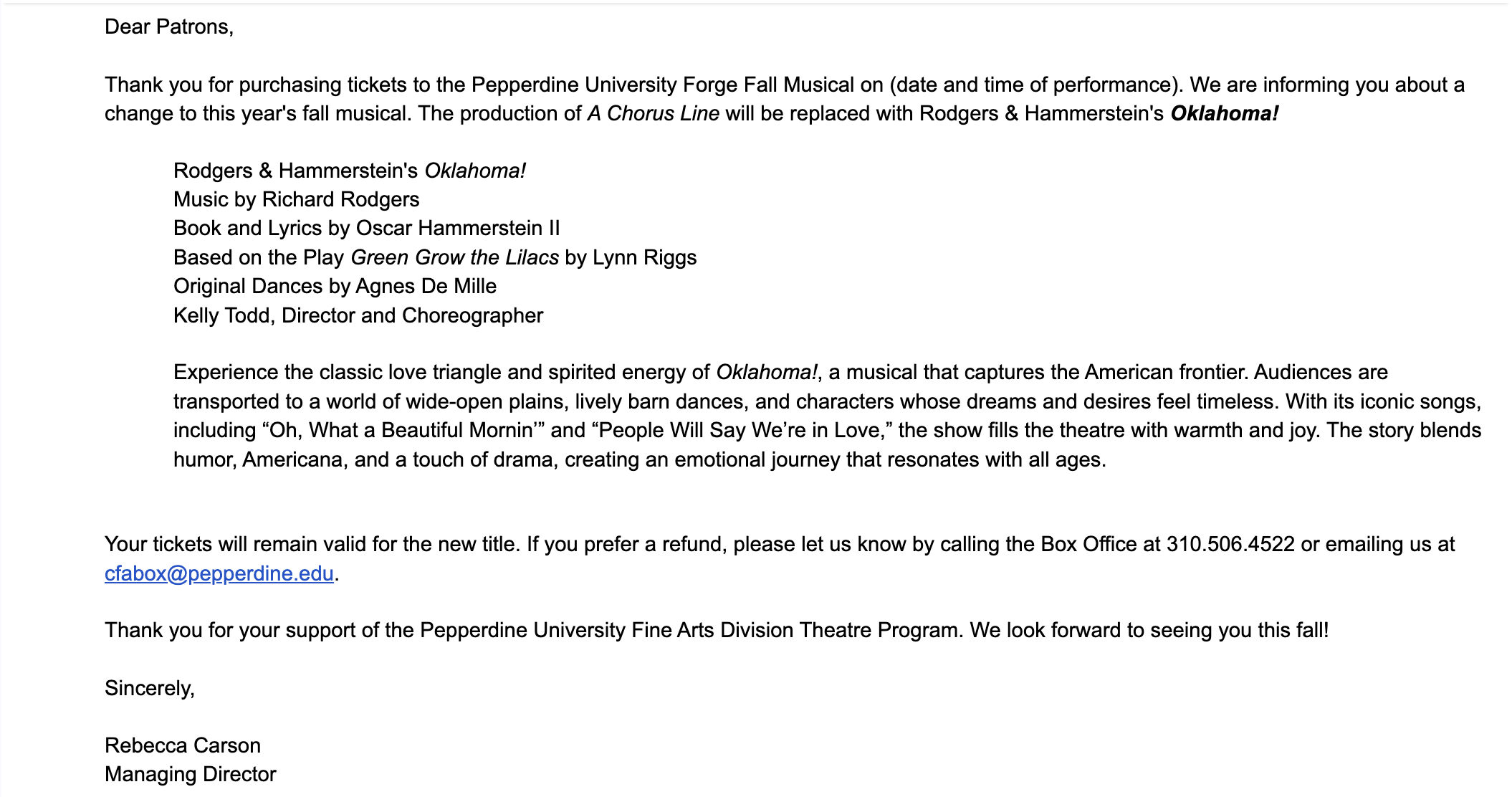
A July 29 email sent by Rebecca Carson, managing director for the Center for the Arts, to patrons regarding the removal of “A Chorus Line” from the theater season. A day later, the Center for the Arts updated their website to reflect the change. Photo courtesy of Rebecca Carson
Carson also communicated to patrons that they would be eligible for refunds if they preferred. The Center for the Arts sold 76 tickets for “A Chorus Line,” and 20 patrons asked for a refund after being informed of the switch. Tickets cost $23 for patrons, $19 for Pepperdine faculty and staff and $13 for Pepperdine students, according to the Center for the Arts’ 2026-27 printed brochure.
Carson said that feedback from patrons was mostly collegial.
“Most were saying that they were looking forward to seeing ‘A Chorus Line’ and that they’ve already seen ‘Oklahoma!,'” Carson said.
A day later, on July 30, the website for the Center for the Arts was updated to reflect the change.
The Process for Buying Rights
For Pepperdine’s Theatre program to host a show in Smothers Theatre, they must undergo a lengthy process that can last about six to eight weeks. First, the Theatre program determines which play publishing house has the rights to the show title that the University wishes to produce.
Griffin said Todd was mainly in charge of finding titles to direct, but enlisted his help in finding one of the potential productions.
For “A Chorus Line,” the publishing and licensing rights are handled by Concord Theatricals on behalf of the Tams-Whitmark Collection and Music Library, according to Concord Theatricals’ website. Coincidentally, Concord Theatricals also holds the same rights for “Oklahoma!”
Griffin said the Theatre program was very nervous about where a replacement could be found for “A Chorus Line” in time.
Todd, who is now in charge of directing “Oklahoma!,” formally submitted three potential titles to Concord Theatricals. The publishing house quickly responded to the Theatre program’s inquiries stating that one title was denied, while one title was accepted — “Oklahoma!” was the one that was approved. Shortly after, the Theatre program received a quote for the royalty fee from Concord Theatricals.
However, because the theatre program had previously rented the rights to “A Chorus Line” from the same publishing house, they were able to transfer the rights from “A Chorus Line” to “Oklahoma!” While the rights process took less time than expected, Todd said the Theatre program was given no guidance from the Dean’s Office.
“Oklahoma!”
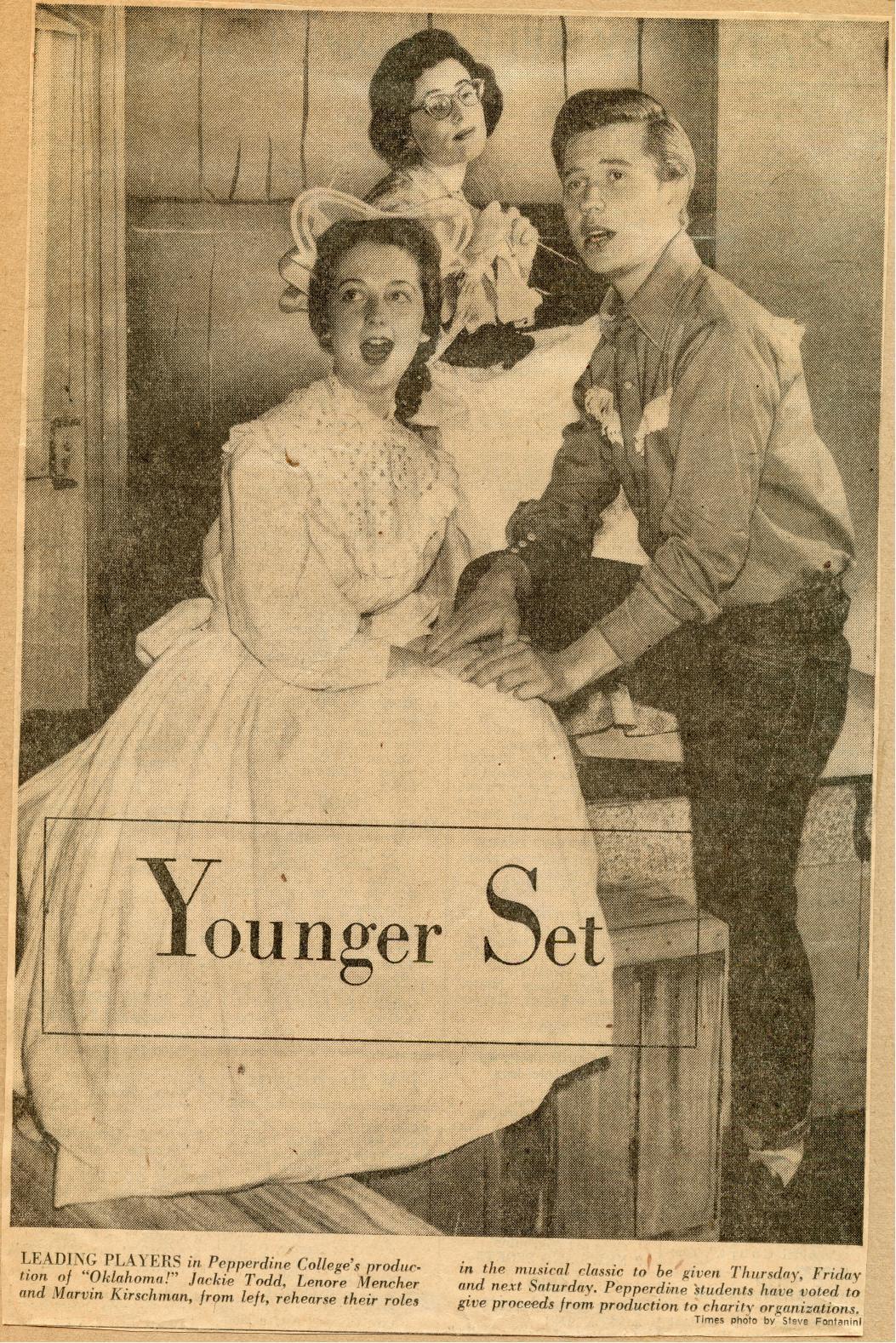
A Newspaper clipping of George Pepperdine College’s production of “Oklahoma!” in 1958. The South Los Angeles campus hosted the production again four years later. Photo courtesy of Pepperdine University Libraries
“Oklahoma!” is a Pulitzer Prize-winning musical that first premiered on Broadway in 1943. Written by Richard Rodgers with lyrics by Oscar Hammerstein, the story follows two love triangles between white settlers in the 20th-century Oklahoma territory.
Based on an earlier play by Cherokee playwright Lynn Riggs called “Green Grow the Lilacs,” “Oklahoma!” stripped many elements from the original play. “Oklahoma!” removed the original play’s concern over Indian sovereignty as well as homosexual undertones, according to New York Magazine. Riggs, who is gay, wrote “Green Glow the Lilacs” as a way to deal with his experience of being an outsider, according to Smithsonian Magazine.
George Pepperdine College welcomed “Oklahoma!” to its stage in 1958 and 1962, according to the Pepperdine Libraries archives. Smothers Theatre was home to “Oklahoma!” in 1992 and 2012.
Griffin said the Theatre program knew the Dean’s Office would likely approve “Oklahoma!” if it was submitted.
Griffin also said that people only remember the cheerful parts of “Oklahoma!,” but the story as a whole is much darker.
“The people only remember one thing about ‘Oklahoma!,'” Griffin said. “They remember the beautiful music and incredible dancing, but they don’t remember that it’s a really dark story.”
The Future of Art at Pepperdine
Carson said it is hard to ignore the comparisons between the art censorship that took place at the Frederick R. Weisman Museum of Art in the fall 2025 semester and the last-minute removal of “A Chorus Line” from the theater season.
In October 2025, Pepperdine administrators shut down a Weisman exhibition after censoring two pieces of artwork that they deemed “political in nature,” according to previous Graphic reporting.
“I think that the exhibition in the Weisman Museum of Art was an outside artist collective, and you know, this situation is Pepperdine students and faculty,” Carson said. “But I think the similarity is it feels like there’s a disconnect between what we are trying to do and what the University thinks we should be doing.”
Carson said she will continue to advocate for the arts at Pepperdine.
“I’m eager to figure out ways to really be better advocates for our work and the importance of the arts as part of a liberal arts education,” Carson said.
For Todd, the censorship at the Weisman Museum was painful.
“That experience eroded relationships — not permanently, but it did,” Todd said. “To have this decision come down in that environment made it even more hurtful for us,” Todd said. “The sense was what happened in the Weisman was a one-off thing, so now when the second thing happens, it seems pretty clear that Pepperdine is censoring art.”
Todd said solving this removal issue between administration and faculty is complex.
“I think some of the challenges of this discussion is that we, as professors, see this as our academic work. We see our shows as the lab in which our students grow and develop,” Todd said. “This feels like an academic freedom issue to me. I have been hired as the person on campus who has the most experience in musical theater. That show would’ve pushed our students.”
With little turnaround, Todd said she is trying her best to put on the best production possible.
“I am so far behind, it’s crazy,” Todd said in an Aug. 18 interview with the Graphic. “But we’ll get there, we’ll get there.”
Todd still encourages the Pepperdine community to come out and support the Theatre program’s iteration of “Oklahoma!”
“The best way to support us is to show up,” Todd said. “It’s going to be hot topics and exciting for sure, and I think people will be interested to see our take on ‘Oklahoma!'”
In a Sept. 16 email to the Graphic, Todd said she’s since made progress in bringing the production up to date.
“Progress on ‘Oklahoma!’ is great,” Todd wrote. “It is going to be a wonderful show.”
This story was copy edited by Lila Rendel.
__________________
Follow the Graphic on X: @PeppGraphic
Contact Marcos Lizarraga via email: marcos.lizarraga@pepperdine.edu