
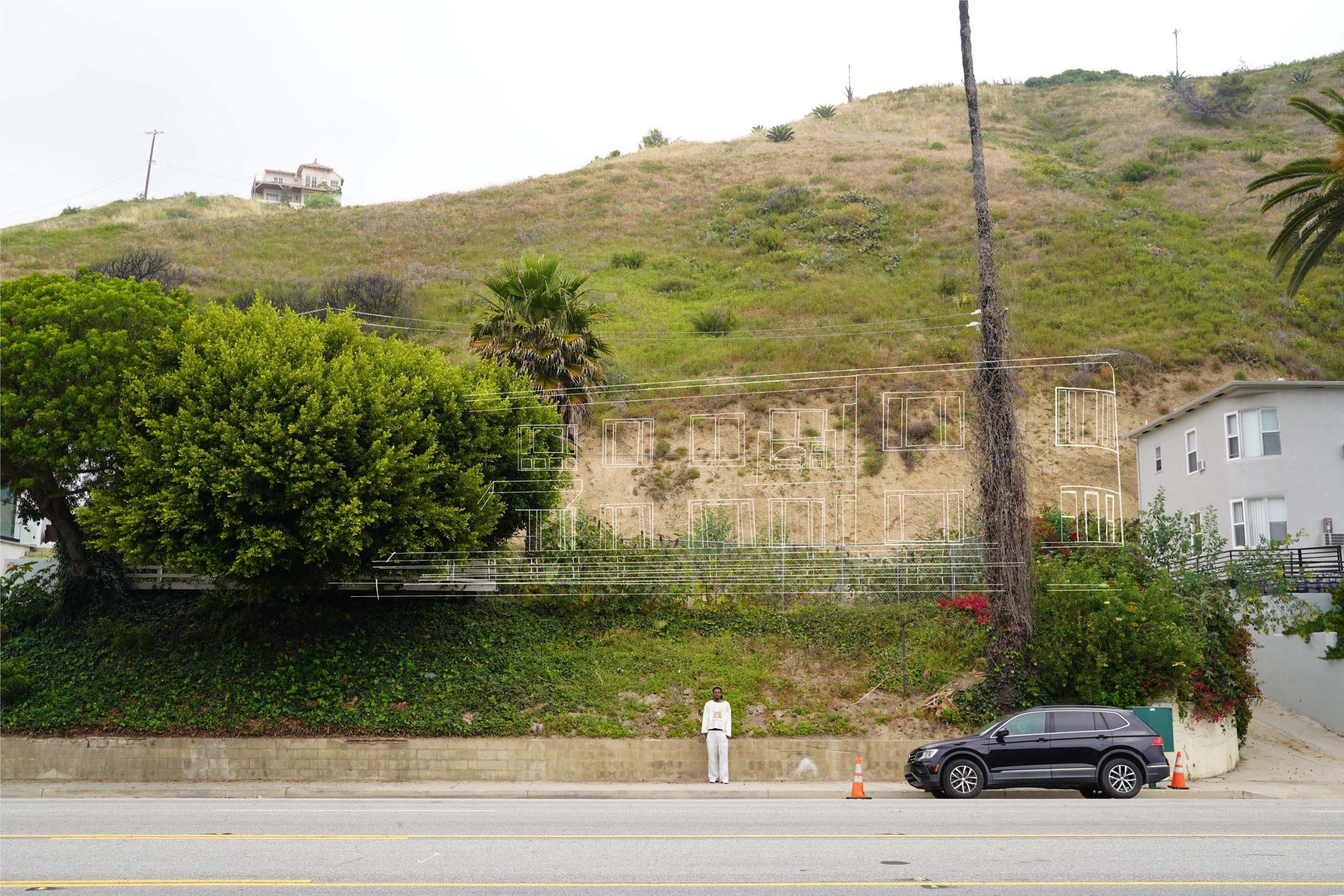
Javon Cooley stands in front of his former apartment complex, a year after it burned down during the Palisades Fire. Photo and illustration by Melissa Houston
Jan. 21, 2025.
Two weeks since thousands of lives in Los Angeles had been turned upside down.
Former Pepperdine professor Rachel Collins was lost driving around the Palisades. She and her husband, Troy, couldn’t figure out where they were. Landmarks were gone. All their favorite spots too. After years of walking these city blocks, they couldn’t orient themselves.
“It looked like a bomb had gone off,” Collins said.
More than a year has passed since America’s costliest wildfire event in history to date. Currents Magazine followed three diverging lives forever changed by the morning of Jan. 7, 2025: Collins, Waves basketball player Javon Cooley and flute instructor Susan Greenberg.
The People
Rachel Collins had just left her job at Pepperdine. She worked at the University for six and a half years as an associate chaplain and then moved to the Religion and Philosophy Division. During her time as a Pepperdine employee, she also received an MBA degree from Pepperdine’s Graziadio Business School.
The Franklin Fire in Fall 2024 cut her final semester short.
Collins and her husband moved into their Palisades apartment a week after they got married. They were part of their local YMCA, knew all their neighbors and had nicknames for the walking routes they took around the Village shopping area.
“It was a really special place,” Collins said.
Collins never forgot the highly destructive Woolsey Fire in November 2018 while she worked in the chaplain’s office.
Grad student Javon Cooley’s story began across the country. He previously played college basketball at Marist University in New York before transferring to Pepperdine. Cooley moved to Malibu in June 2024 for a M.S. in Global Business at Graziadio, and his first year was filled with twists and turns.
“We don’t really have natural disasters,” the 6’5″ Chicago native said. “The only thing I had to worry about growing up was a blizzard and maybe a thunderstorm with tornado warning.”
A month after arriving in Malibu, Cooley slipped on a wet spot during practice and injured his hip, an injury that would sideline him for the entire 2024-25 season.
The Franklin Fire that December forced him to evacuate from his Eastern Malibu apartment — across from Carbon Beach — with only the clothes on his back.
Susan Greenberg came to Pepperdine as an adjunct professor to teach flute and chamber orchestra. As one of LA’s premier flutists, she’s played at the Hollywood Bowl, operas and ballets, with the LA Chamber Orchestra, and for over 500 movies — including “On Golden Pond,” “The Notebook” and “The Lion King” — as well as for TV shows such as “The Simpsons” and “Animaniacs.”
Greenberg and her husband bought their Palisades house in 1974 and raised their kids there. Their house — on a cul-de-sac adjacent to Will Rogers Park — was filled with photos and memories of her wedding and her kids’ bar and bat mitzvahs, candlesticks from her 50th anniversary, her instruments and her husband’s sculptures.
Fire was always a threat. They had evacuated three times before. The Mandeville Canyon Fire in 1978 came close — 150 yards — but firefighters protected their house from damage.
On Monday, Jan. 6, Greenberg received a standard fire-weather warning alert. The email encouraged them to consider packing up valuables, just to be safe. She didn’t take it too seriously. Firefighters routinely refilled their water tanks at Will Rogers Park, next to their house.
“They always saved our area,” Greenberg said. “I figured, ‘Oh, this will be the same.'”
Jan. 7: The Day the Fire Broke Out
That Tuesday, wind gusts ranged from 40 to 55 mph, according to The Weather Channel.
Southern California had documented record dry conditions months before.
“I’d never been in winds like that,” Greenberg said.
Collins remembers that morning as being dry and windy, but nothing worth canceling plans over. Her husband, Troy, headed to work in Burbank and she headed to Pepperdine to babysit for friends who lived in the condos on campus.
Her friends were home but in meetings as Collins was watching their son.
“Hey Rachel, have you looked out the window in a moment?” her friend called out to her.
She saw smoke.
Collins got a text from Troy, telling her that he was going back home. She quickly grabbed her things and handed the baby off to her friend, who gave her a mask in return. Collins sprinted to her car, only to get stuck on Pacific Coast Highway for the next hour and a half.
Greenberg was watching TV when she saw bumper to bumper traffic on Palisades Drive.
“I better get out of here,” Greenberg said.
She and her husband, Michael Norman, packed two flutes, two piccolos and an alto, some clothes for them, two pillows, a laptop, her good jewelry, two passports and the key to the safety deposit box. They left behind photos, her wedding album, more of her flutes, a Steinway piano, laptops, sculptures, clothes and more.
“We left in an empty car,” Greenberg said. “We took nothing, thinking, ‘We’ll be back.’”
They made it out of the Palisades and traveled south to Santa Monica. Meanwhile, Collins strived to make it back to her apartment, facing a police blockade at Topanga.
Collins handed her ID to an officer.
“I’m going to let you through ‘cause we have been instructed to let residents through,” the officer said to Collins. “But please, be careful.”
As Collins heard those words, her heart sank. She’ll never forget the look on his face.
She kept driving into the smoke and eventually lost the sun. Stuck at a standstill and struggling to see around her, she instructed Troy — who had made it home from Burbank — by phone.
“You just need to grab the main things,” Collins told him. “Grab our wedding box, grab the documents, grab a few changes of clothes and get out.”
In her car, stuck on PCH, she could make out flames racing down the hill, coming straight for her and the others stuck on the highway.
“Let me see what I can do,” he told her.
“No — just grab the stuff and get out,” she responded.
Collins made a U-turn and headed back to Malibu.
Greenberg and her husband spent an hour with friends in Santa Monica after evacuating from their Palisades home. But the fire was spreading south toward San Vicente Boulevard.
“I’m leaving,” Greenberg told her friends, heading for another friend’s house in Mar Vista.
Her friends laughed in response; they left an hour after she did.
While the firestorm raged through the Palisades, Cooley’s Eastern Malibu residence was still safe. Men’s Basketball were in the middle of their season, and Cooley headed for Firestone Fieldhouse. He was awaiting hip surgery but still regularly showed up to practices and lift sessions.
As he made his way to practice, Cooley saw light smoke in the sky and ambulances on the roads. After practice, Cooley went home. That night, the lights went out, just like they had with the Franklin Fire. He didn’t leave, he just stayed in the dark.
Eventually, Cooley’s “intuition” told him to leave and check out where the fires were. The blockade had moved from Topanga to Duke’s Malibu — about 1.4 miles from his home near Carbon Beach.
“I seen the fire coming almost over the hill,” Cooley said. “Police officers, everybody, they told us to vacate our homes, so I did. So I left with a book bag and that was about it.”
A month earlier, during the Franklin Fire, Cooley left with nothing. This time, he thought packing a book bag was doing himself a service. He made his way to “Stinkies” — formally known as Malibu Canyon Village Apartments — to a teammate’s apartment and spent the night there.
Collins went back to her friend’s house on Pepperdine’s campus, and Troy joined her later that night, where they planned to stay.
“We started to see the fire coming north and cresting the hills,” Collins said. “There was just something psychologically where we were like, ‘Yeah, we got to get out of here.’”
They made their way down to Oceanside, where Troy’s family lives, and where they would stay for the next 12 days.
Waiting … Hoping … Panicking
Jan. 8: The following morning.
Cooley tried to reach his apartment at 6 a.m. The barricade had pushed further north, blocking traffic around the Country Mart. He went to a lift session instead.
A few hours later, he tried again and was able to drive to his complex.
“I pulled up and it was just nothing there,” Cooley said. “Both of the cribs next to mine, still standing. And the fire came from the south direction, so I really didn’t understand it. But in that moment, I really didn’t know what to think, how to feel.”
He headed back to Stinkies where he told a group of teammates his situation. Cooley said everybody felt for him.
His day was far from over. His long-awaited hip surgery was still slated for that same day.
Because of road closures, Cooley drove to Kanan Dume Road to get to Redondo Beach for his surgery. His family had flown in to help take care of him until he could move on his own again.
His surgery went smoothly. He’d spend the next three weeks on bed rest at a hotel in Redondo. Recovery included a wheelchair and help just getting to the bathroom. All the while, Cooley was processing losing his home, which had everything to his name that wasn’t packed in his book bag.
Rachel and Troy Collins were still in Oceanside, away from the fires, with no idea of what their home looked like. The morning after they evacuated, her husband learned that the fire had reached their local high school, a couple of blocks away from their apartment.
“There’s just no way,” he said to her.
They were frantically trying to figure out if the fire had jumped Temescal Canyon Road and reached their apartment.
“We were doing our best to try to piece things together,” Collins said.
Two days after the fires, Collins found out her apartment complex was still standing, thanks to a neighbor who had snapped a photo for them. There was damage to the structure, but it was saved.
“There was relief in that for a little bit,” Collins said. “But then we slowly realized over the course of that day that didn’t really mean very much because it had just been baking in smoke and ash with lead and arsenic in it.”
Any belongings that could be salvaged would likely be covered in poisons.
Meanwhile, Collins was starting a new job. She dove into her work — not in denial of what had happened — but to distract herself.
Well-wishers, friends, family — they all said the same things to her: at least they were safe, that she and her husband still had each other.
“Those things are all true, but they do ring a little bit hollow coming from people who also have all their things,” Collins said. “The things you have represent where you’ve been in your life and the memories that you have.”
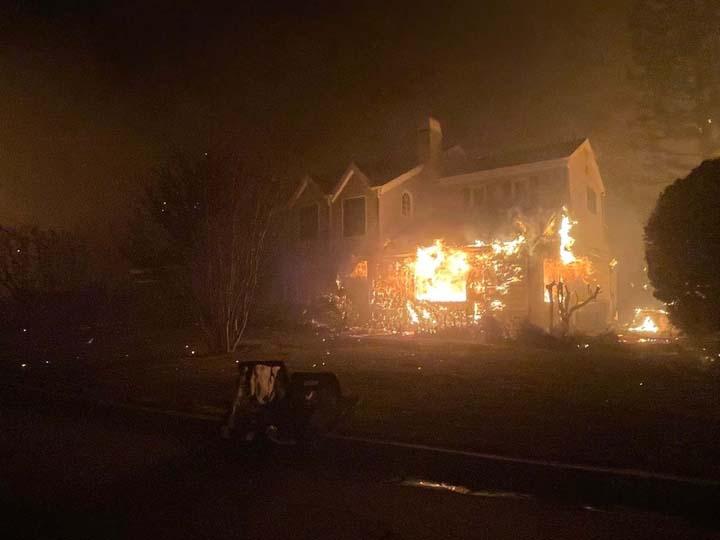
Susan Greenberg’s house on fire during the Palisades Fire. Photo courtesy of Greenberg
Greenberg’s memories of the fire are still foggy. She said she kept looking at charts and maps, keeping herself updated through the internet. Her neighbors had also been communicating with each other. She said she probably heard from a neighbor that her house was gone.
“I don’t think we went up there for a while to see it,” Greenberg said. “I think it was so bad that you can’t even contemplate it, you know what I mean? It was such a shock that you just had to feel grateful that you were safe, that you got out.”
The Aftermath
In all, the fire damaged or destroyed 7,810 structures, according to CAL FIRE.
After the initial recovery stage of Cooley’s surgery was over, he stayed at a hotel in Westwood for two to three weeks so that he could be close to his physical therapist in Santa Monica. He began touring for a new apartment and was looking heavily through Santa Monica because he didn’t even want to be near potential fire locations.
When Cooley came out to the West Coast in May 2024, the first apartment complex he toured was in Calabasas. The second time around, he didn’t pass up on the opportunity to live there.
Whatever wasn’t packed in his book bag, he lost. People rallied around him to help him replace many of his belongings, but there were sentimental items he couldn’t get back.
Soon after the fires had settled, Greenberg got a call from her next-door neighbor. He was in the process of rebuilding his house before the fires.
“Good morning,” he said over the phone to her. “I’m pouring concrete, I want to buy your lot.”
She told him she wanted to think about it.
For the next six months, Collins was in “survival mode.” She was working remotely, but her husband needed to be in LA for work. They bounced around, staying with friends and in Airbnbs.
“There was a night where we left an Airbnb, and then didn’t have another one booked until 24 hours later,” Collins said. “We went to church not knowing where we were going to stay that night, and just like hoped that a friend would take us in.”
They eventually moved into a month-to-month apartment as they tried to get back on their feet. Collins said all of her neighbors have scattered. The potential health hazards are a looming concern.
“FEMA (Federal Emergency Management Agency) did not do soil testing,” Collins said. “I don’t fully understand why. I don’t trust the reports that have come out saying, ‘Oh it’s fine to live there.’ I don’t believe it.”
Collins and her husband came back three weeks after the fires and sat in a line. The Red Cross handed them body suits, N-95 masks, goggles, heavy-duty gloves and covers for their shoes, just for them to go back to their apartment and see if they wanted to rescue anything.
In her former apartment, Collins pulled her mask down for a second and said she couldn’t even describe the smell.
“It’s not a smoke smell,” Collins said.
Because of that experience, Collins doesn’t trust moving back to the Palisades yet. She said they would wait several years before she thinks they would be comfortable.
“Maybe that’s us being overly cautious, but that’s where we landed,” Collins said.
Greenberg’s home was flattened. Little survived — their safe and pieces of Norman’s sculptures remained standing.
Greenberg and her husband eventually found a house for rent while they searched for a new home. Their kids assisted them through the process, and Norman’s USAA insurance helped as well.
Her son-in-law wanted to show her around some houses near his house, in case they wanted to move closer to them, south of the LA County Art Museum. Greenberg went to look for new homes with him and saw a house that she described as beautiful.
However, she stopped there.
“It’s too soon, I can’t even think about it,” Greenberg said. “I’m getting a sick feeling in my stomach, forget it.”
Greenberg said she and her husband bought the smallest house on the smallest lot in 1974. In 1989, they added a second story and moved out for 10 months. They didn’t want to remodel again. Greenberg was also concerned about the soil.
She decided to sell.
Steps Toward Recovery
In November 2025, the LA Times reported that the first home had been rebuilt in the wake of the Palisades Fire. The home received a certificate of occupancy and passed inspection, being deemed safe to inhabit, and had its grand opening Dec. 6.
PCH has been reopened since May 2025, but construction along the highway is still active, forcing lane closures.
Malibu’s City Council announced that they had issued 574 total permits in the fire incident area as of Feb. 27, 2026.
While the rebuilding process has made it possible for some people to start moving back, the trauma from the wildfires — and the uncertainty of it’s long-term health impacts — still stand in the way for many former residents.
Collins said the grief comes in waves.
“There are just a lot of little moments that you don’t really predict,” Collins said. “Funnily enough, this morning I woke up, and I need to travel to the East Coast in a couple days. I was like, ‘I don’t have a coat, a jacket,’ I just never replaced the one that I had in our apartment. It sounds silly, but I loved this coat. It fits so well, I got so many compliments on it, and I never replaced it and couldn’t find the same one again.”
Greenberg compared the loss of her house to a death. She said you don’t get a death right away, that it takes a while to sink in, and that it was the same with the fire.
“A lot of people cried,” Greenberg said. “I cried later, you know? I was just in such shock that I couldn’t even express the emotion.”
She bought a new house in Carthay Square, just a mile from one of her kids’ homes.
“In the Jewish religion, it’s interesting that the prayer for the dead — the Kaddish that you say after somebody dies — doesn’t say anything about death,” Greenberg said. “It reaffirms God, and it says you move on, and I think that’s just what I decided. ‘What other choice do I have?’”
She was given concert clothing donations from fellow musicians, got new instruments and received kind messages from others. Her family helped her throughout. A little over a year later, Greenberg said she’s living in gratitude.
“I just realized that I have a lot of those memories in my heart,” Greenberg said. “Which was kind of a very comforting thing because in a way, that’s kind of what life is. It’s a compendium of the memories you have as you’re building and going through your life. I think that’s been a great comfort to me.”
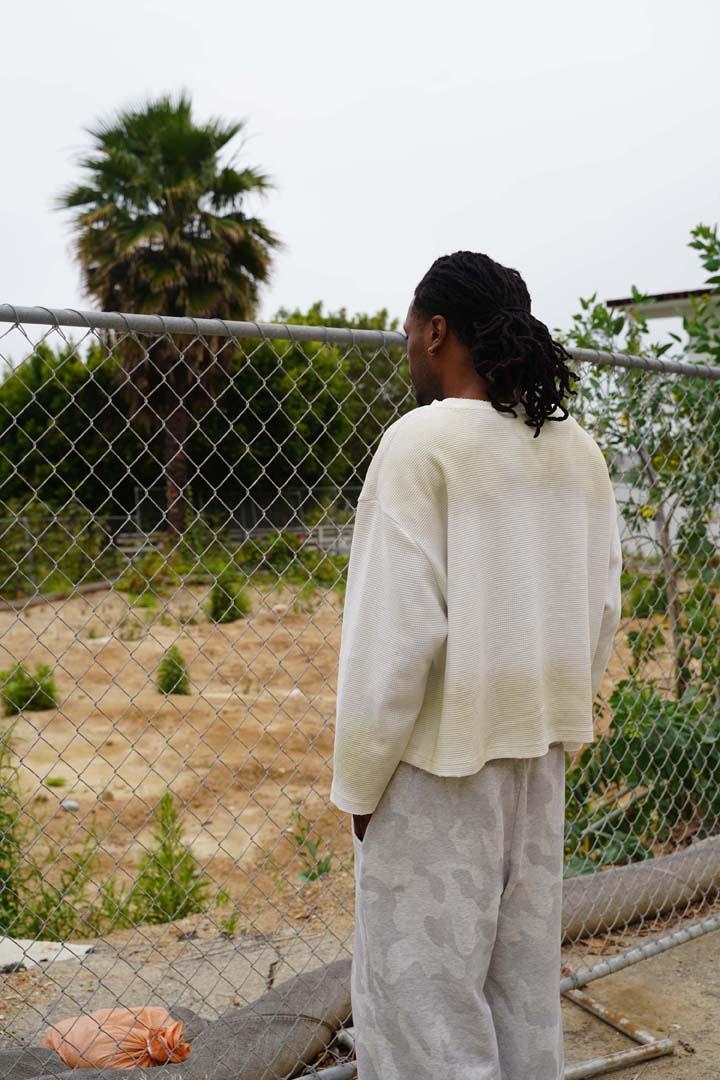
Javon Cooley looks at the empty lot where his apartment complex once stood. Photo by Melissa Houston
Cooley said he’s always dealt with adversity, and he believes this was another stamp in his journey. He believes this is something God put in front of him and that God knew he would be able to overcome.
Ten months after the Palisades Fire and his hip surgery, the power forward grad student made his debut as a Wave in November 2025.
The trauma is still there. He believes the experience is probably going to be something that lives with him forever.
“I wasn’t really able to process it early on, but now I feel better,” Cooley said. “Sometimes in Malibu, when it gets dark, cloudy, sometimes I just think about the smoke and everything.”
_________________________________
Follow Currents Magazine on X: @PeppCurrents and Instagram: @currentsmagazine
Contact Nick Charkhedian via email: nareg.charkhedian@pepperdine.edu or via Instagram: @nickcharkhedianjournalism