
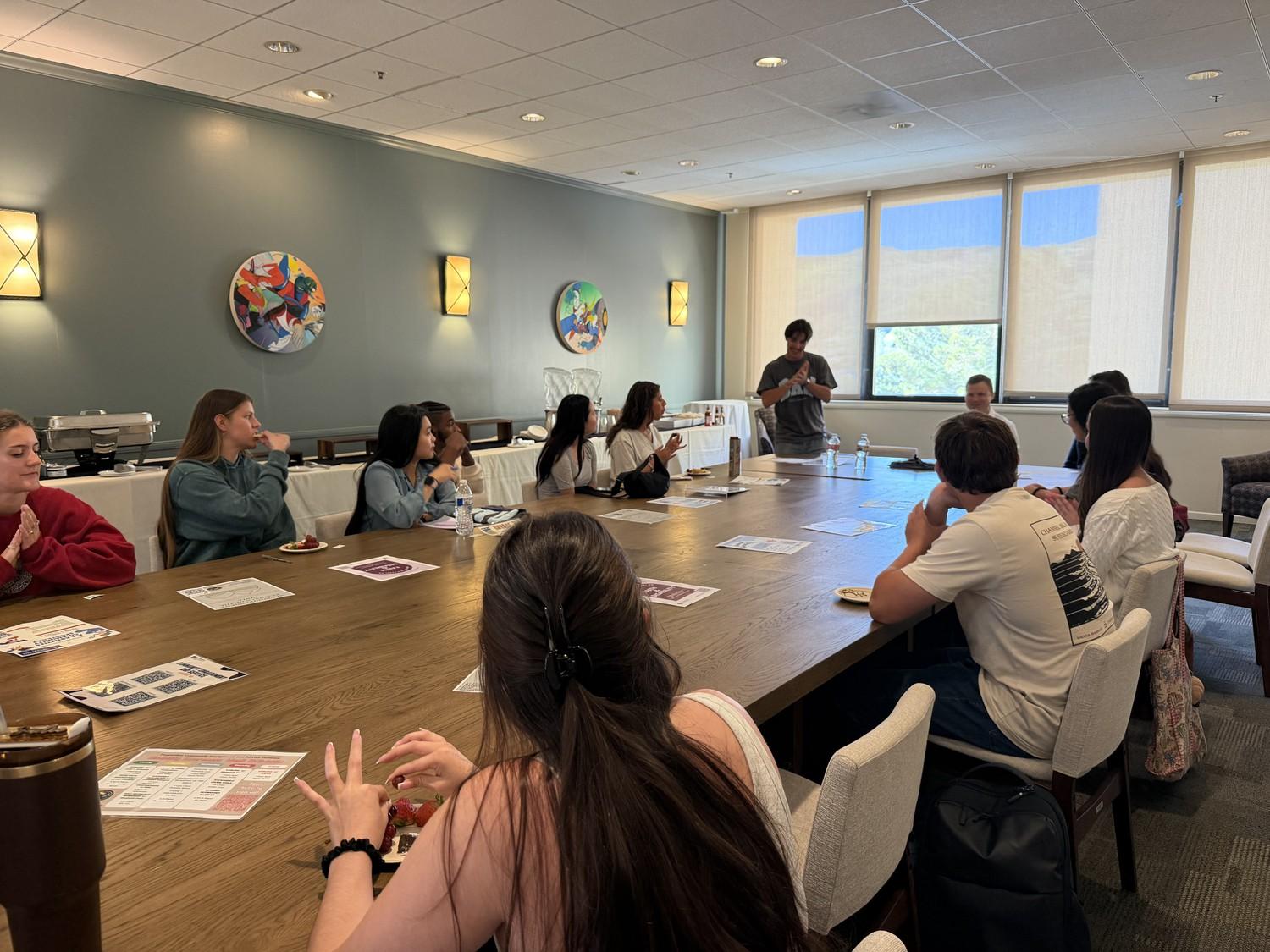
Sports Medicine Professor Adam Pennell and Francesca Lanese, senior Sports Medicine major, sit at the head of the table during a Disability Awareness Week roundtable March 9. A way to get close to the topic of disability research is to think about the implications for us now and for the future, said Christin Shatzer Román, Director of Community Engagement and Service. Photos by Oliver Evans
Pepperdine Community Engagement and Service (CES) hosted a research roundtable as part of its annual Disability Awareness Week (DAW) on March 9.
The roundtable discussed disability research at Pepperdine, communicated the experiences of people with disabilities and disability researchers and highlighted the need for better data-collection tools in the field.
“The point is to raise awareness about disabilities,” sophomore Jaden Markowski said. “Pepperdine has a lot of places where it can grow.”
Markowski, the event’s moderator, started off with a brief introduction. The two panelists were Sports Medicine Professor Adam Pennell and senior Francesca Lanese, a Sports Medicine major and member of Pennell’s research team.
“DAW was started by students with lived experience with disability, and really a goal of this week is to increase all of our proximity to this topic,” Director of CES Christin Shatzer Román said.
When trainers work with elite athletes, the goal is often to achieve little changes like getting milliseconds down or pushing just a little more weight, Lanese said. When working with people who have disabilities, those little changes can be something like buttoning a shirt. Giving a person with a disability slightly more independence through those little changes is a huge part of their life.
“You are doing excellent, phenomenal movements every day,” Pennell said.
Motor skills are goal-directed actions, such as walking, that people do every day, Pennell said. In his field, understanding and assessing how someone moves helps him determine how far to push the needle to help a person be able to do something functional that many people take for granted.
The false public perception of people with disabilities often defaults to the idea they cannot do things, Pennell said. There are many ways to do things, and part of Pennell’s job is modifying or adapting something so someone can do it.
“You can think of the Paralympics — you see amazing things done by all sorts of people,” Pennell said.
Pennell said helicopter parenting and learned helplessness are among some of the issues in many caregiving environments for people with disabilities. More than anything, environmental factors determine how something will unfold for a person with disabilities.
The teams around people with disabilities have a responsibility to continuously challenge and build, even on days that are upsetting, Pennell said.
“There’s a lot of evidence behind that mentality that if you just keep going, it will bear fruit,” Pennell said.
Many people with disabilities have a higher sense of perceived societal burdensomeness, which is linked to suicidal thoughts, Lanese said. Because of that, it is important to identify those thought patterns early to avoid suicidal ideation.
“I think of life and function very much on a continuum, not a binary,” Pennell said.
The event lasted an hour and included a Q&A with audience members. Additionally, Pennell touched on a grant Pepperdine is participating in alongside California State University, Long Beach (CSULB) and Oregon State University (OSU).
The main author of the grant is at OSU, who is coming down to Cal State Long Beach with Pennell and his team to meet with CSULB, which has a great relationship with an adult transition program, Pennell said. The research can source potential participants from this program to develop accessible, improved and vetted fitness programs for individuals with autism, intellectual disabilities and other developmental delays.
Essentially, researchers from Pepperdine, OSU and CSULB will run through a large sequence of tests, both old and new, Pennell said. The research is part of a larger initiative to collect more robust data on K-12 fitness tests and people with intellectual disabilities, using this group of young adults. Researchers are collaborating through an entity known as the Cooper Institute, better known as FitnessGram.
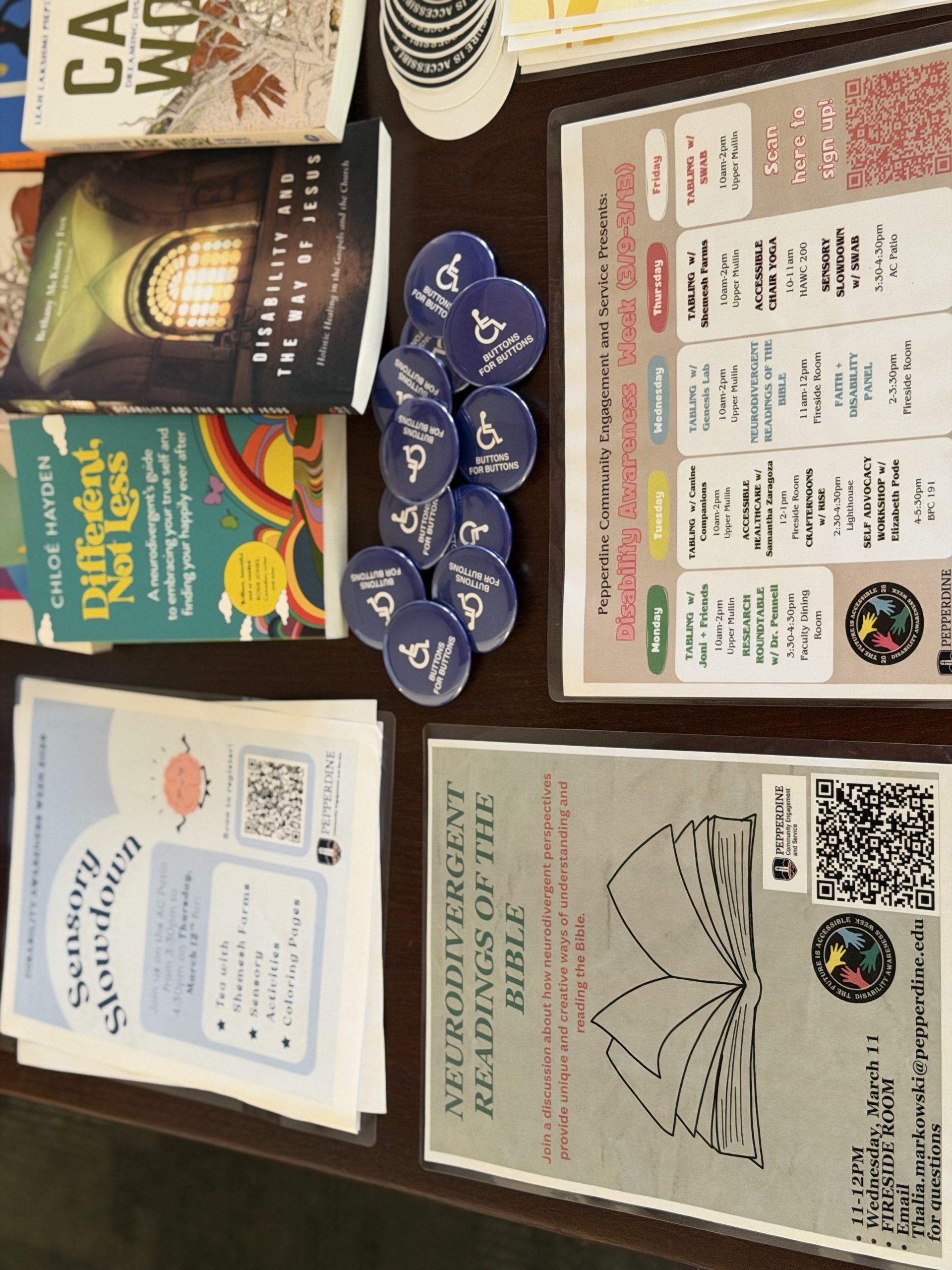
Documents related to Disability Awareness Week sit on a table at the front of TCC 112 during the March 9 roundtable event. Pennell said the University has been supportive through the Grants Office, and any time he has applied for funding, he’s gotten it.
Other events that were part of the DAW 2026 included a faith and disability Panel, a self-advocacy workshop and a presentation on accessible healthcare for college students, according to a University press release.
_______________
Follow the Graphic on X: @PeppGraphic
Contact Oliver Evans via email: oliver.evans@pepperdine.edu