
Center for the Arts’ production of ‘Fiddler on the Roof’ hopes to entertain, educate and transform.
By Peter Celauro
A&E Editor
On Nov. 6, Malibu’s theatergoers will see the curtain go up on Pepperdine’s production of “Fiddler on the Roof.” For them, the show will be three hours of musical entertainment and, maybe, something to think about for the next few weeks.
 For its 70-plus cast and crew members, however, these performances will be the culmination of more than two months of preparation. Through weeks of singing, dancing, cultural study, speech practice, line memorization and physical exercise, everyone involved has worked countless hours to make this production of “Fiddler” unforgettable.
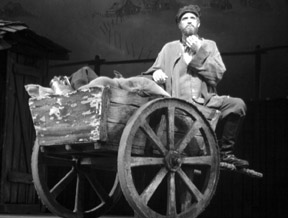
ANDREA BARRET/STAFF PHOTOGRAPHER
None of them have been Senior Eric Downs in ‘Fiddler on the Roof.’
quite as involved, perhaps,
as director Cathy Thomas-Grant.
“We chose the show last March or April and spent the summer trying to figure out what set to rent, where to get the costumes and how to fit it all onto our stage,” she said. “One of the big tensions of putting a show together is the fact that you don’t know what you have until you see it all put together.”
After those early plans were made, Thomas-Grant began one of the more overwhelming aspects of the show’s production: auditions, which took place during the first week of the semester. She said there were three days of auditions: one for singing, one for dancing and script reading and one for callbacks, when the best performers get trimmed into the official cast.
Given the large number of students who showed up to audition, being chosen for the final cast is a fairly big deal. Once cast, however, the actors didn’t have time to celebrate; rehearsals began the day after Labor Day.
“We had our first read-through that day, and we’ve been rehearsing ever since,” she said. “They’ve worked five to six days a week since the first week of September. We start(ed) technical rehearsals Monday (the 20th), and the kids will go from Oct. 27 through Sunday, Nov. 9, without a day off — that’s two weeks straight with no break.”
Though it may seem excessive, Thomas-Grant sees the busy rehearsal schedule as a necessity. While all musicals share some similar parts that need rehearsing (singing, memorization of lines), performing “Fiddler” properly means paying attention to a whole other aspect: cultural accuracy.
“We’re dealing with a Jewish community in 1905 Russia. I need to keep track of all of the Jewish elements: the Sabbath celebration, the wedding, people pronouncing ‘Tzeitel’ right. That kind of detail is really important.”
To get a more personal feel for that kind of detail, some of the actors went to the original source of “Fiddler,” Sholem Aleichem’s “Tevye the Dairyman,” the story on which the play is based.
“Reading those stories was really cool because you hear about the story in its original voice,” said Eric Downs, who will play the lead role of Tevye in the show. “It’s like reading the book compared to watching the movie.”
Thomas-Grant agreed.
“One of the things Shalom Aleichem did was provide a type of humor in Yiddish writing that had never been done before,” she said. “It was a humor about being Jewish. Before he had introduced this sort of writing, Jews had never dealt with laughter directed at themselves.”
To ensure that Alacheim’s unique humor translates properly to Smothers’ stage, Thomas-Grant hired a dialect coach, Danny Campbell, to work with the actors. Meanwhile, musical director Sarah Banta has been working with them on the diction, phrasing and style that make the show’s music so memorable, and choreographer Bill Szobody has gone so far as to run dancers through an obstacle course to build their strength.
“They’re going to be doing these dances 14 days in a row, so they’ve got to have trained bodies,” Thomas-Grant said. “It’s been one of his main goals to make sure they have the physical strength. It’s not easy stuff to do.”
The extra work, she said, will definitely pay off come show time.
“We have contractual agreements that we have to follow (Jerome Robbins’) original choreography,” Thomas-Grant said. “And Bill’s put his own personal touch into all of it. It makes me tear up, it’s so wonderful. Bill’s done a wonderful job of getting that dance into the student’s bodies.”
Thomas-Grant hopes that all this attention to detail will help the audience see “Fiddler” as more than just a few hours in the theater and a few laughs. Having spent a summer in Poland and the Czech Republic studying art and the Holocaust, the director understands that this show’s themes hold a heavier importance as well.
“This was an important time period for the Jewish community,” she said. “Not since the Spanish Inquisition in the 1400s had there been such an eradication of the Jewish community. This is the next big one, and then there was World War II. It’s important for us to be aware of this culture.
“I think there’s a reason this show has been done for 40 years, in Japan, China, all over the world,” she said. “There’s a universality to it. It really does deal with the disintegration of a society. It deals with family and young people looking at the old ways and the new ways. It’s no different from what goes on now, in our world today. I think it will always be relevant.”
“Fiddler on the Roof” opens Nov. 6, and though Thomas-Grant wants the show to entertain, she also has a deeper hope for its impact on the audience.
“There’s a responsibility for us to change the person who’s watching, even if it’s only for a moment,” she said. “They will recognize something of themselves in it. A powerful performance can transform a community. It certainly will transform the students (in the play). If it doesn’t, they haven’t been doing their jobs.”
November 06, 2003