
Modern exhibition gives Pep a taste of a powerful art movement
By Selina Ruiz
Staff Writer
A blank stare follows the comment, “I work at the Weisman Museum.”
But this is nothing new to the senior art history major Amy Cubicciotti.
 “Nobody knows (Weisman) is a great museum conveniently located on campus, nor do students realize that we have rotating exhibits,” Cubicciotti said.
Indeed, some Pepperdine students nonchalantly walk by Weisman without realizing what wonderful things are inside.
The current focus at the Weisman is minimalism. In a handout provided by the museum, minimalism is described as having an emphasis on autonomous objects that signify and symbolize nothing but their own presence. It is also a tendency toward the accumulation and controlled repetition of a DANIEL JOHNSON/PHOTO
few simple shapes or designs. Director of EDITOR
the Weisman Museum and professor of art history Dr. Michael Zakian explained that all of the pieces on display are from Pepperdine donor Frederick R. Weisman’s personal art collection.
“Weisman believed in the educational aspect of art,” Zakian said. “These contemporary artists use their imagination, creativity and experience to bring new and thought-provoking ideas.”
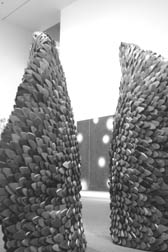
By far, the most intriguing and awe-inspiring piece is the centerpiece of the downstairs Gregg G. Juarez Gallery. The work was crafted by American Les Christenson and entitled, “Why Should I Walk if I Have Wings to Fly?” The art piece, completed in 2000, looks like two free-standing angel wings. Upon closer examination, exhibit visitors see that it is composed of more than 5,300 worn shoes. Zakian described the piece as a powerful example of inspiration.
“The shoes represent the fact that we go through our day, step by step materialistically but the title suggests that you can fly in your imagination, dreams and hopes,” Zakian said.
Also in the lower exhibition room is a breathtaking wall relief by American Robert Irwin. The 1968 piece, “2221” is an acrylic disk coated with a light sensitive acrylic paint. It’s an optical illusion of sorts, because the base seems to dissolve when light is shone toward it, revealing a quatrefoil pattern of four overlapping circles.
British artist Anish Kapoor’s stainless steel and lacquer painted “Blood Mirror III” is a concave disk painted a deep red. The piece is another example of an optical illusion; standing in front of the disk, it feels like you’re staring into a circus mirror, while slowly becoming dizzy and confused.
The title piece, created in 1958 and seen on fliers, postcards and signs advertising the exhibit, is by German American Josef Albers and is entitled “Homage to the Square: Upon Arrival.” The oil-on-masonite work is based on a system of square proportions and a combination of red and orange hues; the work demonstrates Albers’ belief that art begins in “the discrepancy between physical fact and psychic effort.”
Lesley Dill’s “Flood (I Heard a Voice)” from 2001 to 2002, is a combination of paper, acrylic paint, inks and pens. The wall of leaves flows in a water-like undulation, and standing up close, one can see the words “I,” “Heard,” “A” and “Voice” are imprinted singularly on each individual paper leaf.
Zakian plans the exhibits that will come to Pepperdine more than a year in advance. His primary concern is the educational message of the art but also strives to create a balance between modern and traditional art.
Zakian said students can derive much from the visiting exhibits and encourages students to visit often. Cubicciotti and fellow student worker, junior Kimberly Smith, agreed saying the museum is a cultural resource that is not being used by the students as it should be.
“It is a museum for the student,” Zakian emphasizes.
“Minimalism and More: Contemporary Art from the Frederick R. Weisman Art Foundation” runs until Nov. 16. The museum is open Tues.-Sun., 11 a.m. to 5 p.m. and is free to students. For more information, call (310) 506-4851.
October 02, 2003