
In the spring, the Graphic got a sneak peak at Disney’s newest attraction. Here’s what we thought about it.
By JAMES RISWICK
Associate Editor
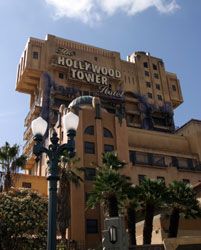 James Riswick/Associate Editor
Some say that imitation is the finest form of flattery. In Disney’s case, imitating itself seems like a sure-fire way to help boost their fledgling California Adventure theme park. And if The Twilight Zone Tower of Terror is any indication, Disney should rip itself off more often.
The Graphic got a sneak-peak at the ride before it opened in April. Based on the attraction of the same name that opened its doors in 1994 at the Disney/MGM Studios in Walt Disney World, the Tower of Terror is essentially an elevator that drops its “guests” 13 floors down from the top of the tower to its “Boiler Room” basement. But this is no run-of-the-mill “Dropzone” knock off — one of which is already at California Adventure.
Instead, like its predecessor in Florida, the Tower of Terror is a ridiculously over-elaborate thrill ride disguised as the fictitious 1930s Hollywood Tower Hotel. Although not nearly as majestic and imposing looking as the original, this Tower is still the tallest attraction at the Disneyland Resort.
As with almost all Disney attractions, the beauty of the Tower of Terror is its elaborate theme, which in this case is based on a “lost” episode of the early 1960s TV show, “The Twilight Zone.” A digitally recreated Rod Serling (the series’ host and head writer) tells the audience about “this week’s episode” in the Hotel lobby’s library just beyond where the attraction’s line forms. As the story goes, the Hollywood Tower Hotel, built in 1923, has been abandoned since a stormy night in 1939 when a lightning strike evaporated the hotel’s main elevator shafts, sending four hotel guests and an unfortunate bellhop down the elevator shaft and into the fifth dimension never to be heard from again. The Tower has remained derelict … until now. Cue Twilight Zone theme: Do do do do, do do do do. At least that’s how the story goes.
The ride is a little less cerebral, though, and a lot more screamful. Passengers are loaded from the hotel boiler room onto service elevators where they are strapped into their seats – it’s disappointing that after 10 years, Disney wasn’t able to figure out a way to let passengers stand up. The elevator dashes up a few floors where passengers are transported into the fifth dimension and the five trapped hotel guests from 1939 appear once again. This story portion of the ride is much shorter than the original, which could be a good thing for simple thrill seekers, but perhaps a bad thing for those who appreciate Disney’s story-telling ability.
According to Disney Imagineer Neil Engel, the ride’s senior production designer, the elevator drops four times and includes a “boomerang” effect that sends guest up and down repeatedly and very quickly. Because the ride is actually powered downward rather than simply free falling, passengers are actually traveling faster than the speed of gravity (or 32 feet per second squared). This produces a weightless feeling that sends your legs up toward the ceiling, as well as any other things handy – like the Graphic’s 10-pound digital camera. It’s certainly an interesting experience that can make passengers a little queasy – especially early in the morning.
The ride is programmable, which means that chances are a park guest could ride it all day and never experience the same thing twice. Compare that to the original ride in 1994 when there were only two drops – an eight-story drop followed by the big 13-story plunge. That was a much different experience, and although it felt more like an actual elevator giving way from underneath you, the updated incarnations of the ride both in Florida and at California Adventure are much more thrilling.
Although the thrill portion of the ride is on par and perhaps a bit better than the original, the charm and grandeur of the Hollywood Tower Hotel at Walt Disney World just isn’t matched. Florida’s Tower looks noticeably larger in almost all proportions, even though the California version gives away only 16 vertical feet to the original (183 to 199). Both were limited to 200 feet by the Federal Aviation Administration, Imagineer and Production Director Cory Sewelson said. Any taller, and it would have required blinking red lights on its roof.
Sewelson added that the Florida Tower is located on a hill, which would explain why it looks that much bigger and the removal of a large portion of the ride’s story from the California Tower also eliminated much of the attraction’s needed girth. Although still impressive, the California Adventure version just doesn’t look as much like an actual hotel, and despite the interesting “Pueblo Deco” architecture (a mix of Art Deco and Spanish architecture popular in the 1920s) used, it doesn’t give the same impression of “I can’t believe they put that much effort into a ride.”
But for those who, literally, drop by the Tower of Terror, these quibbles will mean very little. After all, who cares about how impressive the building looks when you’re being shot down faster than the speed of gravity? It’s a great step forward for the struggling (and so far disappointing) California Adventure park, and if Disney were smart, it would rip itself off a few more times.
08-30-2004