
Students in a Pepperdine service class aid local aid organization founder Judith Jenya in her efforts to teach peaceful conflict resolution skills to kids in war-torn nations.
By Rudabeh Shahbazi
Assistant Perspectives Editor
Multitalented visionary Judith Jenya makes miracles happen on a regular basis. Students in Dr. Mullen’s service and leadership class are learning to make miracles as well. Partnering with humanitarian and Malibu resident Jenya, a group of students in the class will be helping with her new organization Youth Creating Peace.
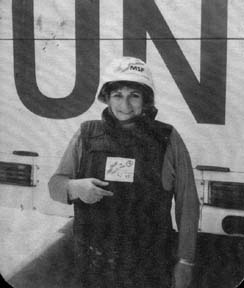 The international organization will be similar to another program she founded, The Global Children’s Organization, by fostering respect through creative expression, peaceful conflict resolution and acceptance of cultural, ethnic and religious diversity. A proposal to make a film about the project has been made.
The attributes her giant leaps to her “chutzpah,” or her audacious daring and self-confidence. When her epiphany of mission and vision of specifics call her, she feels obligated to act on the PHOTO COURTESY OF JUDITH JENYA
inspiration.
Jenya believes that everyone has the responsibility to repair shattered fragments of the world and try to “make it whole with caring compassionate action.”
“She’s great and people should help her by donating to her organization because it’s our duty as humans to strive for peace,” said senior Eduardo Monroy, who is a member of the group in the service leadership class.
As a social worker, Jenya had always been an advocate for women, children and families, so she decided to earn a law degree. After graduation from law school and armed with her new degree, she practiced family law and helped pioneer the first U.S. adoptions of Russian children.
In 1990, Jenya was invited to a camp in Russia by a Honolulu-based nonprofit organization. They brought medical supplies and doctors to orphanages throughout the Soviet Union, where she “discovered a crying desire for someone to help kids.” She waited for the passing revolution and returned solo to talk to orphanage and government officials.
Two years later, Jenya, who has toiled for more than 30 years as an attorney, teacher, social worker, art therapist and workshop leader, was surprised when the Albanian president responded to her letter saying she wanted to help children. That year she went from Russia to Albania to implement her efforts.
Despite the overwhelming need, there was one thing Jenya saw that the barefoot orphans there desperately needed. “We brought shoes to Albania,” she said. The organization also gathered Teddy bears, makeup and other things to deliver.
When a volunteer of that organization told Jenya that his parents were under siege in Sarajevo, she grabbed a map, and, seeing that Sarajevo was between Albania and Russia, soon found herself on a plane to Zagreb on her way back from delivering shoes in Albania. She met humanitarians and visited refugee camps and hospitals for the first time, where she saw children who had lost their limbs in explosions. She knew she had to do something.
When she voluntarily led a youth camp in Russia in 1999, an orphanage administrator expressed his dislike of “humanitarian types,” saying they always came, took pictures and felt sad, but did nothing to help circumstances. He recommended developing a serene summer camp where youth could escape for a while. Jenya, who already had experience creating camps, realized how much more memorable the experience would be for a child who had lost everything.
Jenya founded the Global Children’s Organization to promote awareness, respect and hope to children and youth caught in the crossfire. Since 1993, more than 1,000 children have come to the camp, which is funded by worldwide donations. Religious institutions, social services and schools select the children, many of whom are refugees and orphans from Eastern Europe.
Jenya found the “safe little island” she was looking for with the help of two friends, a Bosnian and a Croat, who had recently left Sarajevo. They assisted her in obtaining the necessary Croatian government permission and helped her find the actual campsite for children who lived in war-torn and violent environments.
A beautiful 15th century Franciscan Monastery provides isolated sanctuary, away from fighting, on a gorgeous island off the Adriatic coast of Croatia that is inaccessible by car. Jenya, who is a Jew, saw the European community turning its blind eye on the Baltic region and said, “I’m a strong believer of never again…I couldn’t know that this was going on and do nothing.”
When asked if the interfaith service among Muslims, Catholics, Jews and Orthodox, taught religious tolerance, she said, “It doesn’t matter if they understand about religions. It’s about respect, not tolerance.” At camp, children create art, play sports and learn to protect the natural environment.
Hundreds of volunteers, including her son Rashi, worked with Jenya when she started the Global Children’s Organization. Rashi became involved in the Baltic culture and is completing his doctorate in Balkan history.
Since establishing the organization, Jenya has stepped down as executive director. “I like to create programs,” she said. “Now I’m starting something else.”
In 1999 Jenya began another camp in Donegal, Ireland, for both Protestant and Catholic children immersed in the Northern Ireland conflict.
She has also created a year-round camp for children growing up around gang violence in Los Angeles.
“In Southern California, for people who live in a temperate climate with food and recreation, it’s hard to perceive people downtown are homeless,” Jenya said. “People dismiss it…It is hard to get them to think of the world, of larger humanity.”
Jenya said peaceful humanity worldwide should start in the Middle East.
“(War) alienates huge numbers and makes it harder for humanitarians,” she said. “It breeds terrorism and hatred and it’s disrespectful to other cultures to say ‘our way is best’.”
Jenya has wanted to involve herself in the region since she met with 99 Christians, including James Baker, secretary of state under George Bush Sr., at the Holy Land when she served as a child abuse consultant to the Jordan River Fund.
Together, they spent Christmas Eve in an old church on Mount Ebo, overlooking the Promise Land. They painted murals and performed other charitable tasks. Among them were Christian Arabs, whom she said are losing ground in the region and need support in their heritage as well. They will be part of her program.
In 1999 she served as a “Teacher of Peace” at a world peace conference. Concerning Israel and Jordan, she spent the millennium New Years Eve on the Red Sea, which touches 40 countries within 40 kilometers. She wants to create an organization established by a connection between all the people who share the Red Sea and call it the “Red Sea Fund.” The Intifada, however, has put this plan on hold.
Her involvement and leadership with humanitarian groups in Russia, Japan, Ireland, Norway, Canada, Jordan, New Zealand, Bosnia and the United States has led to numerous awards. For her work toward peace, she has been presented with International Humanist of the Year, the Temple Award for Creative Altruism and the Giraffe Award, among others.
Her artwork is held in private collections on three continents, and both her paintings and photographs have won awards. She has degrees from Harvard University, University of California at Berkeley, University of Hawaii School of Law, the San Francisco Art Institute, Sir John Cass College of Art in London and the Boston Museum School of Fine Arts.
She said people who have a vision should stay clear and focused on their mission of purpose and inspire others to enlist. She says that people must be willing to live with uncertainty and “cheerful flexibility,” because life is always unpredictable and no one ever really has a plan.
Although she says optimism and well thought out plans are essential to making a difference, she admits she does not have everything planned out when she embarks on a humanitarian mission. Instead, she focuses her energy on her final destination and sees it through to the end.
“Never give up the vision,” Jenya said. “No matter what people say or how bleak things look. Be a big risk taker.”
She warned that humanitarians must be prepared for people who tell them they will not succeed. “Throughout every program I started, people always doubted me,” she said. “Believe in goodness of people, some divine providence…There is possibility to make a difference no matter how small things seem…You can make miracles happen.”
October 30, 2003