AUDREY REED
Assistant News Editor
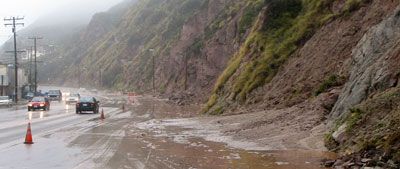 Photo courtesy Greg Carlson
Local residents may be reminded of the recent rain long after the puddles are dry and the roads are clear. Besides immediate flooding, delayed mudslides and sizeable plant growth, which will later act as fire fuel during the dry season, could be the long-term effects of the four-day storm, Pepperdine physics professor Gerard Fasel said.
“The thing to remember about heavy rain and mudslides is that not everything is over,” said Brad Davis, the emergency preparedness coordinator for the city of Malibu. “You’ll notice water is still pouring out of the mountains.”
Fasel said that mudslides can occur even a month after a big rain.
“It’s the drying out period that can cause the landslides,” he said. “You can see the slumping of the land.”
Fasel said the cause of such activity, called the pineapple connection, is a mass of subtropical air that streams from the Hawaiian Islands to the West Coast. This air mass brought the moisture necessary for the amount of rain received in Southern California.
When this air hits the Santa Monica Mountains, rain occurs. As the heavy air crosses over the mountains, it must lose some of its moisture in the form of precipation, Fasel said.
In January 1997, the pineapple connection was also deemed the culprit of the heavy rain in California that caused more than $1.5 billion in damages, according to the textbook “Meteorology Today.” While the pineapple connection plays a heavy part in the recent weather, Fasel said warmer waters aided in the rain by creating an El Niño effect.
One weather phenomenon that did not contribute to the rain is the tsunami waves, Fasel said. The two weather occurrences are only coincidental.
“It could not have shifted the weather patterns or the jet stream,” he said.
Davis said regardless of how a disaster takes place, it’s important to follow directions from authorities.
“It’s important that the citizens need to take certain actions to take care of themselves,” he said. “That’s why we have info on our Web site and offer classes.”
While Malibu offers services to prepare for emergencies as well as during and after a disaster, the Department of Emergency Preparedness has other duties such as inspecting property and roads with the help of sub-contracted companies.
“Our priority in a disaster is always to protect lives, and then after that the protection of property, and then to get life back to normal as soon as possible,” Davis said.
01-13-2005