
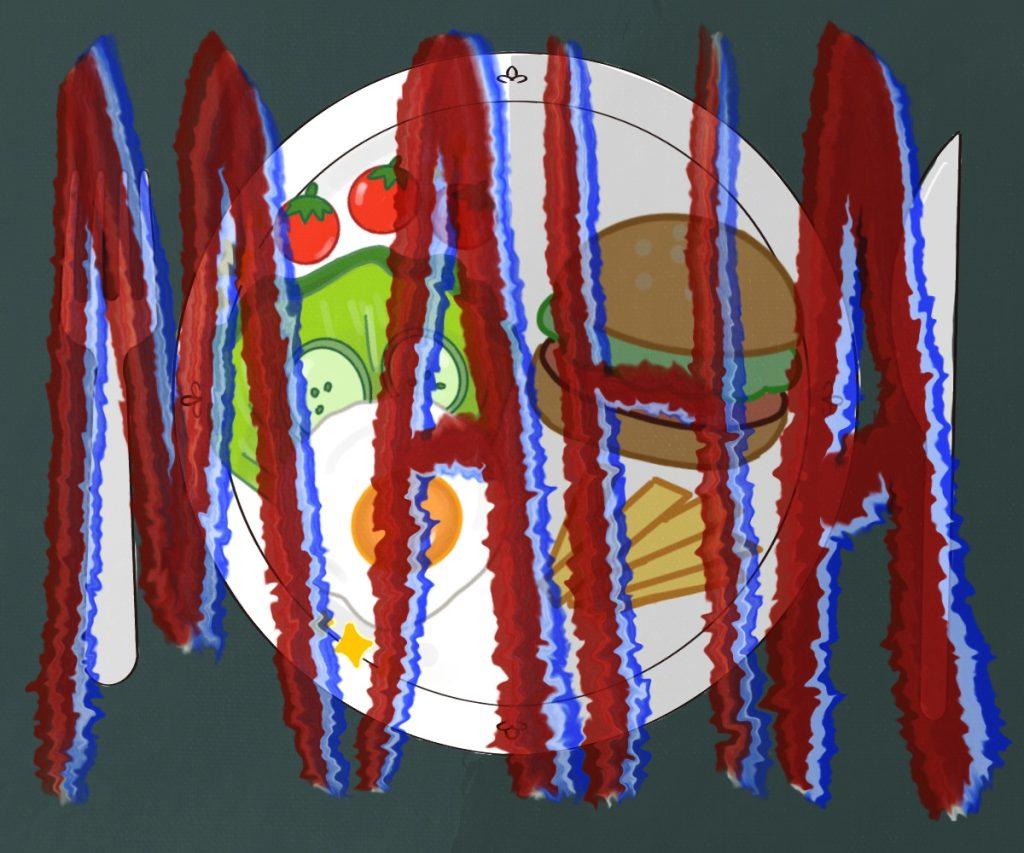
Art by Cara Tang
Transparency Item: The Perspectives section of the Graphic is comprised of articles based on opinion. This is the opinion and perspective of the writer.
A “Make America Healthy Again” (MAHA) event in Tampa on Aug. 26 met an abrupt end after Robert F. Kennedy Jr. faced a question on a $1 million donation from plant-based tonic company Botanic Tonics, according to CRBC News.
At the event, Sky News correspondent Martha Kelner queried RFK, asking, “The Justice Department dropped its case against Feel Free, a MAHA PAC received a $1 million donation. Does that have anything to do with the DOJ?”
Kennedy insisted he knew nothing about the donation before Florida Republican Sen. Ashley Moody promptly thanked the room, ending the meeting.
Make America Healthy Again (MAHA) is a political movement created in 2024 as a branch of President Donald Trump’s Make America Great Again (MAGA) agenda. MAHA centers itself around health reform but also has a history of controversial beliefs such as vaccine skepticism, according to POLITICO.
Kennedy’s strong advocacy for extensive health reform makes this recent development that much more shocking. RFK has soared to new political heights due to the espousing of general health and wellness, according to PolitiFact.
Connection to Botanic Tonics signals a troublesome contradiction in RFK’s pro-health posturing. Feel Free is a recreational beverage product by Botanic Tonics that has garnered much controversy due to kratom, the primary ingredient.
Kratom is an herbal product from Southeast Asia that causes dose-dependent sedative and stimulative effects, as well as has an adverse effect profile similar to opioids, according to the National Library of Medicine.
The proliferation of Feel Free has resulted in the product being available in approximately 24,000 retail locations nationwide, according to The Kansas City Star. A wave of rampant addiction has come along with this surge of popularity.
Subreddit r/Quittingfeelfree, created in January of 2023, has 14,000 weekly visitors along with nearly 1,000 weekly contributions. Users, many former opiate addicts, share their tragic stories of addiction to Feel Free.
Described by critics as “gas station heroin,” Botanic Tonics fell under governmental scrutiny when hundreds of thousands of bottles of Feel Free were federally seized from their manufacturing facilities in Broken Arrow, Okla., in April 2023. The case remained inactive for over two years, with a Botanic Tonics spokesperson citing federal court backlog, according to The Kansas City Star.
By the time the case picked back up in December 2025, the U.S. Department of Justice (DOJ) was under Trump’s control. The DOJ eventually dismissed its own case, claiming the now-expired Feel Free products were no longer a fitting use of resources, according to The New York Times.
The Kennedy-associated MAHA political action committee (PAC) has received donations totaling $1 million from Botanic Tonics, according to The New York Times. Though this may not serve as an outright condemnation, the optics of collusion don’t bode well for Kennedy.
Moreover, the war against ultra-processed foods (UPFs), a cause RFK championed, recently suffered a dispiriting setback. On Aug. 10, the U.S. Food and Drug Administration (FDA) and U.S. Department of Agriculture (USDA) submitted their definition of ultra-processed foods to the Office of Management and Budget rather than releasing it publicly.
A federal-level definition for ultra-processed foods could result in heightened transparency for consumers, including clearer labeling and lowered costs. It could also mean blowback for the food industry, inducing compliance costs and market shifts, according to Ultra Processed Food List.
Unfortunately, the Office of Management and Budget could be where the definition goes to die. Even if the definition is formally considered, which is no guarantee, the rulemaking process could take up to several years, according to the USDA.
The promise of combating UPF risk was one of the main factors that garnered support for RFK. Even beyond MAHA loyalists, there exists a “robust and bipartisan support for addressing UPF harms through many specific legal and policy interventions,” according to The American Public Health Association.
The potential for a federal definition of UPFs to remain unrealized would not only be a betrayal to MAHA sympathizers, but a failure to the entire American population.
In conjunction with the curious circumstances around the case against Botanic Tonics being dismissed, one would be hard-pressed not to look at Kennedy’s MAHA agenda and label it as a failure.
While RFK has made progress on the removal of harmful synthetic food dyes, it is simply not enough to push the needle. If ultra-processed foods are no closer to regulation and opiate adjacent compounds still populate stores nationwide, can we really say we are getting any healthier?
This story was copy edited by Caitlin Murray.
___________________
Follow the Graphic on X: @PeppGraphic
Contact Riley McGeehon via email: riley.mcgeehon@pepperdine.edu