
From the spires covered in exotic carvings to the distinctly non-
Western architecture, the Hindu Temple in Malibu Canyon stands out.
By Rebecca Lawson
Staff Writer
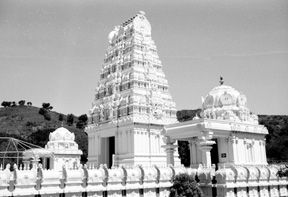 What can students from a Christian university learn from visiting a Hindu temple?
Plenty, according to Dr. Glenn Webb, professor of Asian Studies at Pepperdine University.
“It is helpful in learning that Hindus take their faith as seriously as we take ours,” he said. “That people truly believe these things.”
Hinduism has about 900 million adherents worldwide and is considered the world’s oldest religion. Its important scriptural writings are known as the Vedas. It is a polytheistic religion, with many gods and goddesses that are viewed as divine.
“Hinduism is not a single religion. It is not a monolithic religion, but a collaboration of established practices,” said Varadarajan Ravindran, the vice president and assistant secretary of the temple. Ravindran is quick to point out that those titles are honorary. “I’m a volunteer here,” he said, adding that he is also a teacher at USC and has been with the temple since December 2001.
|
Where to go |
|
What: The Hindu Temple Society of Southern California Where: 1600 Las Virgines Canyon Road (Near Waycross Drive, south of Mulholland Highway.) (818) 880-5552 When: The temple is open every day. Winter hours: 9 a.m. to noon, 5 p.m. to 8 p.m. weekdays, 8 a.m. to 7 p.m. weekends and holidays; Summer hours: 9 a.m. to noon, 5 p.m. to 8 p.m. weekdays, 8 a.m. to 8 p.m. weekends and holidays. |
Virander Surbly, another Temple adherent, adds to Ravindran’s words.
“There is nothing called ‘Hindu religion.’ It comes from the people on the Hindus River and their culture.”
Hinduism is seen by many as less of a religion and more as a philosophy of life. A brochure at the temple describes it as “religious philosophy rather than a abstract religion.” The Vedas scriptures are believed to be the truths and varied experiences realized by “thousands of sages from days immemorial.” Unlike most other religions, Hinduism does not have a discernable founder or even a “starting point.”
Varadarajan Ravindran said visits from Pepperdine students are not uncommon.
“Quite a few (visit),” he said. “About 100 to 150 students a year.”
He also said they are very respectful.
“Otherwise they wouldn’t come,” he continued. “They are usually more respectful than Ivy league students.”
While most Pepperdine students who visit the temple do so out of curiosity, a few have different reasons. Senior Emily Spittler went her junior year for a non-Western art class. The similarities to Western religion struck her the most.
“I had just been in London, (with International Programs) and visited a lot of Roman Catholic cathedrals. In those cathedrals, there were a lot of shrines to different saints, and the courtyard shrines at the Hindu temple reminded me of those cathedral shrines,” she said. “It was an interesting comparison, because they aren’t two religions I normally think of as being similar.”
Partha Bhattacharya, a Hindu student attending Pepperdine, said he does not feel it is difficult to be a Hindu at Pepperdine.
“As long as you are comfortable with what you believe in, and you don’t try to force it on others, it all works,” he said.
 Bhattacharya believes that many Christian students would agree with him, although he acknowledges some would strongly disagree.
“Some people are very passionate about religion,” he said. “I have some friends who are Christian who often don’t want to hear it when other (Christians) try to force religion.”
Regardless of how strongly a student feels about his or her own religion, Webb said it is essential in our multicultural society to be informed about other faiths. The professor notes it is important for Pepperdine students to be exposed to variety of religions.
“It can only do two things,” he said. “It can strengthen your own faith, because you will have a better grasp of where your faith stands in relation to others. On the other hand, it can pull you away from your faith. But I think it’s worth taking that chance. The unknown is always scary, but if you do not challenge yourself, your faith becomes empty.”
Webb recommends that students not be afraid to visit the temple.
“I think they will find the priests to be very friendly and open. The first time I visited the temple was with Pepperdine faculty,” he said. “We had a grant from the Sears foundation for multicultural studies, and it was partly used to arrange for seminars and field trips for faculty.”
Dr. V. Seshan of Pepperdine’s Business Administration Division arranged the visit.
“His family has traditionally worshiped the elephant form of the god Vishnu for 50 generations,” Webb said.
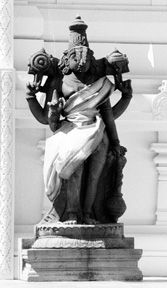
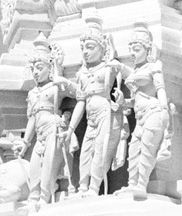
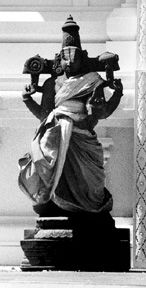
The temple, which was founded in 1981, is dedicated to that deity. Vishnu is one of a trinity of principal Hindu deities, also including the gods Brahma and Shiva.
 “Some of the priests will try to make a connection (to Christianity) by pointing out they also have a Trinity,” Webb said. “I don’t believe this is helpful because those gods fulfill very different roles within Hinduism than the Father, Son and Holy Ghost do in Christianity.”
Webb agreed, however, that there are things a Christian can learn from Hinduism.
“For me, it was the devotional aspect,” he said. “I had never seen that level of devotional expression. In the Christian church, we share prayers and hopes, but this is the kind of devotion that says you wake up every morning, prepare food and incense and pray to a deity. At first it seemed a little creepy, but then I saw how heartfelt it was. It seems to me that our devotion to our God could be a little more ritualized in the sense that we could have stronger devotional worship practices.”
Webb has a few pieces of advice for students interested in visiting the temple.
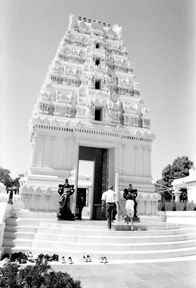
“Remember that you must take off your shoes,” he advised. “They do not take off their shoes simply for cleanliness, like the Japanese tradition. For a Hindu, the temple symbolizes the realm of the gods. You do not want to bring anything that would pollute the ground. Especially if you are wearing leather shoes, you would be bringing in the death of an animal. This is considered defilement.”
To the Hindu, all life is sacred. Although some sects observe animal sacrifice, most Hindus are against killing in any and all forms.
Some students worry about what is expected of them when they visit the temple.
 “At first, I was kind of intimidated because I was unsure about what I was allowed to see and who I was allowed to talk to,” said freshman Megan Willis. “But there wasn’t any need to feel intimidated. Everyone was very kind.”
The priests do not expect conformity.
“You will see people praying and prostrating themselves. But you are not compelled to do the same,” Webb said. “If you feel as though you must greet someone, an appropriate greeting is the Hindi word ‘Namaste,’ said with palms together. This means ‘I greet the sacred in you.’ ”
Intrinsic in this greeting is an essential Hindu belief. The Hindu believes that individuals carry a piece of the perfection that was there in the beginning. No matter what form you take, (or what faith you belong to) Hindus believe we all carry a piece of the divine inside us.
Fast Facts
 • Hinduism is considered the world’s oldest religion.
• It is a polytheistic religion with many gods and goddesses that are viewed as divine.
• It has about 900 million adherents worldwide.
• Hinduism’s important scriptural writings are known as the Vedas.
• Hinduism is a collaboration of established practices, a religious philosophy coming from the people on the Hindus River.
• Most Hindus are against killing in any and all forms.
• Hindus believe all people carry a piece of the divine inside. According to Vedic philosophy, every individual is potentially divine.
• The supreme power is conceptualized through the principal trinity of Brahma, Vishnu and Shiva.
• The Hindu temple is built for the main deity of Lord Venkatweswara (form of Vishnu) and has several shrines for different deities.
April 03, 2003