
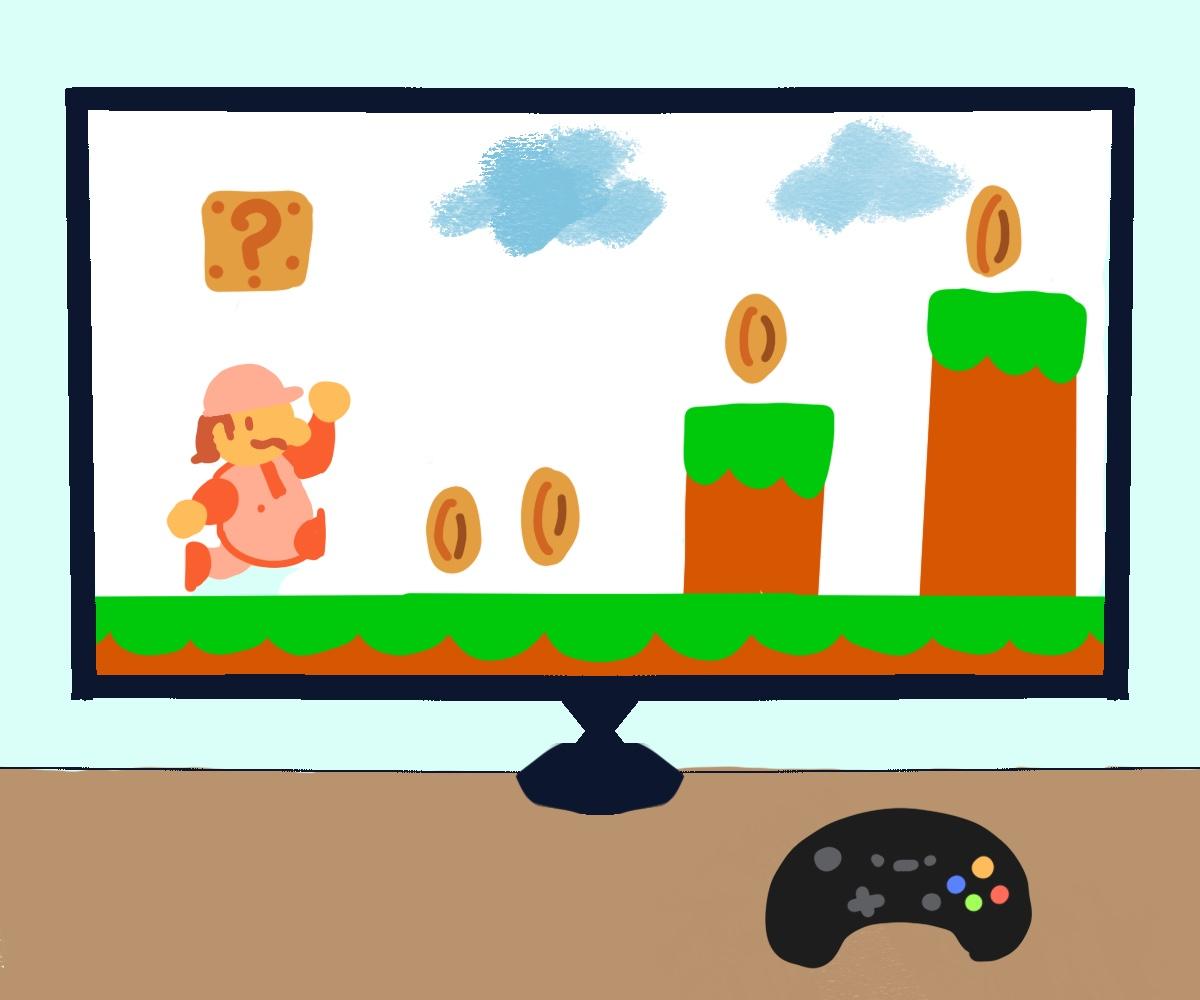
Art by Cara Tang
Transparency Item: The Perspectives section of the Graphic is comprised of articles based on opinion. This is the opinion and perspective of the writer.
Video games have become embedded in culture and equally scorned by parents of prior generations.
Since the 1940s, parents have bemoaned youth’s use of arcade games, with a humorous story of a New York City mayor rounding up pinball machines and smashing them with a sledgehammer in front of the press — winning the hearts of many, according to The Atlantic.
Later on, in 2014, the Kmart and Target retail chains in Australia were forced to ban Grand Theft Auto due to a petition endorsed by many concerned parents, claiming that the video game was far too violent against women, according to The Guardian.
Over the years, a variety of claims have been made about the effects of video games. Some accuse them of draining time; others claim video games are overly addictive, violent and lead to neurocognitive decline, according to Medical News Today.
Interestingly enough, new studies prove otherwise. Studies have shown that video games are beneficial to memory and potentially useful therapeutically for people experiencing early signs of memory loss, according to Science Insights and PubMed. Some have proven to even counteract aging effects in older adults, according to Science Insights and PubMed.
A 2024 study conducted with 471,346 participants showed that those who played video games more often had better performance in cognitive assessments, according to Springer Nature.
Furthermore, frequent computer-game use was associated with a 19% lower hazard of incident dementia compared with never playing computer games, according to Springer Nature.
Another study conducted with 12 trials discovered that “serious” 3D platform games, like Super Mario 64, have been found to increase gray matter in the hippocampus and entorhinal cortex, which is important because the hippocampus is the first area to sustain damage when someone has Alzheimer’s disease, according to Science Insights.
Older adults who frequently play video games also show increased executive function, increased attentiveness and less brain fog, illustrating how important video games may be in reversing mental aging in older adults aged 60-80, according to PubMed. These games present environments of constant new stimuli, enriching the minds of players of all ages.
MRI evidence indicates that people who engage with exergames show a clear improvement in cognitive performance. The study, performed over the span of 12 weeks with a sample of 30 students, found that the participants performed better in both immediate and delayed verbal recall tests than the control group. MRI scans indicate exergaming had a beneficial effect on the volume of gray and white brain matter.
While some may argue that exergaming’s benefits to the brain may be attributed to its active aspect, there is still evidence arguing otherwise. Exergaming has been found to increase BDNF levels and decrease theta activity, allowing for more growth in the brain long term — even more than conventional aerobic and resistance training, according to the Journal of Clinical Medicine.
The fact that exergaming offers greater neurological benefits than traditional exercise suggests that physical activity alone cannot fully explain these effects. Thus, exergaming points toward potential cognitive benefits of video gaming itself.
It is important to note that while video games may be addictive and have the potential to cause Internet Gaming Disorder (IGD), this can be counteracted with structured frequency and strict regulations, according to Archive ouverate UNIGE. Many of the benefits that come from playing video games may only be repeated when played in moderation, for 20 to 40 minutes, three to five times a week, according to PubMed.
Video games have been blamed for causing neurocognitive decline in people for decades now. It’s time we acknowledge the fact that holding a controller could actually be doing something else entirely to us. Gaming sharpens the brain, strengthens its defenses and pushes cognitive decline back, one level at a time.
This story was copy edited by Caitlin Murray.
__________________
Follow the Graphic on X: @PeppGraphic
Contact Abby Samuel via email: abby.samuel@pepperdine.edu or via Instagram: @abbyishereee