
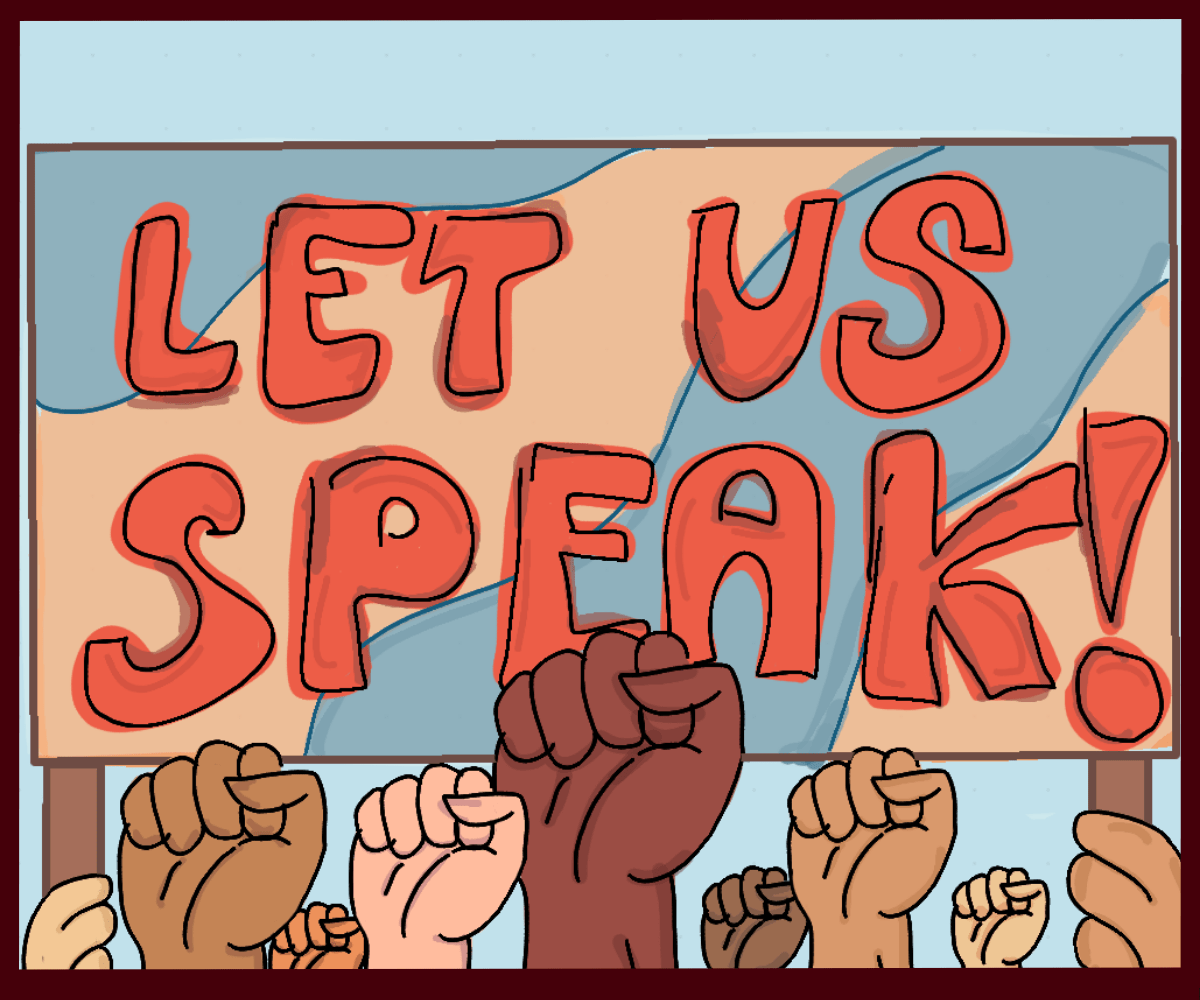
Art By Sofia Cifuentes
Transparency Item: The Perspectives section of the Graphic is comprised of articles based on opinion. This is the opinion and perspective of the writer.
Editor’s Note: The author Anniah Smith is the current president of Pepperdine College Democrats.
From Immigration and Customs Enforcement (ICE) concerns to abortion issues and the Weisman censorship scandal, the policies surrounding protests at Pepperdine University restrict students’ ability to practice their First Amendment right — the right to protest.
Like other major universities, Pepperdine follows “Time, Place, and Manner” policies. Their policy reads:
“The University established these parameters to protect the exercise of free speech and assembly while also ensuring that any displays or demonstrations do not infringe upon the rights of others, threaten the safety of persons or property, or disrupt the regular or essential operations and activities of the University.”
Some of the measures Pepperdine outlined in their statement limit the freedom of expression outlined in the United States Constitution and reinforced by the Department of Education.
Picketing, event disruption, sit–ins and encampments are some viable protest forms, according to American Civil Liberties Union (ACLU).
Pepperdine’s strict protest policies impede those vital forms of expression. Pepperdine students cannot camp, lodge, create loud noises, use University spaces or remain on any portion of University property while protesting, according to Pepperdine’s Time, Place, and Manner restrictions.
“Protesting on campus was near impossible,” said Olivia Berryman, former President of Pepperdine College Democrats.
While organizing a protest April 17, 2025, as President Jim Gash welcomed Dr. Jordan B. Peterson onto Pepperdine’s campus for a discussion surrounding “Biblical Narratives and the Power of Personal Sacrifice,” Berryman was met with significant resistance. The Graphic covered this speaker event.
“We were told by Student Affairs that we could not have political signs propped up on campus in a way that could be interpreted as spreading political messaging,” Berryman said. “As such, at our sign-making event we had to remind people to keep their signs laying flat on the table or the ground.”
Berryman went on to express her concern students may face potential repercussions if they did not comply with the University’s guidance.
Peterson, a political commentator and author, is known for promoting hateful, inflammatory rhetoric surrounding climate change, hatred against non-binary and transgender individuals and an onslaught of sexism levied against women, according to The Guardian, The New York Times and the British Broadcasting Channel (BBC). X even suspended Peterson’s account after he posted multiple anti-transgender comments on his page.
Pepperdine protected Peterson’s right to free speech when speaking with President Jim Gash. Ironically, during the same event, Pepperdine students were told to gather at the baseball field across campus if they wanted to respond, Berryman said.
“As soon as they gave that [spot] to us, I was in shock because it felt like an attack on free speech,” Berryman said. “It was so far out of the way that there was no use. Additionally, we were told we could not walk out of the event because that is not allowed.”
Students at Pepperdine are not allowed to “disrupt or obstruct teaching, research, administration, disciplinary proceedings, or other University activities, including its public service functions on- or off-campus, or other authorized non-University activities when the activity occurs on University premises,” according to the University’s Code of Conduct.
“I am aware that Pepperdine has policies in place; it was just so difficult because there were so many different rules that we were required to follow,” Berryman said.
While these measures seem to protect the University’s functioning on the surface, the tangible effects are an inability for students to freely speak out about issues that have great personal impact. Protesting causes people to pause and actually pay attention to the issues at hand — Pepperdine University’s policies impede this process.
In light of many recent events plaguing the nation and directly impacting Pepperdine’s student body, including but not limited to: ICE abuses of power, abortion bans sweeping across the nation, restriction of Diversity, Equity and Inclusion initiatives and various foreign affairs such as the extradition of Venezuelan President Nicolás Maduro, the Russian-Ukraine war and the ongoing War in Iran, Pepperdine must reform its protest regulations so students can practice their First Amendment rights.
The backbone of the First Amendment’s right to speech and expression is solidified by students’ ability to protest on their university campus, regardless of the university’s political or social views. The result of Pepperdine’s restrictive protest policies is widespread censorship against the student body.
The importance of protests on university campuses cannot be overstated.
Protests on university campuses have led to climate change reforms, efforts to end the Vietnam War, resistance efforts against Nazi Germany, Civil Rights efforts, pro-Palestinian efforts and even freedom of speech advocacy, according to Human Rights Careers and USA Today.
Pepperdine students should be able to engage in large-scale reform through campus protests. Additionally, students should feel free to engage in political efforts on campus without fear of expulsion or academic retaliation.
Advocacy without a voice is dead, and Pepperdine is standing in the way of revival.
___________________
Follow the Graphic on X: @PeppGraphic
Contact Anniah Smith via email: anniah.smith@pepperdine.edu