By Joann Groff
Assistant News Editor
About $10 million. That’s how much Los Angeles Mayor James K. Hahn said the MTA walkout and grocery strikes are costing the local economy — every day.
It’s day 10 of the Metropolitan Transit Authority’s mechanics strike, and little progress has been made since the decision to resume talks Tuesday. Union and MTA officials were in negotiations all day Tuesday and Wednesday, leaving their separate, mediated rooms at the county Hall of Administration with no resolutions.
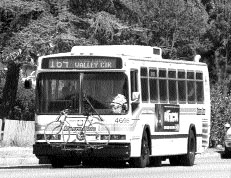 This newest set of talks follow a weekend of negotiations at a Pomona hotel, which produced relatively no movement.
More than 2,000 MTA mechanics walked off the job Oct. 14, after disagreements heightened over the union’s health care fund. The strike affects almost 500,000 L.A. residents who use the transportation system daily, PHOTO COURTESY OFFICIAL MTA WEB SITE
especially because other unionized employees are honoring the picket lines.
Mayor Hahn and City Councilman Antonio Villaraigosa complained to reporters at a press conference Tuesday that they believed there was a lack of urgency to come to the conclusions needed to resolve the issue. Both are members of the MTA board but cannot participate in negotiations because of ethics laws. They urged the negotiators to work nonstop until the strike was resolved.
“The public is fed up with this MTA strike, the fact that buses aren’t moving, the trains aren’t moving and traffic in L.A. is not moving,” Hahn told the Los Angeles Times yesterday. “We want the parties to have a sense of urgency that the public demands, that they get back to the table and try to get this thing resolved today or tomorrow.”
Senior Adam Holdridge is one student at Pepperdine who agrees that the issues need to be resolved — and fast.
“It’s just that you feel so stranded,” Holdridge said. “You can’t get to Santa Monica, you can’t get to Malibu. I’ve had to cancel appointments I’ve made because I couldn’t get to them.”
MTA heads blame the slow movement on a lack of compromise, and said the union has simply not handled their health-care fund properly.
“They have mismanaged that fund,” county Supervisor and MTA board chair Zev Yaroslavsky told ABC 7 News. “They have overspent, they have run it into the ground.”
In a proposal received Monday, the agency stated it would deposit $4.7 million into the fund and up their monthly payments from $1.4 million to $1.9 million.
Union negotiators denied the offer, telling the Los Angeles Times it was “an insult” and “an attempt to limit the amount that the MTA pays for health care.”
There was a glimmer of hope for strikers that MTA negotiators may be backing down within the pages of the proposal. It did include an offer by the MTA to rescind an earlier demand to take complete control over the health care fund — they’ve agreed to a health care board with equal representation.
“The public ought to be sick of this,” Yaroslavsky said. “We’re sick of it. The public ought to be sick of people taking off on strike when they’re paid this kind of money, $50,000 or more a year, some of them making over $100,000 a year.”
Student Holdridge does not support the strike for those exact reasons.
“If they were flying airplanes, sure, but a bus driver will make more than the average student graduating from Pepperdine this year. Everyone’s on the gravy train here, and they need to get off it.”
MTA officials told reporters they were working hard to deliver residents with substitute services, and today opened a “life line” shuttle, running during rush hours between the Pico Transit Center and Union Station.
More information can be found at www.mta.net.
October 23, 2003