

Rylan Dettling (second from the left) visits Greece with her friends. Photo courtesy of Rylan Dettling.
With the road as her classroom and a driver as her tutor, sophomore Rylan Dettling turned a taxi ride into an unexpected learning opportunity.
After graduating high school and moving to Madrid, Spain, Dettling said she found herself outside the Spanish Notary, defeated after struggling to communicate with locals. She felt her effort to learn and speak Spanish correctly had been in vain. As she was getting into a taxi, she immediately made her level of Spanish proficiency clear to the driver.
“I tell him, ‘Entiendo español mejor que lo hablo’ — I understand better than I speak,” Dettling said. “He happily proceeded to encourage me to practice Spanish with him from the back seat.”
After years of hearing the language, Dettling said she had a hard time speaking Spanish but could understand it perfectly. She attended boarding school for most of high school in the district of Canton of Vaud, Switzerland, where she met her best friends — originally from Mexico. Their friendship sparked a determination to be able to speak in their native tongue.
“I never lived in Mexico, but I identified with the Mexican culture through my friends,” Dettling said. “I wanted to know them in their language because they knew me in mine.”
Three Pepperdine students shared how living in different countries opened their eyes to new cultures — ones that gradually became part of who they are today. For some, the need to adapt made it difficult at times to fully open themselves to belonging.
Acclimating to the Unfamiliar
Starting fresh in a new country — regardless of age — forces a person to adapt to a new environment. It brings obstacles that are initially hard to overcome.
Sophomore Ayla Olsen left her native country, Guatemala, when she was 12 to live in Norway. The differences between the countries made adapting take more than a year.
“It started feeling like home,” Olsen said. “It wasn’t easy.”
Senior Peter Runey followed a nomadic lifestyle, living in 18 places throughout his life due to his dad’s corporate job.
Runey was born in State College, Pennsylvania; he then moved to New York state, where he had his first memories. He and his family lived for four years in central Texas, a few months in Kansas and then back to Pennsylvania. His first out-of-continent move was to South Central Bavaria, Germany, and after two years, he moved to Pennsylvania, then Kentucky, and back to Pennsylvania. After that, he moved to Virginia, New Hampshire, Massachusetts, Missouri and Arizona. He later traveled on his own to South Korea, back to the States where he traveled in a van for four months, then to Sicily before college in Malibu.
When he moved to Kentucky from Germany at age 15, he joined a baseball team. He said he struggled to connect with his teammates due to a lack of memories shared together. Runey felt the only way he could relate to his teammates was through his baseball skills.
“I was the new kid on the block and I was stepping into just a mountain of relational equity between each other that I just had never had time to build with them,” Runey said.
Before moving to Spain, Dettling moved from Las Vegas — where she had lived her whole life — to Switzerland for boarding school as a high school junior. At first, Dettling said she felt out of place.
“I went to boarding school for two years in Switzerland, where it was very culturally grouped and there weren’t a lot of Americans,” Dettling said.
Dettling and her family had agreed that it was time for her to be introduced to the world’s cultures and to experience life outside the United States. The biggest challenge for her was being able to communicate.
When Dettling lived in Switzerland, all her classes were in English, due to students being from all parts of the globe.
Outside of school, she was never able to become fluent in French. While she was able to express herself, she was unable to hold a detailed conversation with locals.
Even in the classroom, Dettling found herself struggling in a room crowded with different languages. Speaking made her anxious.
“I was sitting in silence my first year,” Dettling said. “I didn’t understand anyone. When people would finish their conversation, they would give me a 10-minute summary in English of their conversation so I could still be included.”
Similar to Dettling, Olsen said at first she struggled to connect with Norwegians due to the way they express themselves.
“I think one of the differences from Guatemala was how straightforward people were,” Olsen said. “Back in Guate, a lot of people would sugarcoat things for you to not feel bad, but in Norway, they were really direct and straight to your face.”
Something that caught Olsen’s eye immediately was how free Norwegians were compared to Guatemalans. She had never felt safe enough to have the level of independence that people had in Norway. When she first moved, Olsen believed children being able to walk alone and take public transportation was “crazy,” something that could have never been done in Guatemala at their age.
A Moment of Connection
Dettling became close with a group of Mexican girls who gave her a chance, girls who later influenced her to move with most of them to Madrid for a year.
“There’s a lot of Latin American and Mexican people in Madrid,” Dettling said. “So I kind of feel like my circle just expanded since Switzerland and evolved.”
When Dettling was learning Spanish, she got introduced to the singer Bad Bunny through her friends. She found that learning her friends’ languages came quicker when she approached it in an engaging way.
“I remember being in boarding school and my Mexican friends trying to teach me the songs,” Dettling said. “I would literally study the songs and practice them, and I remember the first song that I could get down was ‘Titi Me Pregunto.’ When I started singing it for the first time, all of my Mexican friends were screaming, and it was the cutest thing ever.”
Every time Dettling would understand a deeper part of Mexican culture, her friends would be excited and supportive of her. Being able to slowly learn a new language meant a lot to Dettling, especially when it allowed her to understand her friends as well as they understood her.
“At the beginning, I was learning the language more for them,” Dettling said.
The first time Olsen started feeling seen and accepted in Norway was when her friends became interested in her life in Guatemala, even asking her parents about it. Her friends began learning common phrases in Spanish for her.
“The first thing they learned in Spanish was ‘Hola, yo me llamo,’” Olsen said.
Her friends’ curiosity prompted them to ask about Guatemalan customs, holidays, traditional foods and what she was used to doing on weekends. She immediately felt a barrier had broken between the two cultures.
“I think just seeing how my friends were so interested and intrigued by my culture and willing to learn made me feel welcomed,” Olsen said. “I guess I didn’t think I would ever feel that way.”
After Runey moved to the state of Bavaria in Germany, a wave of culture shock hit him when it came to the lifestyle and language. Runey found familiarity far from home.
“There was a pretty strong American presence where I was at, so that helped soften the landing,” Runey said. “Otherwise, it would have been pretty isolating and pretty shocking for an 11-year-old to just be dropped in the middle of Germany without much outside cultural context for how other people live.”
Runey has never been able to fully identify himself in one culture; instead, he said there was a regular need to adapt to find community. He always made the most of where he lived because Runey knew that time was ticking; the next move was on the horizon.
“That sadness and pain teach you pretty quickly that you have so much time with people,” Runey said.
When moving, Runey often prioritized others by meeting them where they were, allowing them to see a genuine but partial version of himself, especially when they lacked the time to understand his complexities and life experiences fully.
“When your pie of life is divided into 18 different geographical locations, then naturally, it’s kind of hard,” Runey said. “You can’t expect or ask anyone to fully see you.”
Taking It Everywhere
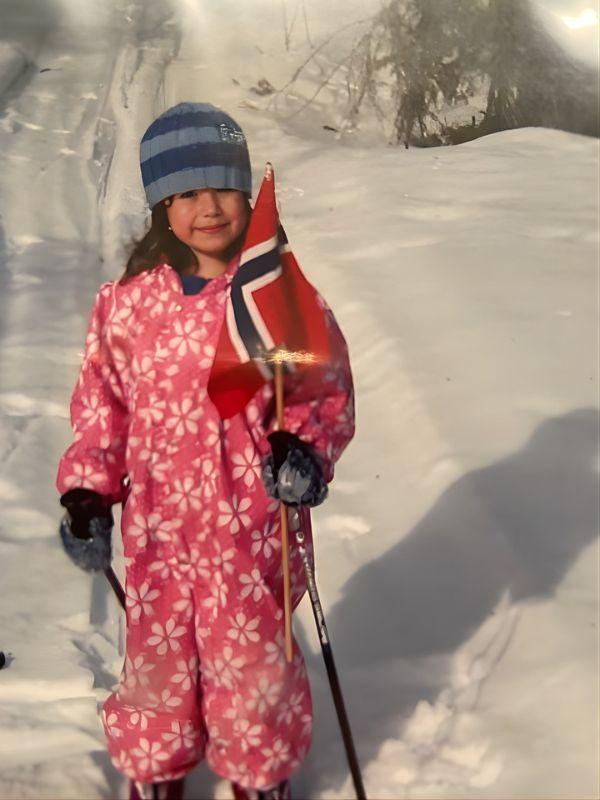
Ayla Olsen, as a young girl, holds the Norwegian flag. Photo courtesy of Ayla Olsen.
Aside from the Norwegian language that she uses to communicate with her sister all the time, Olsen said her family adopted the Norwegian tradition of “Lørdagsgodt dag,” which translates to “Saturday sweets.”
Olsen said that although most Norwegians eat healthily, children often hold off eating candy until Saturdays, which makes the tradition feel particularly special — especially when it means going to the store with loved ones to choose sweet treats.
Though he has absorbed parts of every city he has experienced, Runey said he feels closest to Boston, Massachusetts, where his family has lived for seven generations. As much as he has struggled with a sense of belonging, returning to New England — especially during the winter holidays — reminds him of the importance of ancestry and family, standing as the one place he ultimately considers home.
“Having proximity to a specific location over a long period of time can adjust how you are and how you resonate with yourself,” Runey said.
Dettling now visits her friends back in Mexico City, where they always greet her with open arms.
“Every time I visit them in Mexico City, they have waiting for me all my favorite candies that I would steal from them in boarding school,” Dettling said. “They make me shove my suitcase full of them every single time.”
Excited to root for Spain in the World Cup, Dettling said that while she doesn’t live there anymore, she carries pride for Spain — how it will always feel like home to her.
“It’s like an imposter syndrome because I’m not Spanish,” Dettling said. “I have such a love for it, I’d say I definitely carry every country I’ve lived in as home in a way — even if I’m not from there, I was a part of it, it’s a part of me.”
___________________
Follow Currents Magazine on X: @PeppCurrents and Instagram: @currentsmagazine
Contact Soliel Lara Aponte via email: soliel.lara@pepperdine.edu or via Instagram @soliellarajournalism