

Photo by Melissa Houston
Texas, Alaska, Germany, Japan.
For many military kids, these were not vacation destinations: they were temporary homes.
With each move, there was a new school to learn from, new neighbors to get to know and a new city to start all over in. Rarely did they stay long enough to feel like it was home.
Pepperdine senior Ariel Miles knows this feeling all too well. Growing up in a U.S. Army family meant moving across multiple states and even overseas.
“My dad was in the army for 21 years, and so over the course of 21 years, I lived in, gosh, one, two, maybe six duty stations,” Miles said. “And a bunch of states, like, six or seven states. And I lived in Germany too.”
For children raised in military families, home is not usually just a place on a map. More so, it is a tradition carried from place to place, whether in family, memories, routines or objects that come with them through every move.
Finding Home on Familiar Ground
Moving around so many times leaves the idea of “home” complicated.
For Miles, moving around so often made it hard for her to truly feel rooted anywhere. She said that no matter where she was, nothing felt right; she felt like she didn’t fit in anywhere. She didn’t know how to answer “Where are you from?”
“I usually just say Ohio because that’s where my family is from,” Miles said. “It’s always kind of a complicated answer, you know, because I say Ohio but I didn’t grow up there, I just grew up going there.”
However, Miles quickly learned that home was not necessarily a location; instead, it came from the small things that stayed consistent in her life with every move she made.
Whether it was the decorations or furniture, Miles said those consistencies made her feel comfortable with the constant change.
“We took the same dining room table through all of our moves,” Miles said. “Our couch came with us and just like little decorations that my mom had, things that made it really feel like home.”
For families whose neighborhoods, schools and houses are constantly changing, a sense of home can come from what remains the same.
Holding the Line at Home
Miles said that some of the only relationships that stayed consistent for her were those with her siblings.
“We were each other’s foundational friends,” Miles said.
That closeness is common among military families. When their friendships and schools are shifting every few years, siblings become one of the only relationships that stay the same.
Pepperdine senior Delaney Dickey had a similar experience growing up in an Air Force family. Her journey started in Texas, then transitioned to New York, Alaska, Germany and Arizona, all before she graduated high school.
Like Miles, she found that attaching “home” to a specific location was difficult.
Dickey said, when calling a place home, she picks Casa Grande, Arizona, as her go-to, even though the answer carries a weight of complexity. In high school, it was difficult for her to claim that small town as home, where everyone knew everyone. Instead, home became her family.
“My mom was a huge part of home,” Dickey said. “I think that’s a little bit of a cliche answer, but I would say that my nuclear family, my parents, my two sisters and I are like so close that I think even if they move to another place right now — to a place I’ve never been — that place would still be my home because that’s where they are.”
Frequent moves for military children’s lives can shape how they form friendships. There are expectations that relationships may only last a few years, causing each connection to look different.
Dickey said moving so often made it difficult for her to make long-term friendships, and besides her own family, there is nobody who has known her since she was little.
Even now, Dickey said she experiences these long-term moving effects in how she approaches her friendships.
“It’s like, you’re my ride-or-die or we barely know each other,” Dickey said.
Military life creates a strong sense of community. On base, families often know one another well — they share the same experiences of deployments, relocations and starting all over in a new place.
Miles said the community was very tight knit. To this day, her family still talks about how they miss the community and sense of connection after leaving military life. She said everyone on the base understood the struggles of being a military kid and showed support for everyone — no matter how long they’d been on base.
“Everybody was genuinely there for each other,” Miles said. “Our friend’s moms were like moms to us, and we would just hop from house to house and leave our doors unlocked.”
Dickey had a similar experience of support through her community. As a child, she said many people were willing to help or show true care to her as she processed so much change.
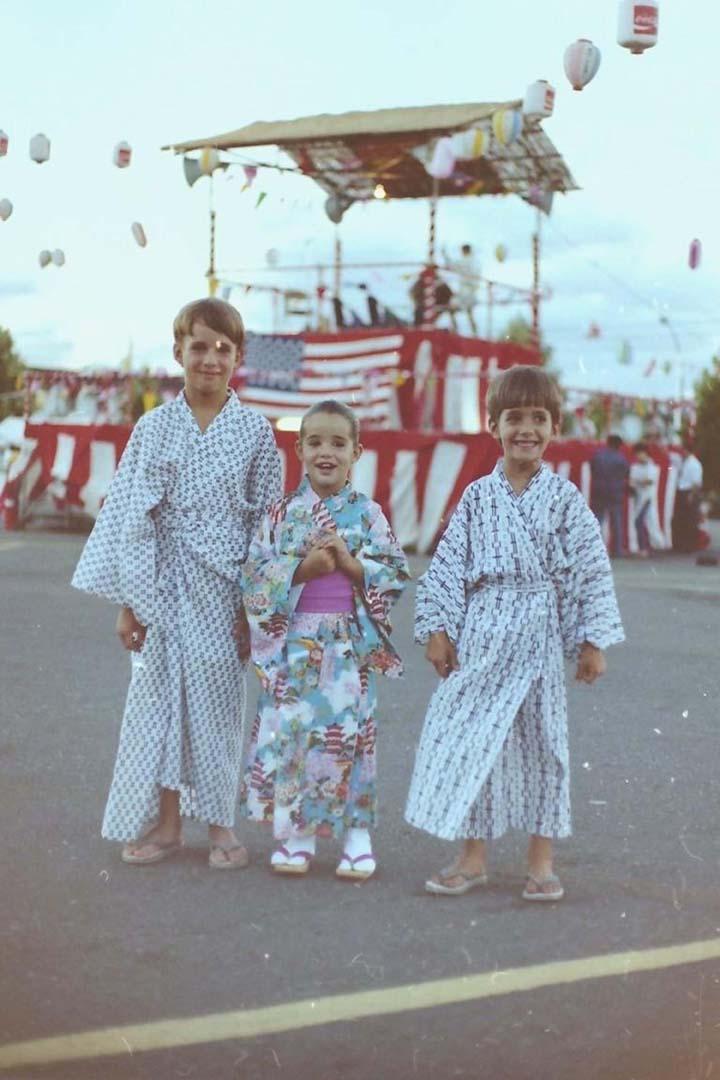
Gretchen Batcheller with her brothers. Photo courtesy of Gretchen Batcheller
Making Sense of Home
For Gretchen Batcheller, a Pepperdine Art professor who also grew up as a military dependent, those experiences stayed with her long after childhood.
Batcheller’s father was a Navy fighter pilot, and by seventh grade she had attended 11 different schools. Over the years, she lived in California, Japan, Washington and Hawaii. To this day, Batcheller doesn’t have a simple answer for where home is.
“It’s complicated right?” Batcheller said. “I don’t know if there’s such thing as military diaspora, but I don’t necessarily know where I belong and where home is.”
That sense of uncertainty about where she belongs has shaped a lot of her perspective as an adult. Today, these reflections have become a central part of her work as an artist.
For nearly a decade, Batcheller has created a body of work based on her family’s time stationed in Japan during her childhood. She said her creative work stems from her life as a military dependent.
“When I first began that body of work, it was pretty nostalgic, which — nostalgia is a one-sided story,” Batcheller said. “It didn’t encompass the entire narrative.”
In her work, she began exploring the broader historical and political context surrounding the childhood memories she has. Once she took the time to reflect on her childhood, her work shifted with it.
“My work is very much about a critique of the military complex and specifically the militarization of the Pacific,” Batcheller said.
Using her family’s photographs and cultural imagery, Batcheller blends her personal experiences with larger historical narratives in her work.
“It’s like this very complicated mixture of critique of military complex and the militarization of the Pacific and its cultural awakening for me,” Batcheller said. “But it’s also wrapped up in family honor of growing up a military dependent, being proud of my father, being grateful that my father survived the war.”
For the military’s dependents, growing up constantly moving does not erase their idea of home; it simply reshapes it.
Sometimes, home is a place. Sometimes, it is a family dinner table, a sibling or a group of friends who are scattered across the world. And sometimes, it is something harder to define.
“But home is where your heart is, you know,” Batcheller said. “Like home is with my family here on campus, and home is still my grandma’s house.”
_________________________________
Follow Currents Magazine on X: @PeppCurrents and Instagram: @currentsmagazine
Contact Melissa Houston via email: Melissa.houston@pepperdine.edu