
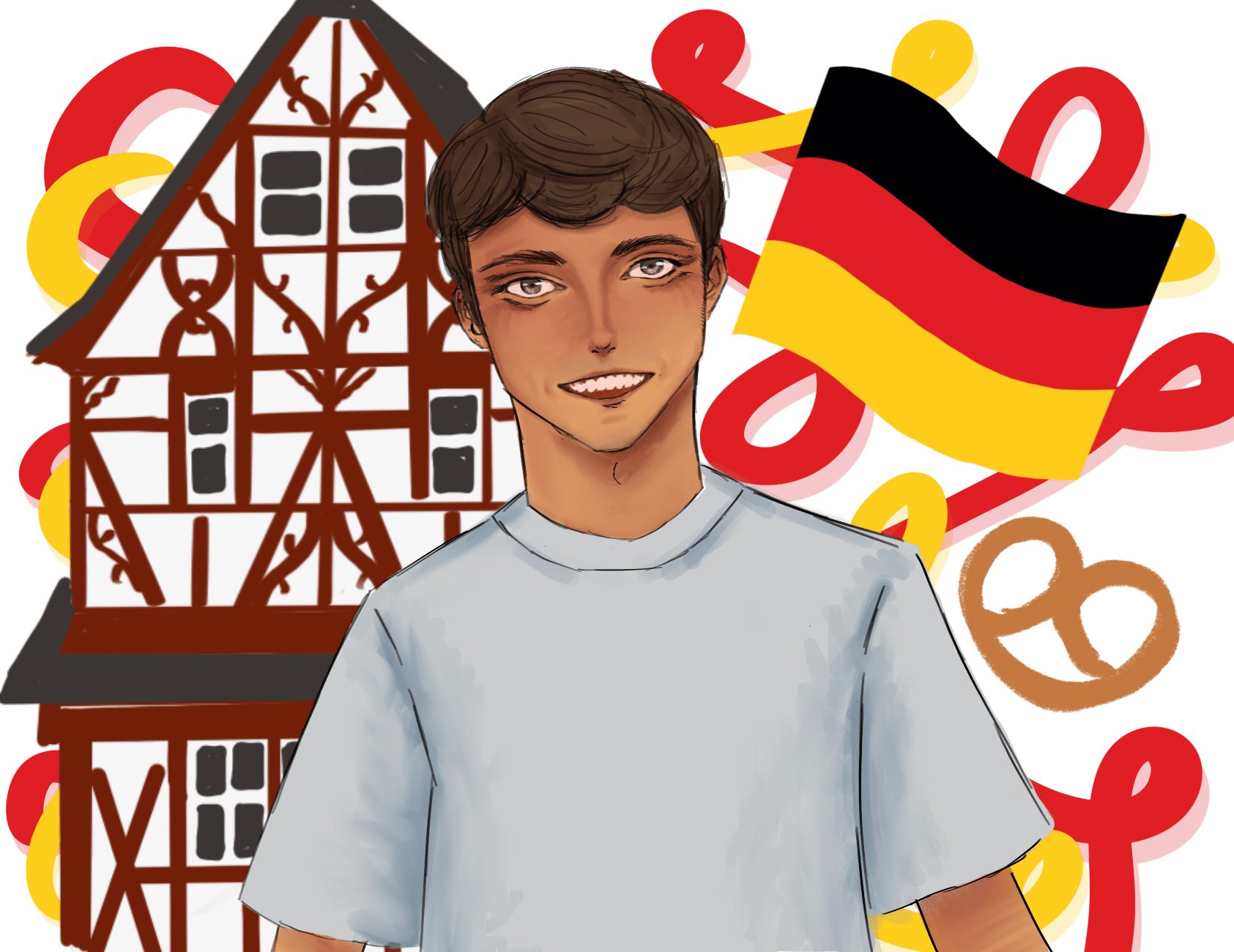
Maximiliian Homberg. Art by Cara Tang
The smooth roads outlining Germany, the vibrant avenues of Brazil and the bustling streets of South Korea all bore witness to an earlier part of life for three international members of the Pepperdine community.
All three call Pepperdine their home now, yet in their hearts, another home exists beyond Pepperdine; one that is tied with family, culture, identity, nationality and language. They recounted the long journey of embracing — and at times, challenging — the American way of life.
“I’m still trying to find out, but to me, home is wherever I have people that I love around me — my friends, my communities, wherever I find that people understand me,” said sophomore Daniel Valini Pacheco da Fonseca, who is from Brazil.
More than 600 international students currently attend Pepperdine, according to the Office of Institutional Effectiveness. As of Fall 2025, international students made up 7% of the student population at Pepperdine University, from over 80 global countries.
Across Continents and Courts
Senior Maximillian Homberg was 6 when he picked up a tennis racket for the first time in his garage in Freising, Germany. His grandpa inspired him to kickstart his lifelong career as an athlete, eventually leading to the courts of the Pepperdine Men’s Tennis team in Summer 2022.
His life in Germany was centered around discipline. He practiced, traveled and went to school online. Unexpectedly, a wrist injury diverted him from a professional career to being a Division I collegiate athlete.
His first-ever class at Pepperdine was a musical theatre dance class. Sitting down on the floor with seven classmates, he felt out of place.
This was a stark contrast to Germany, where the last time he sat in a classroom was in eighth grade.
“I was struggling my first semester a lot because it’s a new environment, new people — can be stressful sometimes,” Homberg said. “Everything is so fast-paced. I was in 17-18 units all semesters and I felt like I was running from one place to the other place.”
Another culture shock was the overall atmosphere at Pepperdine.
“I think Pepperdine in general, people are so nice, so welcoming,” Homberg said. “Whereas in Germany, you would walk by someone, not say anything.”
As an athlete, much of the food he consumes comes from the Waves Cafe, though he finds that American food contains a lot of sugar and processed fats. He misses German cuisine and his favorite dish, called “ente mit knödel und blaukraut,” German-roasted duck with bread dumplings and red cabbage.
“I always have the feeling when you’re at home, where you grew up, where you spent your childhood — that’s, I feel, home,” Homberg said. “But also home — for me, home is everywhere where my friends or my family is.”
Homberg loved Pepperdine from the beginning, even with its ups and downs. Part of his daily routine that brings him comfort is team dinners.
The last few weeks of a semester hit him the hardest, when he feels homesickness and nostalgia the most for Germany.
Reflecting back to his first couple of years at Pepperdine, Homberg said he has grown to embrace being more comfortable with feeling uncomfortable, from navigating a different American tennis culture and coaching environment to adjusting to constant indoor air conditioning and becoming more open to saying yes.
“Be very open to everything. There are going to be times when you’re not gonna be happy with the culture,” Homberg said. “I think it’s very important to stick to your teammates and the friends you have or [are] closest to.”

Daniel Pacheco da Fonseca. Art by Ava Anderson
A Brazilian Beat in Malibu
Pacheco da Fonseca’s weekends revolve around producing music and traveling around Los Angeles for any opportunity to cultivate his passion.
Pacheco da Fonseca is from a small suburban town called Alphaville in Sao Paulo. The town has a tight-knit community culture he thrived off of, building his love for music and ability to connect with diverse people.
Similar to Pepperdine, everyone in his hometown knew of each other.
“Same nationality, spoke the same language, same values, so I really loved being there, but at a certain point, I found myself in a bubble, you know?” Pacheco da Fonseca said.
He knew he wanted to move to the United States, hoping to experience different people from diverse cultures, religions and origins. To him, America allowed a space for him to evolve in life and build his music career and network.
“I found the best school to be in when I got accepted into Pepperdine,” Pacheco da Fonseca said. “I came [to] visit this campus and right when I saw the view, I said, ‘This is the university for me.’”
Despite his aspirations to become a music producer, Pacheco da Fonseca values the importance of a college education. Pacheco da Fonseca said studying economics has allowed him to understand the way money works within the government, being able to apply it more directly to what he wants to do with his life beyond just a business standpoint.
Growing up in a conservative Catholic household, attending church was the norm in a predominantly Roman Catholic country. Now, his time in the U.S. has deepened his understanding of American diversity, fostering friendships with people from different religions: Baháʼí, Hinduism, Buddhism and Christianity.
When first coming to Malibu, there were some American social norms that created a divide between him being able to fully connect with his newfound community.
“As a Brazilian, I’m a very touchy person,” Pacheco da Fonseca said. “I always hug, I always dap people up, and I find that a lot of Americans, they are not that comfortable the way I am.”
Another hurdle he had to manage was getting into disagreements, due to misunderstandings of his Brazilian way of being very open with his thoughts without hesitation. He also finds that people here who aren’t Brazilian are not used to the high energy he has.
Still, he finds community through the Brazilian community at Pepperdine. As co-founder of BRASA (Brazilian Student Association), a Brazilian club that hosts events that foster belonging, he finds comfort in the support they all have for each other.
“I love Brazil, I miss Brazil, but I’m so grateful to be here in a place where I can be safe in a place where I have friends, and they have their diverse experiences that help me shape my life,” Pacheco da Fonseca said.
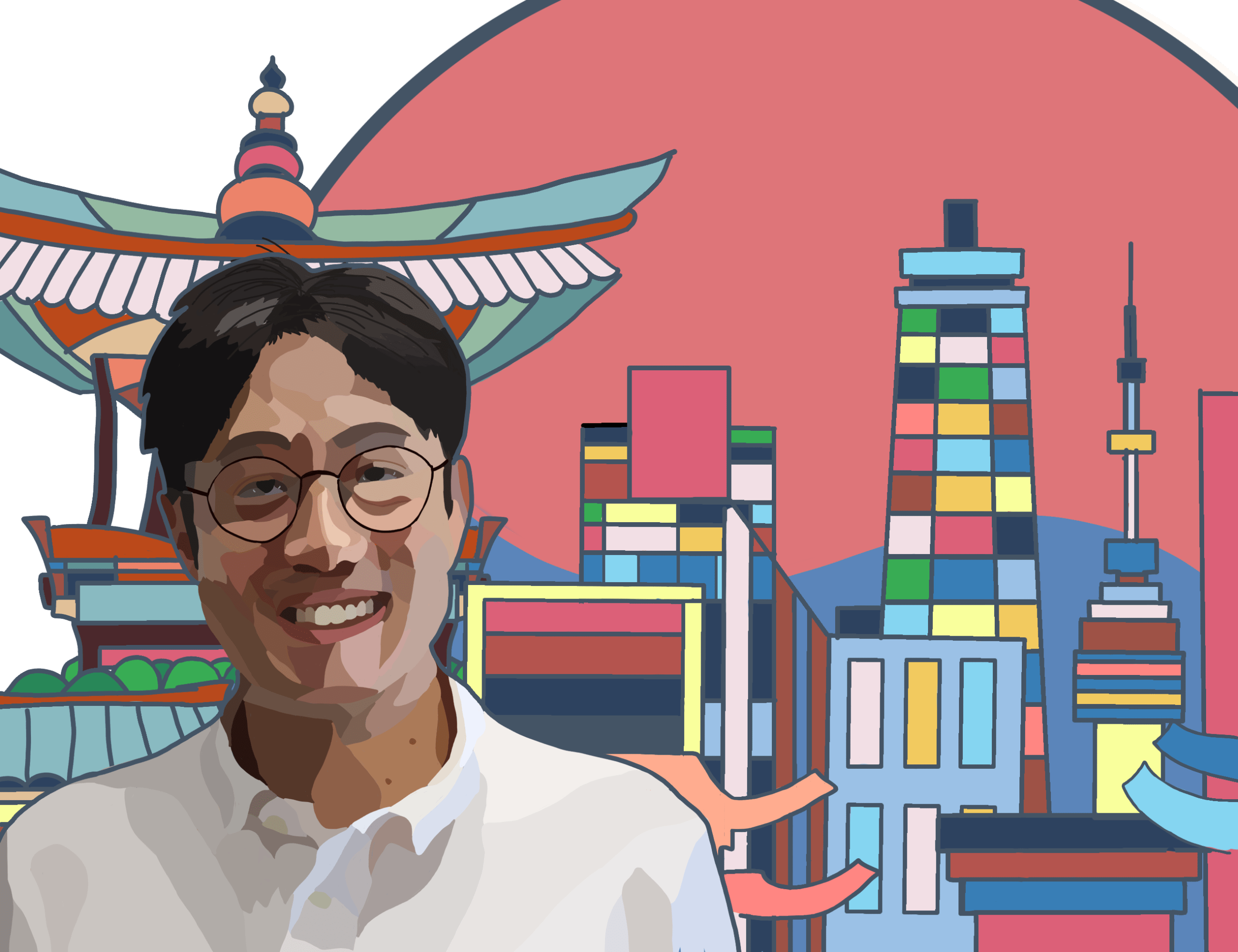
Klive Oh. Art by Sofia Cifuentes
Teaching Beyond the Textbook
Professor Klive Oh’s first time in the States was in fifth grade, down South in Richmond, Virginia, when his family moved due to his father studying for his doctorate.
Oh recalled the language barrier and the racial jokes he and his brother faced in elementary school at first as the only East Asian international students. Yet, year after year, English became more familiar as they adjusted to life in the United States and started to build friendships with their classmates.
Afterward, Oh moved back to South Korea for high school and eventually attended a Korean university, majoring in English due to his love for the language and literature. The bigger challenge Oh faced was transitioning from an American education to the Korean system.
“My friends and how freely they were expressing their views and, you know, the lifestyle whereas in Korea was very strict,” Oh said. “So, I’ve always had that longing for coming back to the United States, which I eventually did after many years.”
Additionally, Oh served in the mandatory military service and worked professionally in the public relations and marketing fields.
Eventually, he returned to receive his master’s at the Missouri School of Journalism, and then his PhD from the University of Maryland.
“That was quite difficult because I thought I was a very flexible person with the two cultures within me,” Oh said. “But having worked for several years at a Korean company, the way things work or how people behave, their attitude towards things, I guess I was a little flustered by that at first, all the same.”
Growing up, Oh said he was inspired by the uplifting community he experienced in his home, as his father — a professor, and his students would gather on holidays. Thus, he pursued teaching as a profession, following his calling to help students succeed in the field.
Oh said the lack of PR training in his undergraduate years led him to emphasize coaching students with essential skills to know in the field.
“I mean, I wouldn’t wish for anyone to have to go through some of the things that I did to learn about the field,” Oh said. “Like the sleepless nights and the overtime hours and just to kind of make myself heard.”
Ultimately, his journey led him to Pepperdine where he provided a teaching demonstration.
“It was in CCB 257, I still remember it,” Oh said. “I was doing a PR lecture, and the students were so engaged and so sweet and kind and so smart. Even after my little session, walking down the hallway, a few of them would follow me out, say hi, introduce themselves and then tell me about places I should go to in Malibu. I’d never had that at any other school.”
Having worked in PR globally, Oh wants students to understand that his ability to provide diverse perspectives comes from a combination of his life and professional experiences beyond just his cultural background.
Now, home to Oh is an intermingling of both cultures, Korean and American, as he equally loves both settings.
“It’s [Seoul is] just deeply rooted in my heart, this is my hometown, I know the ins-and-outs, like every corner, the vibe and the air, food, those things, I reminisce on quite often, right?” Oh said. “And so, I do miss it, but at the same time, here, I have my family, I have a home and a job that I love.”
Drawing from his own international experience, Oh touches on how, for international students, it can be lonesome at times — the lack of belonging due to the sheer distance and cultural barriers. Even when seeking communities, sometimes it’s not natural as international students have to force themselves to engage because they need the resources.
Malibu’s location provides a unique international experience. Even though it’s right next to LA, the isolation makes it difficult for the students to assimilate into their cultures or find churches easily, Oh said.
“I would just say in order to really experience, sometimes that means maybe get out of your comfort zone and try to engage more because everyone is willing and the culture is there and the resources are there,” Oh said.
_________________________________
Follow Currents Magazine on X: @PeppCurrents and Instagram: @currentsmagazine
Contact Christine Park via email: christine.park@pepperdine.edu